The articlegameplay, story, development, reception
Gameplay
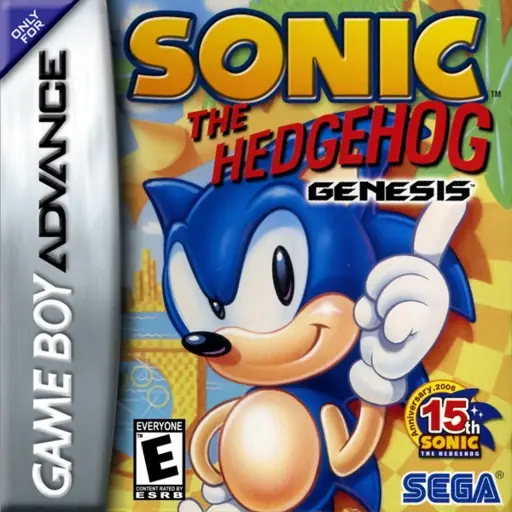
Sonic the Hedgehog is a platform game where players control the titular character Sonic, who is tasked with defeating Doctor Robotnik and obtaining the six Chaos Emeralds. The game takes place from a side-scrolling perspective. He is capable of running at high speed through levels that include springs, slopes, bottomless pits, and vertical loops. The levels are populated with robot enemies, inside which Dr.
Eggman has trapped animals; destroying a robot frees the animal, but is not necessary to complete the game. His primary form of offense is a spin attack, in which he curls into a ball and spins his body, damaging enemies and certain obstacles upon collision. This may be performed by jumping or rolling.
Scattered around each level are gold rings that can grant Sonic protection from a single enemy or hazard as well as an extra life if 100 are collected. Also scattered throughout the level are canisters containing power-ups such as additional rings and temporary invincibility. Signposts act as checkpoints where Sonic can respawn after losing a life.
The game is split into six principal zones, followed by a short Final Zone. Each main zone has its own visual style, and while some enemies appear throughout, each zone has unique enemies and obstacles. Each main zone is split into three acts, all of which must be completed. At the end of each main zone's third act, the player confronts Dr.
Eggman for a boss fight. For most of the fights, Eggman's vehicle is fitted with different weapons. After completing the sixth zone, the player continues to the single-level Final Zone for a last encounter with Eggman inside a large machine environment. A brief animation shows Sonic's return to the first zone, with animals liberated from Dr.
Eggman.
Reaching the end of any zone's Act 1 or Act 2 with 50 rings will cause a large ring to appear through which Sonic can jump to enter a bonus stage. In them, Sonic is perpetually curled up in his Spin Attack animation, and bounces off the bumpers and walls of a fully rotating maze. In these levels, the player earns a number of continues for each multiple of 50 rings collected, but the main goal is to obtain the Chaos Emerald hidden within the maze. Colliding with any of the blocks marked "GOAL" ends the level.
In his attempt to steal the six Chaos Emeralds and harness their power, the mad scientist Doctor Eggman has trapped the animal inhabitants of South Island inside aggressive robots and stationary metal capsules. The titular character, Sonic, a hedgehog named for his ability to run at supersonic speed, aims to thwart Eggman's plans by freeing his animal friends and collecting the emeralds himself. If Sonic collects all the Chaos Emeralds and completes the game, an ending sequence is shown. If all the emeralds are not collected, Eggman taunts the player while juggling any of the Chaos Emeralds not collected by the player in an alternate ending.
Development
In the 1980s, Sega had limited success with Genesis ports of its arcade games, but wanted a stronger foothold against its main competitor, Nintendo. In 1988, Sega of Japan began an in-house competition to create a rival to Nintendo's mascot Mario. For the next three years, programmers and designers at Sega worked on a brand new character to rival Mario. In 1990, Sega ordered its in-house development studios to develop a game featuring a mascot for the company. Sega's president Hayao Nakayama wanted a character as iconic as Mickey Mouse.
Conception of Sonic the Hedgehog began in November 1989, when character designer Naoto Ohshima was working on another project titled Twin Stars. The story focused on a pair of twin brothers from the Dream World defending it against the boss of the Nightmare World, "Thirteen." The game was to feature smooth terrain and loops that the characters would run through. While the gameplay concept was approved by Ohshima's superiors, the characters were not, leaving Ohshima to come up with a new protagonist.
The team developed ideas for characters, an engine, and gameplay mechanics. Development emphasized speed, so Sega considered fast creatures such as kangaroos and squirrels and eliminated designs not associated with fast animals. One idea, a rabbit able to grasp objects with prehensile ears, showed promise but was too complex for the Genesis hardware. The team narrowed its search to animals that could roll into a ball, their idea for an attacking move, and considered armadillos and hedgehogs.
The hedgehog character, proposed by employee Naoto Ohshima, prevailed. Ohshima went on vacation to New York, taking sketches with him. He went to Central Park and asked locals for their opinions on them, and Sonic was the favorite. A man with a moustache, who eventually became Dr.
Robotnik, was in second place.
Sonic was originally teal-colored, then a light shade of blue, but he was changed to dark blue so he would stand out against certain backgrounds and to match the Sega logo. According to Ohshima, Sonic's basic design was created by combining Felix the Cat's head with Mickey Mouse's body. His shoes had buckles through the inspiration of Michael Jackson's boots on the album cover for Bad and the red and white color scheme of Santa Claus, whom Ohshima saw as the most "famous character in the world". Sonic's spikes were emphasized to make him sleeker, and he was given the ability to spin while jumping (so attacking and jumping could be controlled with one button).
The new character was originally named "Mr. Hedgehog", but the eight-member team changed his name to "Sonic" and took the nickname Sonic Team. According to Yuji Naka, Sonic Team was a one-time unofficial nickname for the studio within Sega that was used during the development of the game; it was never mentioned again on the division's releases until Ohshima-directed and Naka-produced Nights into Dreams was released in 1996. , Ltd.
in 2000.
Ohshima said that "Sonic" was chosen because it represented speed. Ideas proposed to flesh out the character included placing him in a rock band, giving him vampire fangs, and giving him a human girlfriend named Madonna. Sega of America scrapped these ideas to keep his identity simple. Sega of America also expressed concerns that most Americans would not know what a hedgehog is.
According to Mark Cerny, who worked in Tokyo as an intermediary between the Japanese and American Sega offices, the American staff felt the character was "unsalvageable". They made plans to educate Sonic Team on character design with the work of Will Vinton, the creator of The California Raisins. They proposed a full-scale recreation of the character, but compromised with Sonic Team to simply make design changes for western audiences. The antagonist was named "Dr.
Eggman" in Japan and "Dr. Robotnik" in other regions as a result of a dispute between Sega's American and Japanese divisions.
With a satisfying protagonist established, Sega turned to programmer Yuji Naka, who had impressed executives with his work on Phantasy Star and the Genesis port of Ghouls 'n Ghosts. Naka was a fan of Super Mario Bros. but wanted something faster, so the game was made to play quickly, which was where he focused most of his effort. Production on Sonic the Hedgehog officially began in April 1990 and lasted about 14 months. Naka explained that the reason he wanted a fast game was that he had ported Ghouls 'n Ghosts, and wanted to work on its movement but found it slow.
Sonic the Hedgehog was developed by a team of seven at Sega R&D9: two programmers, two sound engineers, and three designers, although it began with just Ohshima and Naka. People came onto the team as the need for content increased. After being assigned a project with the code name "Defeat Mario", Ohshima and Naka began work, but encountered problems: Ohshima's Rabbit proved hard to program. Catching items and throwing them caused the action's rhythm to break.
Naka stated that the rabbit was not suitable for his game engine, and he also wanted the game to be playable with only one button. Hirokazu Yasuhara came onto the team to supervise Ohshima and Naka and develop levels. He became the lead designer due to his greater experience, and found the way to make the game playable with only one button by having Sonic do damage by jumping. The trio came up with the idea of him rolling into a ball.
After the hedgehog character was chosen, many characters were redrawn, and the team agreed on the environments' visual complexity, with particular focus on the colors. After this, four people came onto the team to speed development up.
Due to the popularity of Mario, Naka wanted Sonic to take over the American market. Sonic's default speed was set to that of Mario while running. Tests were run using the Genesis' tool library, and problems such as flickering, slow frame rates, and s
Reception
Sonic the Hedgehog was a commercial success. It became America's best-selling video game for several months in 1991, outselling Super Mario. By Christmas 1991, Sonic the Hedgehog had sold nearly 1 million game cartridges in the United States. It was also Blockbuster Video's highest-renting game of the year. In the United Kingdom, it was the top-selling Mega Drive game for two months following its release.
Sonic the Hedgehog was the best-selling home video game of 1991, with 2 million copies sold worldwide by the end of the year, becoming Sega's best-selling home video game up until then. In 1991, Sonic the Hedgehog helped Sega generate a gross revenue of $1 billion in console sales and capture a 65% share of the European console market. Sonic the Hedgehog set a Sega software sales record with 2.8 million cartridges sold by March 1992, including 1.8 million copies in the United States and another 1 million in Europe and Japan. The game went on to sell 3.7 million units by October 1992, and 4.5 million copies worldwide by November 1992. By 1997, the game had sold over 14 million copies worldwide, and earned over $400 million ($950 million adjusted for inflation), higher than the $200–300 million typically grossed by a blockbuster movie at the time.
The original version bundled with the Sega Genesis/Mega Drive hardware had sold over 15 million copies as of February 2009. The mobile game version also had eight million paid downloads by 2008, 482,960 units were sold on Xbox Live Arcade as of 2011, and 10 million paid Android downloads were sold as of 2017 bringing total sales to 33.5 million worldwide across all platforms.
Sonic the Hedgehog was praised by critics, with scores above 90% from most video game magazines at the time. It was considered Sega's answer to Nintendo's widely popular Mario series, as it was a platformer featuring the company's mascot. In a preview following its CES debut in January 1991, John Cook of Computer and Video Games called it the most impressive game at the show and said it was "another jumpy jumpy game in the Mario mould, but with an astonishing turn of speed and great music." Upon release, Paul Rand of Computer and Video Games compared the two in depth and characterized Sonic the Hedgehog as being faster, with brighter colors and Super Mario World as having more "depth of play". Frank Ladoire of Génération 4 believed Sonic the Hedgehog was part of a new generation of games that demonstrate that the Mega Drive is capable of "beautiful things" in the technical department.
Reviewers praised the colorful, detailed graphics. Rand called its color scheme "lively, but never garish", praising the interaction of color with detail in the sprites, backgrounds, and animations and describing its graphics as the best available for the Mega Drive. Reviewer Boogie Man of GamePro called the intricate backgrounds "eye-popping" and "gorgeous", which was echoed by Mean Machines. The Lessers (Hartley, Patricia, and Kirk) of Dragon claimed the graphics made Sonic a possible contender for the best game of 1991 and GameZone called the animation "some of the smoothest and fastest ...
ever seen". Julian Boardman of Raze praised the "colourful and highly detailed" backdrops and "fabulous" sprites. The music and sound effects were also well received; Dragon called them "great", and GameZone "amazing". Rand praised the "catchy" soundtrack, calling some of the sound effects "absolutely brilliant".
Although Mean Machines called the songs "vaguely appealing", the sound effects were better appreciated. However, Boardman of Raze considered the music "a little boring".
Critics cited the fast gameplay, unprecedented in platformers. The difficulty was disputed, described as "impossible" by Rand and "average" by EGM. Rand said about the gameplay in general that it "plays like a dream"; according to GameZone it would enchant players for hours, and Boogie Man praised Sonic Team's ability to provide an engaging experience primarily from running and jumping. Although EGM, Dragon, Paul of Mean Machines, and Boardman of Raze praised the level design (especially the hidden rooms), Paul found losing all of one's rings frustrating.
Bob Strauss of Entertainment Weekly gave the game an A+ and wrote that it was a very fast game, yet never felt chaotic or impossible, and they later named it the best game available in 1991.
At the 1991 Golden Joystick Awards, Sonic the Hedgehog won Overall Game of the Year. In the 1991 Electronic Gaming Monthly awards, Sonic the Hedgehog won Game of the Year. At the European Computer Trade Show (ECTS) awards, it won the awards for Best Video Game and Going Live Viewers Award. In 1992, Mega ranked Sonic as their third-favorite Genesis game.
In 1995, Flux rated the game fourth in its "Top 100 Video Games". In 1996, GamesMaster ranked the game 78th on their "Top 100 Games of All Time". In 2016, The Strong National Museum of Play inducted Sonic the Hedgehog to its World Video Game Hall of Fame.
Retrospective reception has been positive, with an 86% rating at the review aggregator GameRankings based on nine reviews published online in the 2000s. Sonic the Hedgehog has maintained its popularity, and has since been considered one of the greatest video games of all time.
Frank Provo of GameSpot described the game as "one of the best platformers of all time", finding that despite technical issues in the Game Boy Advance port "after all these years, the underlying graphics, audio, and gameplay still hold up". Lucas M. Thomas of IGN agreed that it stood the test of time. Writing in The Guardian, Keith Stuart observed that Sonic the Hedgehog's emphasis on speed and pinball mechanics dramatically departs from generally accepted precepts of game design, requiring that players "learn through repetition rather than observation" as "the levels aren't designed to be seen or even understood in one playthrough." However, Stuart concluded that "sometimes in Sonic, when you get better, or throug
Legacy
Primarily because of its Genesis bundling, Sonic the Hedgehog was a factor in popularising the console in North America, thus solidifying Sega as a competitor to Nintendo and their Super Nintendo Entertainment System. During October–December 1991, with the game's success, the Genesis outsold the SNES by two to one; at its January 1992 peak it gained a foothold in the industry and had 65 percent of the market for 16-bit consoles. Although Nintendo eventually overtook Sega, it was the first time since December 1985 that Nintendo did not lead the console market.
Sonic the Hedgehog inspired similar platformers starring animal mascots, including Bubsy, Aero the Acro-Bat, James Pond 3, Earthworm Jim, Zero the Kamikaze Squirrel, and Radical Rex. "Animal with attitude" games carried over to the next generation of consoles, with Naughty Dog's Crash Bandicoot and Crystal Dynamics's Gex citing Sonic as a major inspiration.
Sonic's success led to an extensive media franchise, with the first of many sequels, Sonic the Hedgehog 2, released the following year. It has generated dozens of additional games and a large cast of recurring characters, keeping Sonic and Robotnik (later renamed as Eggman) mainstays, and continued beyond Sega's exit from the console industry after the Dreamcast. The series has ventured from platformers to fighting, racing, role-playing, and sports games, and also expanded into anime, manga, cartoons comic books, novels, and toys. Sonic the Hedgehog is one of the best-selling video game franchises of all time, with over 140 million copies sold or downloaded worldwide across consoles, PC's, mobile phones, and tablets by May 2014.
The game's first level, Green Hill Zone, has been featured in later games such as Sonic Adventure 2, Sonic Generations, Sonic Mania, Sonic Forces, and the Super Smash Bros. series.
The game inspired a number of unofficial variants, including Somari, a pirated Nintendo Entertainment System conversion featuring Nintendo's Mario character in levels from the original Sonic game, Sonic the Hedgehog Megamix, a total conversion mod of the original game, and Sonic 1 Boomed, a ROM hack which implements Sonic's redesign from the Sonic Boom animated series.
An incomplete prototype build of the game was leaked and released by Hidden Palace on January 1, 2021.