Ludography
74/100
Players98 ratings
40/100
Critics1 review
Spider-Man 2: Enter Electro cover

2001 · Vicarious Visions · Adventure · Beat 'em up

Spider-Man 2: Enter Electro

PlayStation exclusive

Spider-Man 2: Enter Electro is an action-adventure video game developed by Vicarious Visions and published by Activision for the PlayStation in 2001. It is the sequel to Neversoft's Spider-Man title, which was released the previous year. The game follows Spider-Man as he attempts to stop another old nemesis Electro from obtaining a source of power known as the Bio-Nexus Device. Game bosses include Shocker, Hammerhead, Lizard, Sandman and the exclusive charged-up Hyper-Electro.

Also known as
Spider-Man: Enter Electro · スパイダーマン2 ~エンター:エレクトロ~ · Spider-Man 2 - La Revanche d'Electro
Released
19 October 2001
Platforms
PlayStation
Genres
AdventureBeat 'em up
Developers
Vicarious Visions
Publishers
ActivisionSuccess
Modes
Single-player
Perspective
Third person
Themes
Action
Country
United States
Age ratings
ESRB EACB PG
Languages
EnglishGermanJapaneseFrench
Time to beat
2.5hmain story4.5hwith extras9hcompletionist

About

Spider-Man 2: Enter: Electro is a 2001 action-adventure video game based on the Marvel Comics character Spider-Man. It was developed by Vicarious Visions and published by Activision exclusively for the PlayStation. It is the sequel to Spider-Man (2000) and directly follows the events of the game, as Spider-Man attempts to thwart a criminal conspiracy orchestrated by Electro. Like its predecessor, the game features several Spider-Man villains as bosses, including the Shocker, Hammerhead, the Lizard, Sandman, and Electro, as well as his charged-up Hyper-Electro form, created exclusively for the game.

Enter: Electro received a mixed reception from critics; many of whom generally considered it a downgrade from its predecessor. The game has become notorious for having numerous details, including its entire final level, modified after the September 11 attacks; originally set to take place atop the World Trade Center, the setting was changed to a generic skyscraper following a release delay.

›Story

Shortly after the Symbiote Invasion, a series of robberies led by Electro have taken place throughout New York City. While out on patrol, Spider-Man spots one of the robberies taking place at a building owned by BioTech. Planting a Spider-Tracer on the head thief's motorcycle, Spider-Man follows it to an abandoned warehouse where the thief is passing off a stolen briefcase to a contact. Spider-Man takes out the thugs and interrogates one of them, but is then attacked by the head thief: Shocker.

After defeating Shocker, Spider-Man follows the thug's tip and heads for the airfield, where the contact is heading towards. Along the way, Spider-Man is forced to disable a bomb threat, take out a machine-gun nest, and stop a runaway airplane from crashing. As the contact escapes via helicopter, Spider-Man is able to plant another tracer on it and track it to a trainyard owned by Hammerhead. Fighting through the mob-employed night staff and Sandman, Spider-Man races to catch a fleeing train and meets with the contact, who is revealed as The Beetle. The masked villain escapes with his briefcase, but he unknowingly leaves Spider-Man a clue: an invitation to the Science and Industry Ball.

Elsewhere, Electro explains his plan to the other villains. He and his partners have stolen the parts to the Bio-Nexus Device, which can amplify one's bio-energy to power a city block, and Electro plans to use it to increase his own powers. The device is currently incomplete, and only its creator Dr. Watts knows how to finish it.

Hammerhead and his goons are sent to the Science and Industry Ball to take Dr. Watts hostage.

Though Spider-Man arrives at the Ball and manages to defeat Hammerhead, Sandman secretly escapes with the good doctor. Spider-Man decides to call Dr. Curt Conners at BioTech for some answers, but hears the sounds of a battle on the line. Spider-Man immediately infiltrates BioTech and reaches Dr.

Connors's lab, where his alter-ego The Lizard is on an uncontrolled rampage. After being changed back to normal, Conners explains Electro's goal to become a god with the Bio-Nexus Device. He instructs Spider-Man to go and check out Dr. Watts' lab.

Following a rooftop chase, Spider-Man eventually arrives at the lab and learns of the device's main power source, only to be caught in another battle with Sandman. After defeating Sandman by flushing him down the sewer grate with water, Spider-Man subsequently sees a newspaper article about the power source - a sapphire named Zeus's Tear - being on display at the museum. Electro is also informed of the jewel when one of his thugs brings him the same news article.

At the museum, Spider-Man catches up to Electro, who is still holding Dr. Watts as his hostage. He offers to give her up if Spider-Man gives him the Zeus's Tear. Spider-Man reluctantly obeys, and Electro tosses the doctor as Spider-Man throws the jewel.

When Spider-Man attempts to snag the jewel back in midair with a web, Dr. Watts accidentally throws off his aim and he misses, allowing Electro to catch it. The Bio-Nexus Device complete, Electro activates it and flies off in an electrifying flash of lightning bolt. Spider-Man follows the villain to a massive conductor at a tower, where he supercharges himself into Hyper-Electro, a being of pure electrical energy.

Unable to directly attack Electro, Spider-Man instead uses the tower's generators to overload and destroy the Bio-Nexus Device, ending Electro's power play for good.

The next day, The Mighty Thor is credited in the Daily Bugle as having saved New York from Electro, much to Spider-Man's disappointment. In prison, Electro sits in his cell moaning over his defeat while Hammerhead and Shocker play Poker. In a nearby cell, Doctor Octopus and the rest of the villains from the previous game are still locked up, and Shocker attempts to ask them if they know how to play Go Fish.

Keywords

  • action-adventure
  • superhero
  • airplane
  • comic book
  • licensed game
  • alternate costumes
  • titular antagonist
  • super strength
  • crime fighting
  • superpowers
  • cutscene menu
  • secret identity

Media

The articlegameplay, story, development, reception

Gameplay

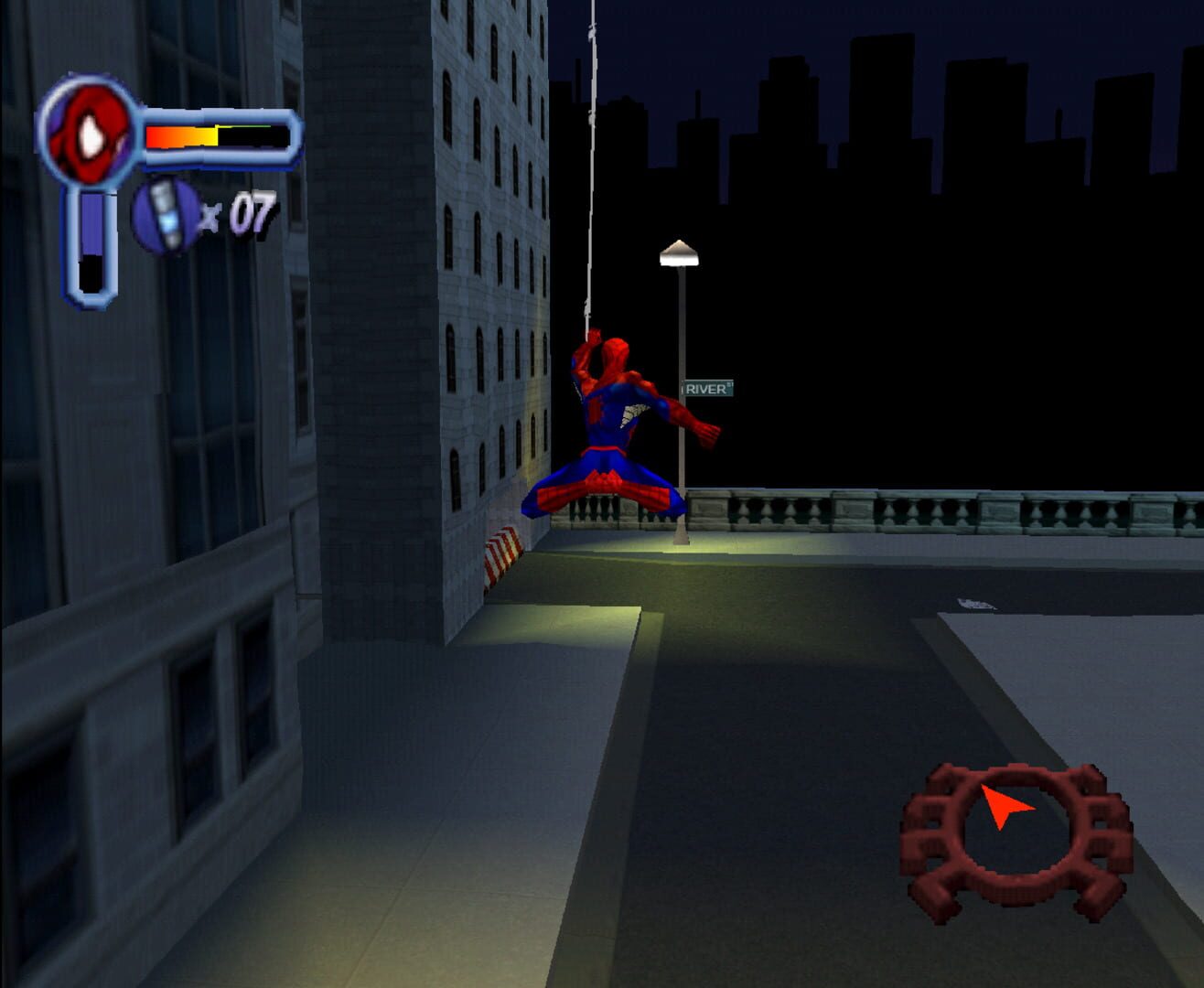
One major difference between the game and its predecessor is the ability to play on ground levels. In the first game's outdoor levels, if Spider-Man swung too low below designated rooftops, he would fall into yellow mist that dominated most of the game's levels and die. Enter: Electro, however, presented levels based in limited city streets. They were confined grids rather than a free-roam environment.

The enemies in Enter: Electro are more realistic than the ones in the previous game, with the lizardmen and alien symbiotes being replaced by criminals, drones, and robots. In this game, Spider-Man has the ability to shoot a Web Ball while in mid-air. Spider-Man can also attach electricity and ice to his webbing. The training mode takes the player to the X-Men's Danger Room, wherein Rogue and Professor X assist Spider-Man with everything that may be useful during the course of gameplay.

Story

Shortly after the events of Spider-Man, the Daily Bugle has given Captain America full credit for foiling "Doctor Octopus and Spider-Man's sinister plot" while stating that Spider-Man is "still at large". Spider-Man takes on some criminals while being watched by a visiting Beast.

A series of robberies led by Electro take place throughout New York City. While out on patrol, Spider-Man spots one of the robberies taking place at a building owned by BioTech. Planting a Spider-Tracer on the head thief's motorcycle, Spider-Man follows it to an abandoned warehouse where the thief is passing off a stolen briefcase to a contact. Spider-Man takes out the thugs and interrogates one of them, before being forced to fight the head thug: Shocker.

Development

Enter: Electro was originally scheduled for release on September 18, 2001. Following the September 11 attacks, Activision delayed the release of the game in order to remove references to the World Trade Center, and the game was pushed back to October 18 of that year.

The pre-9/11 version of the game was released online by an Argentinian YouTube user in 2015. The video under which the ISO was linked explains that the uncut version was sourced from the user's childhood copy of the game, which the user suggests may have been a pirated bootleg disc.

Reception

Spider-Man 2: Enter: Electro received mixed reviews, with sentiment leaning more critical than that of the first game. Critics noted the choice of villains was more obscure than its predecessor, and the short length of time to complete the game was criticised. The game's storyline was divisive, as some saw it as below average and not up to par with the last installment, while others enjoyed it. The graphics, voice acting, soundtrack, and gameplay received praise, however.

Jeff Lundrigan of Next Generation called it "a worthy successor, if not as exceptional as the original". In Japan, where the game was ported and published by Success on October 31, 2002, Famitsu gave it a score of 27 out of 40.

Releases by platformdates and regions as published

Releases by platform
PlatformReleasedRegions
PlayStation18 October 2001North America · Europe 26 October 2001

Title IDsone per regional release, with its latest update

Title ids and disc serials by release
PlatformTitle IDRegionLatest update
PlayStationSLES-03623Europe—
SLES-03624Europe—
SLES-03624-PEurope—
SLES-03625Europe—
SLES-03623-ANZ-PEurope / Australia—
SLES-03623-PEurope / Australia—
SLPM-87073Japan—
SLUS-01378North America—
SLUS-01378GHNorth America—

Box artone per regional release we hold art for

Decompilations and portscommunity projects that rebuild or port the game

Editions and related releases

Follows
Spider-Man

Games like this

Collections3 collections

Reception and records

Platform libraries

Description adapted from its source, CC BY-SA 4.0.