The articlegameplay, story, development, reception
Gameplay
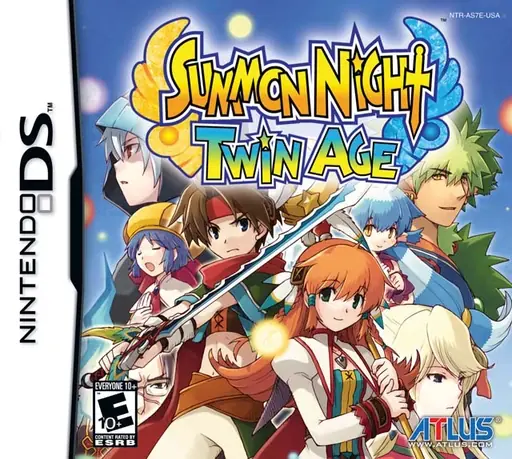
Summon Night: Twin Age uses a fully touch-based control system. Gameplay in Summon Night is based on a top-down, hack and slash, RPG similar to Diablo II or Ragnarok Online. Moving the main character is done by tapping the screen where the player wishes it to move. Attacking is done by tapping a target enemy onscreen with the stylus.
The controlled character will then attack periodically until given a different command. Skills, spells, and items are used through two pop-up windows along the sides of the screen where the player can preset abilities. They are used by tapping the desired ability and then a target. Summon Night uses a party based system of three characters at a time.
I. controlled party member of the player's choice. Control between the heroes can be done at any time they are on the same screen. Summoned creatures can also be used in battle by defeating the respective monster, obtaining its creation item, and then conjuring it into a flask through a menu on the world map.
These flasks can be used as items to summon monsters for the player's team.
Other than the controlled main character, other party members, be they humanoid or monster, will act independently, attacking and using skills, but will follow the main character's movement. Continued use of a certain party member will increase that character's "rank" improving its performance and granting access to new skills. The two main characters both gain experience from defeating enemies, gaining levels in the process, while the third party member shares a level with the "chosen" main character. Leveling up increases a character's parameters and grants the two main characters access to skill points they can spend on their skill tree to unlock/upgrade their skills. All skills have a maximum level of seven and have both a level requirement, and a skill point requirement, to unlock.
Story
The world in which Summon Night: Twin Age takes place is called Clardona. In this world there are two main races; humans, and the Kascuza, creatures which have both human and beast-like features. The two races are constantly battling, and a short-lived peace began after the humans pushed the Kascuza onto a small island called Jarazi. A third group that inhabits Clardona are spirits, entities from another world, which mainly manifest in the form of nature spirits, and rarely as creatures or humanoids known as Summon Beasts.
Humans can call up creatures from another world in a process known as "Summoning" and they are constantly researching ways to increase their summoning powers. In one of the facilities, a terrible accident happened caused by a young girl named Reiha's summoning powers getting out of control. The girl was assumed to have died along with her family in the accident, but she survived, and was hidden with the Kascuza on the island of Jarazi, along with the result of the summoning, a young Summon Beast boy named Aldo. Seven years passed.
Near their coming of age ceremony the spirits of nature suddenly began to go wild, and the two of them leave to discover the reason for the strange events, which is also an under kingdom.
Reception
The game received "average" reviews according to the review aggregation website Metacritic. In Japan, Famitsu gave it a score of one nine and three eights for a total of 33 out of 40.
GameSpot praised the "simple, but charming gameplay and the cute presentation", but stated that "there are a few AI and targeting issues", and that "exploration can get monotonous". IGN praised the game's "beautiful art, strong effect, deep customization aspects, and a slick overall interface". IGN also stated that "while the touch control is simple, it is varied with spells, skills, and attacks", and that "the monster battle system, skill trees, item creation/upgrading, and general flow of the game are all well designed"; and "while the soundtrack is simple, it is effective". GamePro said that the game was "suitably cute and colorful, more or less what you'd expect from a Japanese RPG. The character sprites and magic spells are shiny and well-animated."