Ludography
78/100
Players194 ratings
100/100
Critics1 review

Where to get it

Super Castlevania IV cover

1991 · Remake · Konami · Beat 'em up · Horror

Super Castlevania IV

Nintendo exclusiveRemake

A century of Transylvanian tranquility is about to come to a shocking end. Once again the mortifying screams of helpless villagers shake the ground as they huddle against new nightmarish horrors unleashed by the Duke of Darkness, Count Dracula. And this time he has a tombstone with your name on it, Simon Belmont.

Also known as
Akumajou Dracula · Devil's Castle Dracula · Akumajō Dracula
Released
31 October 1991
Platforms
SNESWiiWii UNintendo 3DS
Genres
Beat 'em upHorrorPlatformerVampire
Developers
Konami
Publishers
Konami
Modes
Single-player
Perspective
Side view
Themes
ActionHorror
Country
Japan
Age ratings
CLASS_IND 10ESRB E10+CERO APEGI 7ACB PG
Languages
EnglishJapanese

About

Super Castlevania IV is a 1991 platform game developed and published by Konami for the Super Nintendo Entertainment System. It has been re-released multiple times, including for the Super NES Classic Edition.

Super Castlevania IV features expanded play control, 16-bit graphics featuring Super NES's Mode 7, and a soundtrack featuring new pieces and arrangements based on previous Castlevania music. Following the same setting as Castlevania on the NES, the game takes place in 1691 Transylvania, where the vampire hunter Simon Belmont must defeat the vampire Dracula. The game received critical acclaim, with praise for its graphics, gameplay, soundtrack, and visual style, and has since been considered one of the greatest video games ever made.

Keywords

  • castlevania
  • dracula
  • atmospheric
  • vampires
  • vampire hunter
  • gothic horror
  • wii virtual console
  • simon belmont
  • nintendo 3ds virtual console
  • wii u virtual console
  • nintendo selects
  • technical feature - snes mode 7

Media

The articlegameplay, story, development, reception

Gameplay

Super Castlevania IV is a platform game where the player takes control of Simon through eleven levels. Players begin the game with five lives, and it ends in a game over once they have lost them all. The player will lose a life if all of Simon's health gauge is depleted, fall into a hole or if they do not finish the level within the time limit. The health gauge can be restored through food items that can be dropped from candles and breakable blocks, or with the Magic Crystal, which is received after defeating the boss at the end of each level. A password can be entered to continue the game.

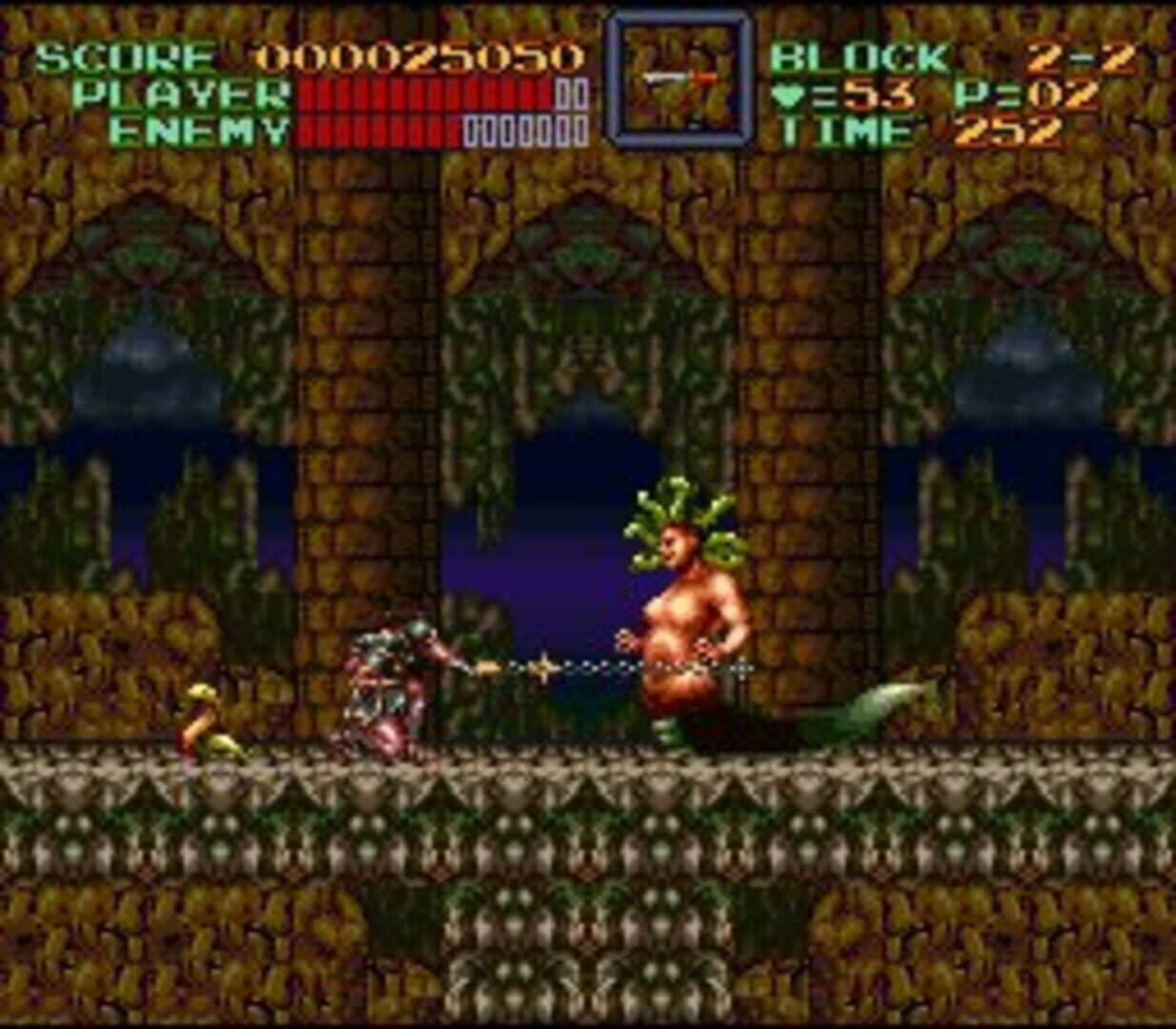
With Simon's whip, players can attack enemies in eight directions with the use of the control pad. By holding down the attack button, the whip will go limp and can be waved around with the control pad, which can be used to block projectiles and hit enemies (albeit for much less damage). The length and power of the whip can be increased up to two levels by collecting an item called the Morning Star. The whip is used for fighting and for latching onto rings to swing over areas that are too wide or dangerous for the player to jump across. In addition to jumping, the player can control Simon to move while crouching.

Development

Super Castlevania IV was directed by Masahiro Ueno (credited in the game as Jun Furano since Konami did not allow the use of real names at the time), who was also the main programmer. His first 16-bit game, Ueno's team possibly started development on it during 1989. Ueno liked the original Castlevania for the Nintendo Entertainment System the most and wanted to make a pure action game that was similar to it. Ueno only considers Super Castlevania IV a remake of the original Castlevania to some extent.

Early design documents depict the player-character in modern attire, since the setting was not decided at the time. Many features in Super Castlevania IV were introduced to make it a less frustrating game for players, such as giving them more control over Simon when he walked up stairs.

Reception

The game sold 800,000 cartridges worldwide.

Upon Super Castlevania IV's release, the game was acclaimed by critics. Weekly Famicom Tsūshin generally complimented the game with three reviewers praising the graphics quality and three praising the control and gameplay, specifically the ability to use the whip in different angles. 5 out of 5. Among several items, the magazine cited the game's graphics, music, and action sequences as positives.

Releases by platformdates and regions as published

Releases by platform
PlatformReleasedRegions
SNES31 October 1991Japan · North America 4 December 1991 · Europe 23 November 1992
Wii2 December 2006Japan · North America 25 December 2006 · Europe 29 December 2006 · Australia 29 December 2006
Wii U11 September 2013Japan · Europe 31 October 2013 · North America 31 October 2013
Nintendo 3DS8 September 2016North America · Europe 20 October 2016

Title IDsone per regional release, with its latest update

Title ids and disc serials by release
PlatformTitle IDRegionLatest update
Nintendo 3DS000400000F703500North America—
SNESSNSP-ADEurope—
SHVC-ADJapan—
SNS-P-ADNorth America—
Wii U0005000010130B00Europe—
0005000010130A00North America—

Box artone per regional release we hold art for

Editions and related releases

Included in
Castlevania Anniversary CollectionSuper NES Classic Edition
Part of
Castlevania
Remake of
Castlevania

Games like this

Collections14 collections

Platform libraries

Publishers

Series and characters

Reception and records

Description adapted from its source, CC BY-SA 4.0.