The articlegameplay, story, development, reception
Development
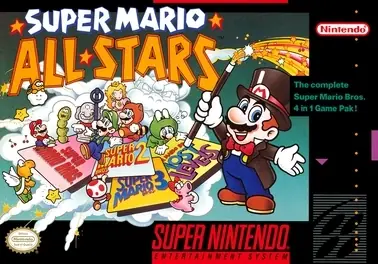
Super Mario All-Stars was developed by Nintendo Entertainment Analysis & Development, a former game development division of Japanese publisher Nintendo. It had the working title Mario Extravaganza as, according to Nintendo president Satoru Iwata, "It was a single game cartridge packed full of the first ten years of Nintendo's rich history."
The concept emerged after the completion of Super Mario Kart (1992). The next major Mario game, Yoshi's Island (1995), was still in production, creating a gap in Nintendo's release schedule. Mario creator Shigeru Miyamoto suggested developing a "value pack" containing all the Super Mario games. According to assistant director and designer Tadashi Sugiyama, Miyamoto's idea was to give players a chance to experience The Lost Levels.
Nintendo had deemed The Lost Levels, released in Japan as Super Mario Bros. 2 in 1986, too difficult for the North American market and instead released a retrofitted version of the game Doki Doki Panic (1987). As such, it had not attracted a large audience. Rather than simply transfer the NES games to a SNES cartridge, Nintendo remade them for SNES.
One of the first tasks the developers accomplished was updating and reworking the graphics for the SNES. The more powerful hardware gave the developers more colors to use in Mario's world. Designer Naoki Mori recalled feeling intimidated, as it was only his third year at Nintendo and he had been tasked with updating its flagship series. The artists based their designs on those from the SNES game Super Mario World (1990) and added a black outline around Mario to make him stand out against the backgrounds.
, Mori and Sugiyama added details such as portraits of Bowser and Mario. The team strove to retain the feel of the original games by leaving level designs and Mario's movement unaltered. To preserve the gameplay, they added no new animations or actions.
Alterations were made by hand, and Sugiyama ran the original Super Mario Bros. while he worked on the remake so he could compare them side by side. Staff who worked on the original games were involved and consulted during development. ; however, for that glitch, they limited how many lives the player could earn.
Sugiyama recalled the team fixed glitches they thought would hinder players' progress, although this created some differences in the controls. To make the games easier, the team increased the number of lives they start with. They also added a save-game option, a feature made possible by the recent development of battery backup cartridges. Save points were added after each level in The Lost Levels to reduce its difficulty.
While Mori helped with the other remakes, he avoided debugging The Lost Levels because it was so difficult.
Reception
The compilation received critical acclaim. Reviewers thought it was a must-have that represented the SNES library at its finest, and would occupy players for hours, if not days. Nintendo Magazine System (NMS) estimated it could entertain players for up to a year. A critic from Computer and Video Games (CVG) described Super Mario All-Stars as the Super Mario director's cut, bringing fans updated graphics and audio in addition to a game (The Lost Levels) few had experienced. A reviewer from Electronic Gaming Monthly (EGM), overwhelmed by the improvements, called it a "masterpiece from beginning to end".
Critics praised the collection's games as excellent remakes, stating they aged well and appreciating the effort that went into retrofitting them for the SNES. For AllGame, retrospectively reviewing the version including Super Mario World, the compilation represented "the absolute pinnacle of the 2D platform genre". Critics said the games played just as they did on the NES and retained what made them great. EGM's reviewers were satisfied the various secrets were left intact.
Nintendo Power wrote the games got better with time, while EGM and CVG suggested players abandon the antiquated NES games for the SNES upgrade. Although one of the NMS reviewers admitted to preferring Super Mario World, citing the compilation's less instinctive controls and somewhat simplistic graphics, he said Super Mario All-Stars was still worth buying.
Reviewers liked the updates the games received in the transition to the SNES. Nintendo Power, for instance, praised the addition of a save feature, believing it would give players who never finished the games a chance to do so. The updated graphics were praised; NMS's reviewers admired the attention to detail, which they said made the compilation worth buying, and AllGame called the visuals colorful and cartoonish. CVG thought the backgrounds could have benefited from more detail, but GamePro thought they were detailed enough.
Reviewers offered praise for the updated soundtracks as well. For EGM, the audio enhanced the experience, and GamePro noted the addition of echo and bass effects.
Criticism of Super Mario All-Stars generally focused on its lack of innovation. Aside from the 16-bit updates, save feature, and (for American audiences) The Lost Levels, Nintendo Power wrote, the compilation did not present anything new, a sentiment CVG echoed. "[I]f the best cart around is a compilation of old eight-bit games," wrote Edge, "it doesn't say much for the standard of new games, does it?" One reviewer in the Japanese magazine Weekly Famicom Tsūshin said that while the games were fun and nostalgic, he found it too expensive at a retail price of ¥9,800.
Reviewers also disagreed over which game in the compilation was best. One EGM reviewer argued Super Mario Bros. 2 was, but another critic and Nintendo Power said that honor went to The Lost Levels. NMS, CVG, and Edge, however, criticized The Lost Levels for its difficulty, with Nintendo Magazine System viewing it as just an interesting bonus.
Edge said the compilation was worth buying for Super Mario Bros. and Super Mario Bros. 3, but not Super Mario Bros. 2 because the reviewer found its gameplay lacking fluidity and the level design poor.
According to the review aggregate website Metacritic, Super Mario All-Stars 25th Anniversary Edition received "mixed or average reviews". Critics were disappointed by the unaltered rerelease, which they found lazy. They expressed surprise the developers did not take advantage of the extra space Wii discs offer to add more games or use the Super Mario All-Stars + Super Mario World version. The Guardian compared the 25th Anniversary Edition unfavorably to the Wii remake of the Nintendo 64 game GoldenEye 007 (1997) released earlier that year.
The writer argued that though GoldenEye offered new graphics, levels, and reasons to play, Super Mario All-Stars was just the same compilation released on the SNES in 1993. V. Club went as far as to state the 25th Anniversary Edition "fails on every conceivable level, and a few inconceivable ones, too".
The Super Mario History booklet divided reviewers. V. Club panned it for what they considered cheap production quality. Although Nintendo Life found it somewhat intriguing, both called the one-sentence developer comments vague and meaningless.
V. Club said the level design documents were "obscured by pictures, and schematics written in Japanese with no translation". Meanwhile, IGN opined the booklet failed to demonstrate Mario's importance, missing information about the Game Boy installments, Yoshi's Island, and other Nintendo games. Others found the booklet interesting; GamesRadar+ stated that for Mario fans Miyamoto's original outline "alone is worth $30".
The soundtrack CD received criticism and was viewed as a missed opportunity. Reviewers were disappointed it contained only ten tracks and that half of it was dedicated to sound effects. For instance, Nintendo Life said it "doesn't even fill half of that potential running time" of 74 minutes of CD audio. Similarly, IGN said ten tracks were not enough, including only one of the twenty tracks from Super Mario Galaxy (2007).
Conversely, The Guardian said the CD would make players happy and GamesRadar+ thought it was rare for Nintendo to release game soundtracks outside Japan. GamesRadar+ said the CD helped make the compilation seem important, noting that it contained the first official release of the Super Mario Bros. "Ground Theme".
Nintendo Life wrote there was no reason for Nintendo not to add more to the compilation, suggesting it would not have taken much effort to add interviews, advertisements, and other behind-the-scenes content. Despite the general disappointment, critics said the games remained high quality. Some admitted to preferring the NES originals, but others thought the updated 16-bit graphics and addition of a save feature were great. However, some en
Legacy
, Super Mario Bros. 2, and Super Mario Bros. 3 in its list of the best console games of all time, they specified the All-Stars edition for all three games. In the listing for Super Mario Bros.
3 (ranked at number 2), they noted, "Just a reminder: We're not including compilation games on our Top 100, or Super Mario All-Stars would be the clear-cut number-one game of all time." Famitsu called All-Stars a role model for video game remakes in a 2005 retrospective. In 2018, Complex named All-Stars the tenth-best SNES game. In 1996, GamesMaster named All-Stars the third top SNES game.
In 1995, Total! named All-Stars the top SNES game on their Top 100 SNES Games writing: "This is possibly the best cartridge on any system, anywhere."
Super Mario Advance (2001) and Super Mario Advance 4: Super Mario Bros. 3 (2003), remakes of Super Mario Bros. 2 and 3 for Nintendo's Game Boy Advance, incorporate elements from the Super Mario All-Stars versions, such as the updated graphics and audio. Super Mario 3D All-Stars, a Nintendo Switch compilation of the first three 3D Super Mario games, was released for the series' 35th anniversary in 2020. According to Eurogamer, Nintendo internally referred to the compilation as Super Mario All-Stars 2 during development.