
1977 · Taito · Arcade · Racing
Super Speed Race
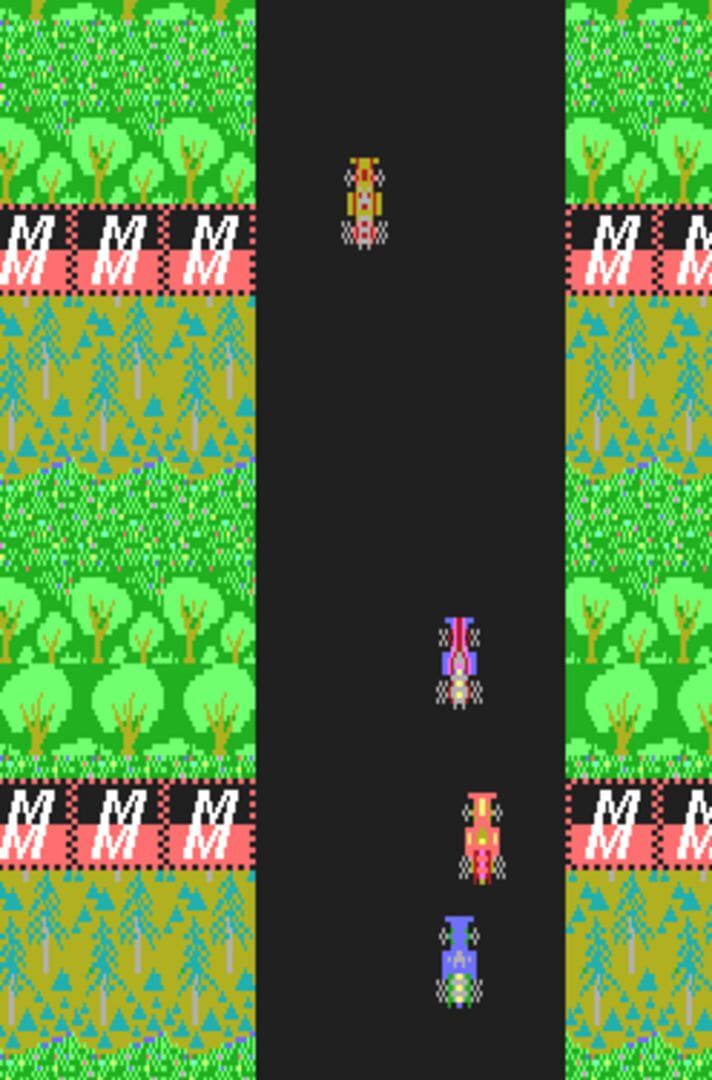
Super Speed Race GP V (released as "Super Speed Race" in North America, and as "Speed Race CL-5" in Europe) is an edition in Speed Race series. The primary gameplay stays identical to earlier games in the series. The player races in a top-down view and must pass other cars to score points. Compared to its predecessor Super Speed Race there are some new elements like the cars' headlights emitting light in tunnels and water slicks on the track. Also new are bridges where the player must choose between two paths and not crash against the divider.
- Released
- 1 December 1977
- Platforms
- Arcade
- Genres
- ArcadeRacing
- Developers
- Taito
- Publishers
- TaitoMidway Manufacturing
- Modes
- MultiplayerSingle-player
- Perspective
- Bird view / Isometric
- Themes
- Action
About
Speed Race is a 1974 racing video game developed and published by Taito for arcades. It was released under the titles Racer and Wheels in North America by distributor Midway Manufacturing in 1975. Designed by Tomohiro Nishikado, the gameplay involves the player using the attached steering wheel to maneuver a car alongside a fast vertical scrolling road. The objective is to score points by driving past other cars without colliding with them; more points are awarded for driving faster.
Players must do this under a 90-second time limit, which ends the game when it runs out. The gameplay concepts were adapted from two earlier driving electro-mechanical games: Kasco's Mini Drive (1958) and Taito's Super Road 7 (1970).
Media
The articlegameplay, story, development, reception
Gameplay
Speed Race is a one or two-player racing video game where players controls a race car along a constantly-scrolling vertical road. The player uses a steering wheel to move the car left or right and an accelerator to make it move faster. The objective of the game is to drive past other cars that scroll past the players under a 90-second time limit without colliding into them. The time limit and the player's score are displayed on an auxiliary LED display placed above the monitor.
Points are earned by driving past cars, with additional points being awarded based on how fast the car is moving. Colliding with a car resets the player's speed and starts them at the beginning of the track. The game ends when the time limit runs out, though the timer can be extended by earning a certain number of points. Two difficulty modes are available that increase the speed of the cars and the number of cars on the track.
Development
Following the release of Atari's Gran Trak 10 earlier in 1974, Taito employee Tomohiro Nishikado decided to develop his own racing video game the same year; he did not enjoy Gran Trak 10, due to its twisting tracks and complex controls. Nishikado looked to two older driving electro-mechanical games for inspiration: Kasco's Mini Drive (1958) and Taito's 1970 rear-projection driving game Super Road 7, the latter in turn similar to Kasco's Indy 500 (1968) and Chicago Coin's Speedway (1969). Mini Drive and Super Road 7 involved driving a car down an endlessly scrolling road, with Super Road 7 also having the need to dodge cars in front of the player. Nishikado adapted these gameplay concepts into a video game called Speed Race. In order to simulate the scrolling effect and give the illusion of a moving background, he animated a background road image and modulated the speed of oncoming computer-controlled cars based on the player's speed.
Reception
In Japan, due to the complexity of the hardware, Taito released Speed Race at a price point of 100 yen per play, compared to the standard 50 yen per play up until then. Despite this, the game became a major hit in Japan, establishing 100 yen as the standard price point for arcade games in Japan over the next several decades. The updated versions Speed Race DX and Speed Race Twin were among the top ten highest-grossing arcade video games of 1976 in Japan, with Speed Race DX at number two (below Taito's Ball Park) and Speed Race Twin at number eight. Speed Race DX went on to be the highest-grossing arcade video game of 1977 in Japan, and second-highest-grossing overall arcade game below Namco's electro-mechanical F-1.
In North America, the game became a hit when it was released by Midway there in 1975. Wheels sold 7,000 arcade cabinets and Wheels II sold 3,000 for a combined 10,000 sold in the United States, making it the best-selling arcade game of 1975, according to sales figures provided by Ralph H. Baer. In March 1976, the first annual RePlay arcade chart listed Wheels and Wheels II as the second-highest-grossing arcade game of the previous year in the United States, in terms of coin drop earnings (below Atari's Tank and Tank II), while the Racer version was the year's eighth-highest-grossing arcade video game. In October, RePlay listed Wheels as the third-highest-grossing arcade video game of 1976 in the United States, below Sea Wolf and Gun Fight (both manufactured by Midway).
Legacy
The game's use of vertical scrolling was influential on later games. One of the games it influenced was Atari's Hi-way (1975), which added a sit-down cockpit cabinet like older electro-mechanical games.
Speed Race spawned numerous updates, variations and sequels released by Taito and Midway in arcades.
Releases by platformdates and regions as published
Games like this

Speed Race
1974 · Arcade
Arcade · Racing

Auto Racing
1980 · Intellivision
Arcade · Racing
 Nintendo exclusive
Head On
1979 · Arcade, Game Boy
Arcade · Racing
 Xbox exclusive55
Sprint 2
1976 · Arcade, Xbox One
Arcade · Racing

Indy 4
1976 · Arcade
Arcade · Racing

Crash 'N Score
1975 · Arcade
Arcade · Racing

Hi-way
1975 · Arcade
Arcade · Racing

Dirt Fox
1989 · Arcade
Arcade · Racing
Collections1 collection
Genres
- Racing gamesList › 1970s and 1980s
- Racing gamesList › 1970s and 1980s
- Racing gamesList › 1970s and 1980s
- Racing gamesList › 1970s and 1980s
- Racing gamesList › 1970s and 1980s
Description adapted from its source, CC BY-SA 4.0.