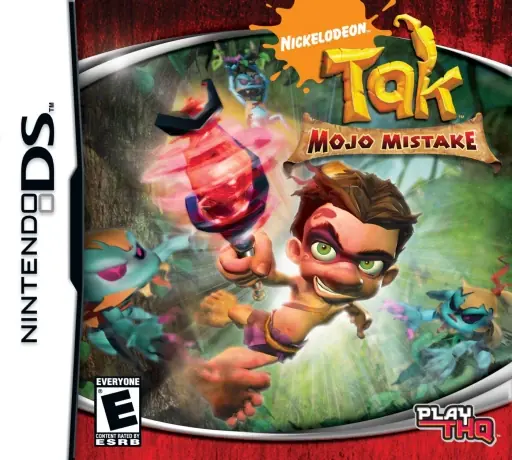
The articlegameplay, story, development, reception
Gameplay
Tak and the Power of Juju is a platformer in which the player controls Tak, who can jump, attack, and interact with animals to overcome obstacles. The player's health is represented by the feather on Tak's head and, along with mana, can be restored by collecting feathers found throughout the environment. After obtaining the Spirit Rattle, he gains access to "Juju Powers", which are acquired by collecting tokens scattered around the environment.
Story
According to an ancient prophecy, the Moon Juju, the guardian of the Pupanunu people, will be weakened by the evil Tlaloc, an embittered Pupanunu shaman who seeks to transform the Pupanunu into sheep as revenge for not being made high shaman in favor of another shaman, Jibolba. However, a warrior trained by the high shaman will restore the Moon Juju, defeat Tlaloc, and bring peace to the Pupanunu.
In the present, Tlaloc steals the Moon Stones, which the Moon Juju uses to protect the Pupanunu from evil, and uses them to change the people into sheep. Jibolba escapes Tlaloc's spell and believes his apprentice Lok to be the warrior of the prophecy. However, as he prepares to send him off, he discovers that he has seemingly been transformed into a sheep. Jibolba sends his younger apprentice, Tak (voiced by Jason Marsden), to find magical plants and change him back, though it turns out not to be Lok, but his squire Tobar. Jibolba tells Tak to obtain the Spirit Rattle, which allows its wielder to communicate with Juju spirits, while he finds Lok.
Development
The concept for Tak and the Power of Juju originated at Avalanche Software as early as 1995, inspired by a team member's dream of playing a video game with a witch doctor protagonist. Initial concept art and pitches were developed by 1998. Avalanche pitched the game to THQ, who in turn proposed the concept to Nickelodeon. After nine months of further refinements, the concept was sold to Nickelodeon. Its development marked an innovative approach in creating an intellectual property for video games before expanding to television.
Avalanche CEO John Blackburn listed Jak and Daxter: The Precursor Legacy, Ratchet & Clank, and Sly Cooper and the Thievius Raccoonus as influences on the game, and looked to Super Mario 64, Yoshi's Island, and The Lost Vikings as examples for its design. The game's focus on humor was inspired by Looney Tunes, and was done to make the characters more easily likable and to broaden the game's appeal to all ages. Nickelodeon contributed story, character development, voice talent, and scripting by Randolph Heard, while Avalanche retained primary creative control due to Nickelodeon's lack of hands-on experience in game development. Maryland-based band Wakefield recorded a cover of Iggy Pop's "Real Wild Child (Wild One)" for the soundtrack after playing a beta in-studio.
Reception
The game received "mixed or average reviews" on all platforms according to the review aggregation website Metacritic. GameSpot gave both the GameCube and PlayStation 2 versions a 6.8 out of 10, writing, "Tak and the Power of Juju can serve as a decent platformer, but if you're in the market for one, it shouldn't be your first choice." The game sold more than one million units.
During the 7th Annual Interactive Achievement Awards, Tak and the Power of Juju was nominated by the Academy of Interactive Arts & Sciences for "Console Children's Game of the Year", but lost to Mario Party 5.