The articlegameplay, story, development, reception
Gameplay
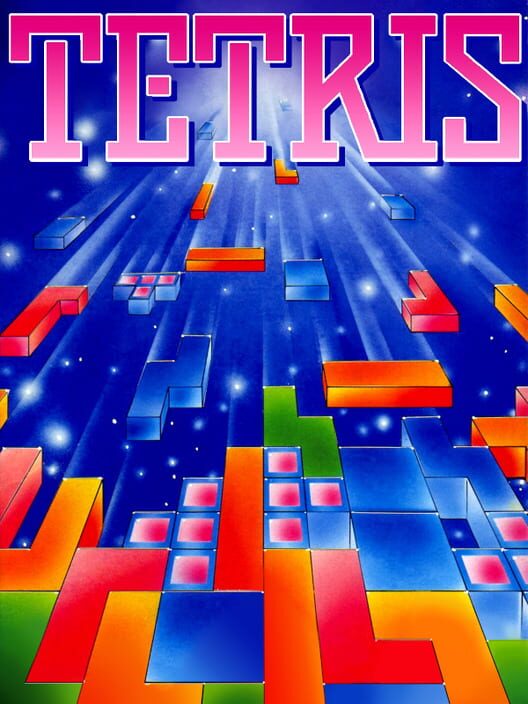
This version of Tetris has two modes of play: A-Type and B-Type. In A-Type play, the goal is to achieve the highest score. As lines are cleared, the level advances and increases the speed of the falling blocks. In B-Type play, the board starts with randomized obstacle blocks at the bottom of the field, and the goal is to clear 25 lines. The level remains constant, and players choose the height of the obstacle beforehand.
During play, the tetrominoes are chosen randomly. This leaves the possibility of extended periods with no long bar pieces, which are essential because clearing four lines at once (known as a "tetris") is worth more than clearing the equivalent amount of lines in singles, doubles, or triples. The next piece to fall is shown in a preview window next to the playfield. In a side panel, the game tracks how many of each tetromino has appeared in the game so far.
In A-Type, the level advances for every 10 lines cleared. Each successive level increases the points scored by line clears and changes the colors of the game pieces. All levels from 1 to 10 increase the game speed. After level 10, the game speed only increases on levels 13, 16, 19, and 29, at which point the speed no longer increases.
On level 29, pieces fall at 1 grid cell every frame, which is too fast for almost all players, and it is thus called the "kill screen". The developers of the game never intended anyone to play past the kill screen, as the game does not properly display the level numbers past 29, but with modern speed techniques, skilled players can play past level 29.
When starting a game, players can select a starting level from 0 to 9, but if the A button is held on the controller when selecting a level, 10 additional levels are added, raising the starting options to 0 to 19. When starting on a later level, the level is not supposed to advance until as many lines have been cleared as it would have taken to advance from level 0 to the starting level. Due to a bug, the levels will begin advancing earlier than intended when starting on level 10 or higher.
At the end of an A-Type game, a substantial score yields an animated ending of a rocket launch in front of Saint Basil's Cathedral. The size of the rocket depends on the score, ranging from a bottle rocket to the Buran spaceplane. In the best ending, a UFO appears on the launch pad and the cathedral lifts off. After a high-level B-Type game, various Nintendo characters perform in front of the cathedral.
The definition of "beating the game" has changed over time with the development of novel controller methods designed for high-level play. After clearing around 1550 lines, the game is at risk of crashing due to inefficient multiplication operations. Crashing the game in this way is popularly considered "beating the game", a feat first achieved on 21 December 2023 by 13-year-old Willis Gibson, known by his online alias "Blue Scuti".
The score received by each line clear is dependent on the level. Each type of clear, being a single, double, triple, or Tetris, has a base value which is multiplied by the number 1 higher than the current level. For any level
n
{\displaystyle n}
, a single will give
40
(
n
+
1
)
{\displaystyle 40(n+1)}
points, a double will give
100
(
n
+
1
)
{\displaystyle 100(n+1)}
points, a triple will give
300
(
n
+
1
)
{\displaystyle 300(n+1)}
points, and a Tetris will give
1200
(
n
+
1
)
{\displaystyle 1200(n+1)}
points. The game also awards points for holding the down key to make pieces fall faster, awarding 1 point for every grid cell that a piece is continuously soft dropped. Unlike line clears, this does not scale by level.
This scoring convention makes scoring Tetrises much more efficient than scoring an equivalent amount of lines through smaller line clears. At level 0, a Tetris awards 300 points per line cleared, a triple awards 100 points per line cleared, a double awards 50 points per line cleared, and a single awards 40 points per line cleared. For example, a single in level 0 is worth 40 points and a Tetris worth 1,200 points. A single in level 9 is worth 400 points and a Tetris worth 12,000 points, and a single in level 29 is worth 1,200 points (same as a Tetris on level 0) and a Tetris on level 29 is worth 36,000 points.
Development
Tetris was shown at the January 1988 Consumer Electronics Show in Las Vegas, where it was picked up by Dutch-born American games publisher Henk Rogers, then based in Japan. This eventually led to an agreement brokered with Nintendo where Tetris became a launch game for Game Boy and bundled with every system.
By 1989, about six companies claimed rights to create and distribute the Tetris software for home computers, game consoles, and handheld systems. ELORG, the Soviet bureau that held the ultimate copyright, claimed that none of the companies were legally entitled to produce an arcade version, and signed those rights over to Andromeda Software, who had already and fraudulently sub-licensed them to Atari Games prior to this revised agreement. International handheld rights were signed to Rogers' Bullet-Proof Software, who sub-licensed them to Nintendo to produce a Game Boy version. International console rights were signed over to Nintendo, who sub-licensed Japanese console rights back to Bullet-Proof Software. Nintendo retained the rights to produce their own port of Tetris on home console for sale in other parts of the world.
Pajitnov is credited for the "original concept, design and program" but was not directly involved in developing this version. According to the Video Game History Foundation, the game's color palettes were selected by Howard Phillips.
The NES does not have hardware support for generating random numbers. A pseudo-random number generator was implemented with a 16-bit linear-feedback shift register. The algorithm produces a close, but slightly uneven distribution of the seven types of game pieces; for every 224 pieces, there is one fewer long bar piece than would be expected from an even distribution.
The game's code includes an unfinished and inaccessible two-player versus mode, which sends rows of garbage blocks (with one opening) to the bottom of the opponent's board when lines are cleared. This feature may have been scrapped due to a rushed development schedule, or to promote sales of the Game Link Cable which enables a two-player mode in Nintendo's Game Boy Tetris.
Focusing on Russian classical music, the soundtrack features arrangements of "The Dance of the Sugar Plum Fairy" from Pyotr Ilyich Tchaikovsky's ballet The Nutcracker and the overture from Georges Bizet's opera Carmen. The former replaces the arrangement of "Korobeiniki", present in the Game Boy version, which has become strongly associated with Tetris.
Reception
IGN noted that "almost everyone" regarded Nintendo's Tetris as inferior to Atari's Tetris, which was pulled from shelves due to licensing issues. Computer Entertainer recommended Nintendo's Tetris only to consumers who had not played Atari's version, which it says has superior graphics, gameplay and options – further calling its removal from stores "unfortunate for players" of puzzle games. Electronic Gaming Monthly called Atari's version "more playable and in-depth" than Nintendo's.
The German gaming magazine Aktueller Software Markt considered the game a success, praising the adjustable starting level and music. The review held the graphics to be adequate, noting that they do not overwhelm the senses.
Legacy
Tetris & Dr. Mario (1994) features an enhanced remake of Tetris. Tetris Effect: Connected (2020) includes a game mode that simulates the rules and visuals of Tetris for the NES.
The events that lead to Nintendo acquiring the license to publish a Tetris game for consoles are explained in BBC's TV documentary Tetris: From Russia with Love (2004), as well as a dramatic retelling in Tetris (2023).
Since 2018, Nintendo's Tetris has experienced a resurgence in popularity with a younger audience. In 2020, more people attained a maxout score than from 1990 to 2019 combined.
In 2018, eleven classic Tetris experts were instructed to play with the next piece preview window disabled ("no next box"). Their average score was found to drop dramatically, from 465,371 in control games to 6,457 with no next box. The author notes that even though one participant went on to become that year's world champion, no player was recorded scoring a Tetris during any of the games without next boxes.
In a 2023 study, 160 people were recorded playing classic Tetris. The recordings suggested that novice players blink less than usual while playing Tetris, whereas experienced players remained closer to their normal blinking rate. The study concludes that a person's Tetris ability can be assessed by their blink rate during the first minute of play. In contrast, seven-time world champion Jonas Neubauer manually suppressed his blink reflex while playing, leading to health concerns and his regular use of eye drops.