
2009 · IronMonkey Studios · Beat 'em up
The Simpsons Arcade
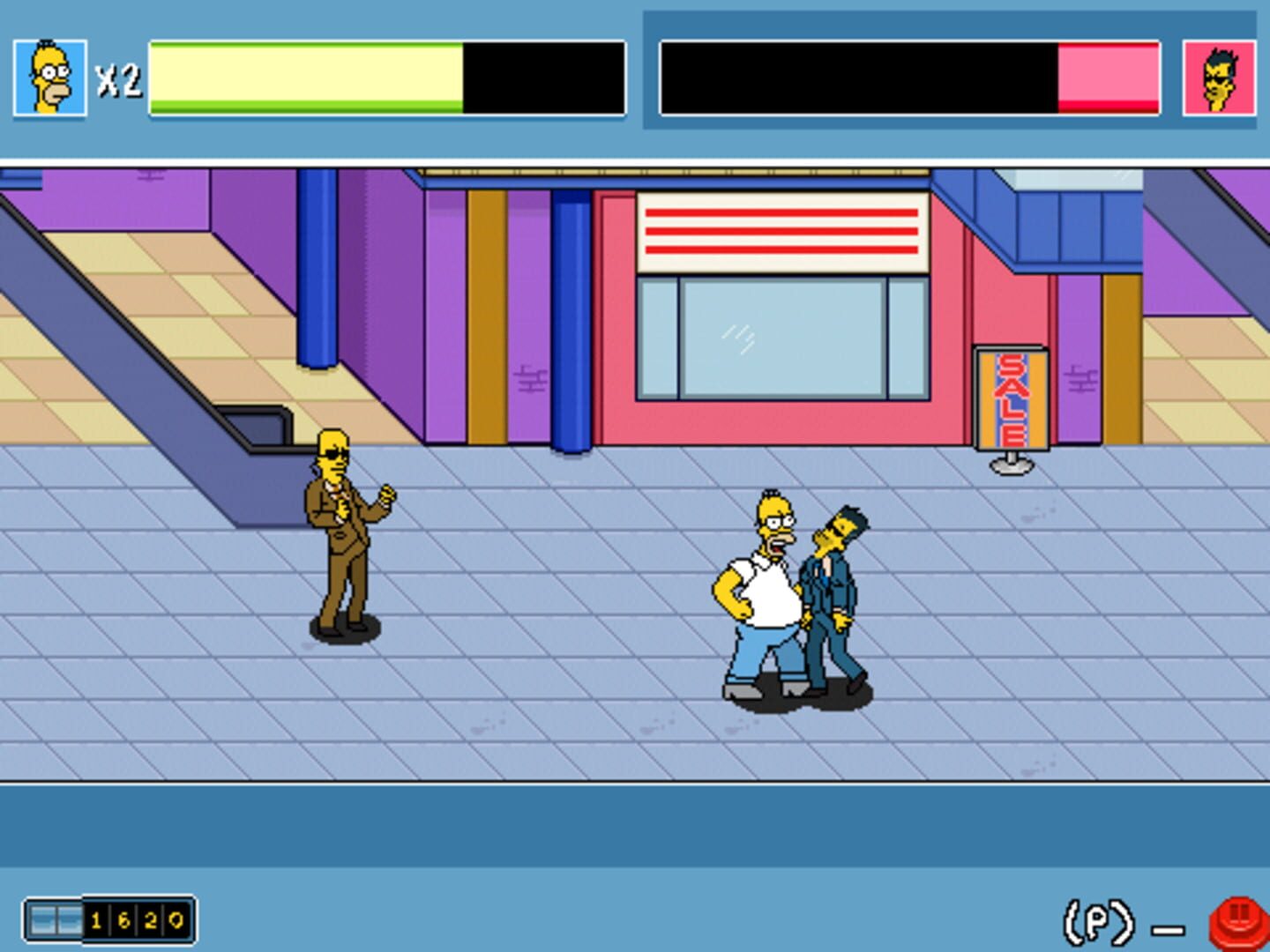
Although the game is called The Simpsons Arcade, this game is not a port of the well-known coin-op game of the same name. Instead, it is an homage to it, retaining the same beat-em-up gameplay, but featuring new characters from later seasons of The Simpsons, such as Chief Wiggum, Bumblebee Man and Mayor Quimby. Players attack enemies with punches and kicks, and can find power-ups in the form of other Simpsons family members, who appear on-screen briefly to give assistance in beating up foes.
- Released
- 9 December 2009
- Platforms
- Legacy Mobile DeviceiOS
- Genres
- Beat 'em up
- Developers
- IronMonkey Studios
- Publishers
- —
- Themes
- Comedy
About
The Simpsons is a 1991 beat 'em up video game developed and published by Konami. It was the second video game based on the animated television series The Simpsons to be released in North America. The game allows up to four players to control members of the Simpson family as they fight various enemies to rescue Maggie. The game features archival recordings from the show's first season mixed with brand new recordings by its voice actors, with Dan Castellaneta, Julie Kavner, Nancy Cartwright and Yeardley Smith reprising their respective roles as the Simpsons family.
The game was a commercial success in the United States, where it was one of the top three best-selling arcade games of 1991. It was ported to the Commodore 64 and MS-DOS soon after its launch in the arcades, and was released as The Simpsons Arcade Game on those platforms. It was also released under that title on Xbox Live Arcade for Xbox 360 and PlayStation Network for PlayStation 3 in February 2012; however, for unknown reasons, it was removed from both services on December 20, 2013. In 2021, under license from 20th Century Games, Arcade1Up released a 30th anniversary home arcade cabinet that features this game and The Simpsons Bowling.
Keywords
- helicopter
- brawler
- boss fight
- licensed game
- clowns
- cat
- human
- mouse
- rat
- touch controls
- arcade cabinet
- controversy
Media
The articlegameplay, story, development, reception
Gameplay
The Simpsons is a side-scrolling beat 'em up that allows players to join in at any time. Two different cabinet models were produced: one allowing up to two simultaneous players, each able to choose a character, and another allowing four players with a dedicated position for each character. Controls consist of an eight-way joystick and two buttons to jump and attack. However, the Japanese version is exclusively 2-player.
The characters have distinctive attack styles; Homer punches and kicks, Marge swings a vacuum cleaner, Bart wields a skateboard, and Lisa attacks with a jump rope. Two characters standing close to each other can mount a combined attack: Homer and Marge holding each other's ankles to roll around the screen and mow down enemies, Homer placing either kid on his shoulders so they can strike at two different heights, Marge throwing either kid, and Bart and Lisa linking arms to execute a clothesline attack. Each player has a health meter, which decreases upon being hit by enemies; food items can be picked up to replenish it. Players can also pick up and throw/swing items such as hammers, bowling balls, and mailboxes as melee weapons, and two players can team up to throw very heavy items such as police cars.
Story
While walking through downtown Springfield, the Simpson family collide with Waylon Smithers, who has just stolen a large diamond from a jewelry shop for Mr. Burns. The diamond goes flying and lands in Maggie Simpson's mouth, and she begins sucking on it like a pacifier as Smithers kidnaps her. The rest of the Simpsons give chase across the city, fighting off hordes of enemies (hired by Mr.
Burns) to reach the Springfield Nuclear Power Plant. The pursuit covers eight stages, each of which ends with a fight against a strong boss character. In the final stage, the Simpsons must defeat first Smithers and then Mr. Burns, who uses a mobile battle suit equipped with a variety of weapons.
Reception
In the United States, thousands of arcade cabinets were ordered upon its debut at the American Coin Machine Exposition (ACME) in March 1991. The Simpsons went on to win a Platinum award from the American Amusement Machine Association (AAMA) for sales achievement in 1991, making it one of the top three best-selling arcade video game machines of 1991 (with the Neo Geo MVS which won Platinum and below Street Fighter II which won Diamond). In Japan, Game Machine listed The Simpsons on their October 1, 1991, issue as being the eleventh-most-popular arcade game for the previous two weeks.
The arcade game received positive reviews from critics. Sinclair User gave it a positive review, saying: "It's the great looking graphics, good sampled sound and clever animations that makes the Simpsons such fun to play". ScrewAttack ranked the arcade game as the best cartoon-based game. The game was inducted into GameSpy's Hall of Fame.
Legacy
Soon after the Simpsons' arcade release, Novotrade released ports for Commodore 64 and MS-DOS computers. A listing on the Australian Classification Board website, posted on November 9, 2011, hinted at a port of the game being developed by Backbone Entertainment for multiple platforms. In January 2012, a high-definition port of The Simpsons Arcade Game was announced for PlayStation Network for release in February, with a release on Xbox Live Arcade also revealed. The port features online multiplayer, the ability to unlock the rare Japanese 4-player version of the game, and promotional content from the game's arcade launch.
The game was initially made available exclusively to PlayStation Plus users at no charge. In December 2013, the game was removed from the PlayStation Network store, although at the time it was still available through the Xbox Live Marketplace; no reason for the removal was given by either Sony or Konami.
Releases by platformdates and regions as published
Games like this

The Simpsons
1991 · Commodore 64, Legacy Mobile Device +3
Beat 'em up · Helicopter

The Simpsons: Cartoon Studio
1996 · Windows, macOS
Licensed game · Overweight character
 64
The Simpsons Arcade Game
1991 · Arcade, Commodore C64/128/MAX +3
Beat 'em up · Helicopter
 60
The Simpsons: Road Rage
2001 · GameCube, PlayStation 2 +1
Licensed game · Clowns
 PlayStation exclusive38
The Simpsons Wrestling
2001 · PlayStation
Boss fight · Licensed game
 PlayStation exclusive38
The Simpsons Skateboarding
2002 · PlayStation 2
Licensed game · Overweight character
 66
The Simpsons: Tapped Out
2012 · Android, iOS
Licensed game · Overweight character
 63
South Park Rally
1999 · Dreamcast, Nintendo 64 +2
Licensed game · Cat
Collections1 collection
Platform libraries
- IOS gamesGames and applications
Description adapted from its source, CC BY-SA 4.0.