
1964 · Business simulation · City-building
The Sumerian Game
The Sumerian Game is a text-based strategy video game of land and resource management. It was developed as part of a joint research project between the Board of Cooperative Educational Services of Westchester County, New York and IBM in 1964–1966 for investigation of the use of computer-based simulations in schools. It was designed by Mabel Addis, then a fourth-grade teacher, and programmed by William McKay for the IBM 7090 time-shared mainframe computer.
- Released
- 31 December 1964
- Platforms
- IBM 700/7000 seriesLegacy Computer
- Genres
- Business simulationCity-buildingEducationalSimulationStrategyText adventure
- Developers
- —
- Publishers
- —
- Modes
- Single-player
- Perspective
- Text
- Themes
- Historical
- Country
- United States
About
The Sumerian Game was an early text-based strategy video game of land and resource management. It was developed as part of a joint research project between the Board of Cooperative Educational Services of Westchester County, New York, and IBM in 1964–1966 for investigation of the use of computer-based simulations in schools. It was designed by Mabel Addis, then a fourth-grade teacher, and programmed by William McKay for the IBM 7090 time-shared mainframe computer. The first version of the early mainframe game was played by a group of 30 sixth-grade students in 1964, and a revised version featuring refocused gameplay and added narrative and audiovisual elements was played by a second group of students in 1966.
The game is composed of three segments, representing the reigns of three successive rulers of the city of Lagash in Sumer around 3500 BC. In each segment the game asks the players how to allocate workers and grain over a series of rounds while accommodating the effects of their prior decisions, random disasters, and technological innovations, with each segment adding complexity. At the conclusion of the project the game was not put into widespread use, though it was used as a demonstration in the BOCES Research Center in Yorktown Heights, New York, and made available by "special arrangement" with BOCES into at least the early 1970s.
Keywords
- god game
- resource management
- prehistoric
- city builder
- developed by one person
- based on - true story
- ibm 7090
Media
The articlegameplay, story, development, reception
Gameplay
The Sumerian Game is a largely text-based strategy video game centered on resource management. The game, set around 3500 BC, has players act as three successive rulers of the city of Lagash in Sumer—Luduga I, II, and III—over three segments of increasingly complex economic simulation. Two versions of the game were created, both intended for play by a classroom of students with a single person inputting commands into a teleprinter, which would output responses from the mainframe computer. The second version had a stronger narrative component to the game's text and interspersed the game with taped audio lectures, presented as the discussions of the ruler's court of advisors, corresponding with images on a slide projector. In both versions, the player enters numbers in response to questions posed by the game.
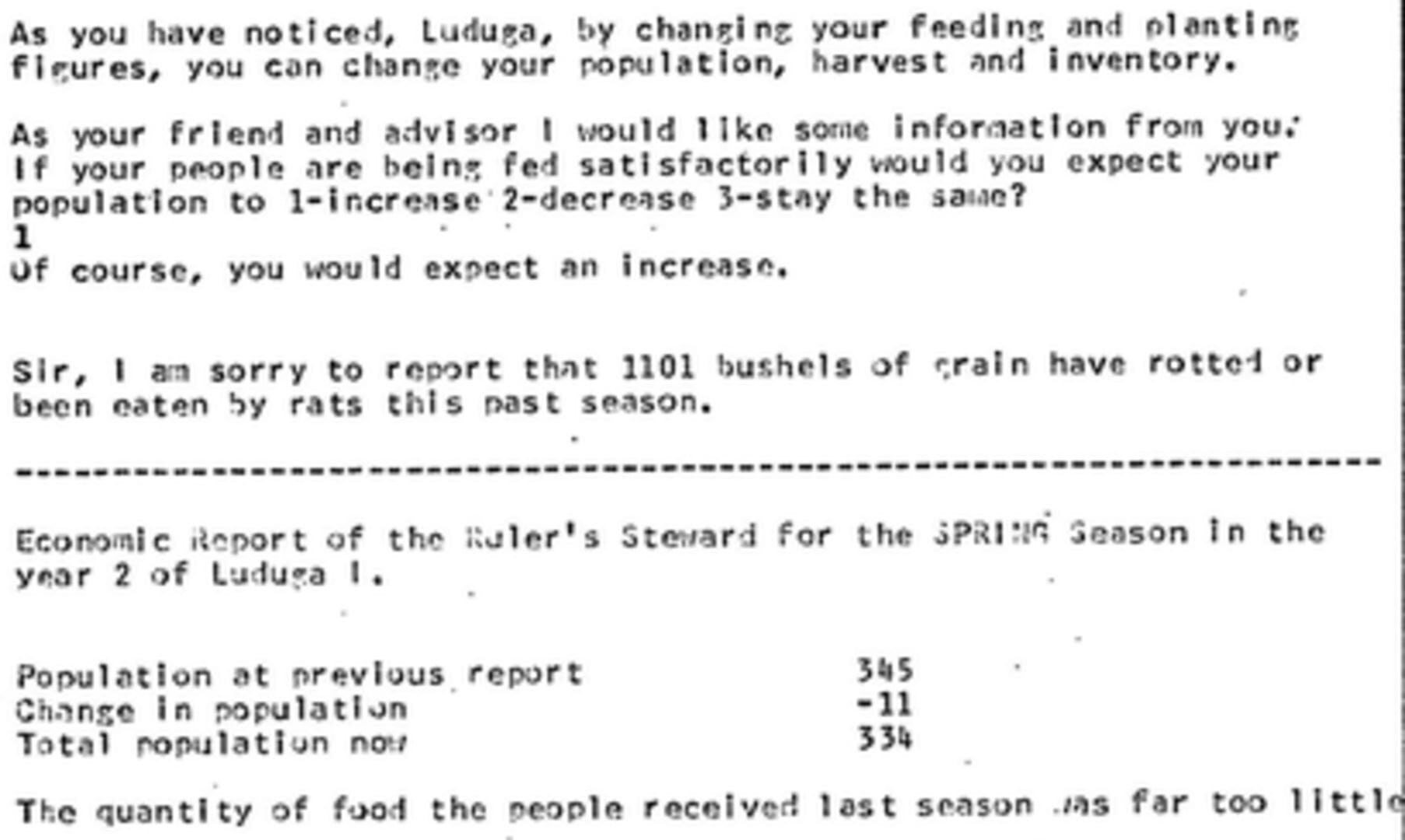
In the first segment of the game, the player plays a series of rounds—limited to 30 in the second version of the game—in which they are given information about the current population, acres of farmland, number of farmers, grain harvested that round, and stored grain. The rounds start in 3500 BC, and are meant to represent seasons. The player then selects how much grain will be used as food, seed for planting, and storage. After making their selections, the game calculates the effect of the player's choices on the population for the next round.
Development
In 1962, the Board of Cooperative Educational Services (BOCES) of Westchester County, New York, began a series of discussions with researchers at IBM, which was headquartered in Westchester County, about the use of computers in education research. The BOCES system had been established in New York to help rural school districts pool resources, and the Westchester BOCES Superintendent Dr. Noble Gividen believed that computers, along with computer simulation games like the Carnagie Tech Management Game being used in colleges, could be used to improve educational outcomes at small districts in Westchester. The Westchester County BOCES and IBM held a joint workshop, led by Bruse Moncreiff and James Dinneen of IBM along with Dr.
Richard Wing, curriculum research coordinator for BOCES, in June 1962, involving ten teachers from the area to discuss ways of using simulations in classroom curricula. S. Office of Education that December to continue to study the concept for 18 months as a joint project between IBM and the New York State Education Department, receiving almost US$104,000 (equivalent to $1,107,000 in 2025) instead for "Cooperative Research Project 1948".
Legacy
BOCES copyrighted The Sumerian Game in 1964. The grants for the second version of the game were in part to create a "center of demonstration" at the BOCES Research Center in Yorktown Heights for computer-assisted instruction. To this end, following the creation of the second version of the game, the first segment was reprogrammed by Jimmer Leonard, a graduate student in Social Relations at Johns Hopkins University, for the IBM 1401, to be used at demonstrations at the BOCES Research Center. Further revisions to the other sections of the game were considered, but no further grants for the project were received and no further changes were made.
The project was mentioned in Time and Life magazines in 1966. The game was made available to other schools by "special arrangement" with Westchester County BOCES into at least the early 1970s. In 1969, professor Herbert Hallworth of the University of Calgary reported that the computer science department there had recreated the game for the FOCAL programming language as an educational tool and was in the process of writing an assembly language version.
Releases by platformdates and regions as published
Editions and related releases
- Remade as
- The Sumerian GameHamurabi
- Built on it
- The Sumer Game
Games like this
 Nintendo exclusive70
Banished
2014 · Windows, Browser +1
City-building · Simulation
 71
Dawn of Man
2019 · PlayStation 4, PlayStation 5 +3
Business simulation · City-building

Prehistoric Kingdom
2022 · Windows, macOS
Business simulation · Simulation
 64
Nebuchadnezzar
2021 · Linux, Windows
City-building · Simulation
 75
Forge of Empires
2012 · Android, Browser +2
Simulation · Strategy
 88
Master of Olympus: Zeus
2000 · Windows
City-building · Strategy

Evolution: Dino Dudes
1992 · 3DO, Amiga 1200 +9
Strategy · Prehistoric

Medieval Lords: Build, Defend, Expand
2005 · Windows
City-building · Strategy
Collections3 collections
Genres
- Business simulation gamesList
- City-building gamesList
- Text-based gamesOn mainframe computers
Description adapted from its source, CC BY-SA 4.0.