

- 46/100
- Critics2 reviews
2007 · Sudoku
Toon-doku
Nintendo exclusive
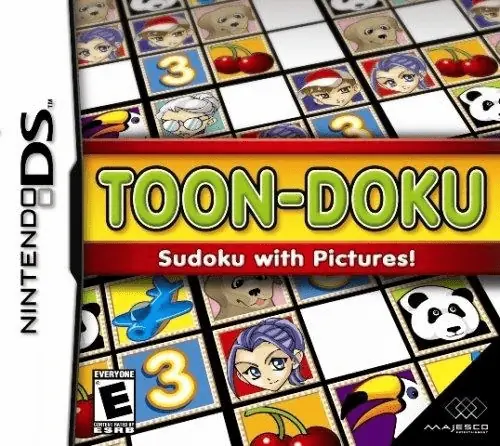
Toon-Doku is a sudoku game for Nintendo DS which attempts to substitute the numbers used in the original game for colorful images. The game features 99 custom sudoku puzzles widely ranging in difficulty, 9 different avatars, and 246 different images to substitute the numbers with. The game is fully customizable, allowing the player to choose not only his or her own avatar, but the background skin, music tracks, as well as all 9 of the symbols used to play the game (the game doesn't force the player to use images, one can choose to use numbers). Furthermore, the player is given a choice to draw his/her own unique set of symbols.
- Released
- 2007
- Platforms
- Nintendo DS
- Genres
- Sudoku
- Developers
- —
- Publishers
- —
- Age ratings
- ESRB EPEGI 3USK 0
About
Toon-Doku is a 2007 sudoku puzzle video game developed by Dragon's Den Unlimited and published by Majesco for the Nintendo DS. Directed by Joseph Sutton, the game was first released in North America and Europe in April 2007, with an Australian release following in October later the same year.
Toon-Doku was received generally negatively by critics, who criticized the game for having poor controls, as well as its replacement of numbers with symbols.
Media
The articlegameplay, story, development, reception
Gameplay
Toon-Doku follows the same principles as the logic-based puzzle Sudoku. In Toon-Doku, players have to fill a 9×9 grid with different symbols; however, no line or 3×3 subgrid can feature multiple of the same symbols. One of Toon-Doku's main gameplay points is the player's ability to draw custom symbols for use within the games puzzles. The game also has several unlockable symbols, which can be obtained by completing certain puzzles.
Toon-Doku features three main single-player modes: the instant mode, where players can play over 250 different sudoku puzzles, the stage mode, which features nine different levels, each with eleven puzzles, and the "Vs. CPU" mode, where the player competes against a CPU. Levels in the stage mode end with a boss fight, where an enemy can hide some of the boxes in the player's grid. Additionally, the game also features a multiplayer mode, where the player can hide some of the boxes in their enemies grids, similarly to the game's boss fights.
Development
Toon-Doku was developed by the American video game development studio Dragon's Den Unlimited. The game was published by Majesco. The game was intended to be more suitable for younger players than traditional sudoku, which was attempted via the game primarily using symbols, instead of numbers.
The game was first announced on January 24, 2007, by its publisher, Majesco, with a scheduled release of April later that same year. Toon-Doku released on April 10, 2007, in Europe, with a North American release following on April 16. The game released in Australia on October 12.
Reception
Toon-Doku received "generally unfavorable reviews", according to review aggregator Metacritic. The aggregator calculated a normalized score of 39/100, based on six critic reviews.
The game has been criticized by multiple reviewers for primarily using symbols instead of numbers. JC Fletcher of Engadget wrote that the use of symbols makes it harder to solve puzzles, due to it being easier to know that a number is missing in a line, as opposed to a symbol, using a walrus as an example. Jeuxvideo.com's Jihem was more positive towards the use of symbols, while still writing that the idea wasn't original, due to it being used in children's newspaper, as well as another sudoku Nintendo DS game, Zendoku.
Releases by platformdates and regions as published
Title IDsone per regional release, with its latest update
Box artone per regional release we hold art for
North America
Nintendo DS
Games like this
 Nintendo exclusive
Kurikin Nano Island Story
2007 · Nintendo DS
Often paired
 Nintendo exclusive
Make 10: A Journey of Numbers
2007 · Nintendo DS
Often paired

Summon Night 2
2008 · Port · Nintendo DS, PlayStation
Often paired
 Nintendo exclusive48
Flash Focus: Vision Training in Minutes a Day
2007 · Nintendo DS
Often paired
 Nintendo exclusive
Dragon Tamer Sound Spirit
2007 · Nintendo DS
Often paired
 Nintendo exclusive
Klustar
1999 · Game Boy Color
Often paired
 Nintendo exclusive79
Monster Farm DS 2: Yomigaeru! Master Breeder Densetsu
2008 · Nintendo DS
Often paired
 Nintendo exclusive
The Grinch (GBC video game)
2000 · Port · Game Boy Color
Often paired
Collections1 collection
Platform libraries
Description adapted from its source, CC BY-SA 4.0.