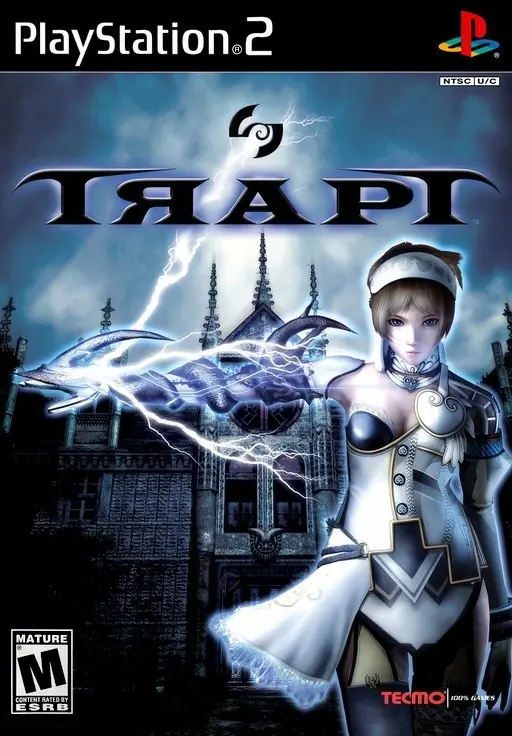
The articlegameplay, story, development, reception
Gameplay
Players begin by equipping and making traps for Allura to take with her into the game mission. Each mission starts in a specific room, where players can position traps in order to defeat enemies. The traps are classified into three types according to where they can be positioned within the game world (wall, ceiling, and floor). The player is allowed to take up to three traps of each type into a game stage, and additional traps can be obtained by completing the game.
Enemies' life bars are shown at the top of the screen, while Allura's life bar and active traps are shown at the bottom left and right respectively. As the player defeats enemies they are rewarded with "warl", the game's currency, which can be used to purchase new traps between missions. Players may also purchase room keys, which allow Allura to access other rooms in the game missions. Apart from the main story missions, the game also includes several "side stories", which are optional missions that give different angles and insights into the game's main story.
Story
For the majority of the game, the player controls Allura, the daughter of the recently deceased king. Reina and Millenia, protagonists of the third and second Deception games respectively, are shown as unlockable characters in the game, and Millenia is also included as a boss:
Allura: The heroine of the story and princess of Fronenberg. She is caught up in the plot taking place in the palace, and is forced to flee. After escaping, she enters a mansion where she encounters the Fiend (Malphas), who grants her the power to control traps. The Japanese voiceovers in the game refer to Allura as "Alicia".
Development
Producer Keisuke Kikuchi renamed the game Trapt from its original title of Deception 4 because he considered it the first part of a new series. The development team used existing torture devices and historical items as the basis for the traps found in the game, collecting books and photographs for reference. These traps were modified "so that they would be good for a video game". Most of the traps were generated from the staffs' own ideas, some others were inspired by comic books and films.
Two weeks were spent creating an initial pool of 720 trap ideas, after a few days deliberation and examination it was decided that 45 traps would be needed. A number of further screening processes were needed to bring down the total to 45. Hitoshi Hasegawa (the game's Director of Development and Promotion) stated that the "killer clock" Dark Illusion was inspired by a specific anime but did not mention its title. The more advanced PlayStation 2 graphics, compared to those of the original PlayStation which previous Deception games were developed for, resulted in some traps being toned down due to them being considered too grotesque.
Reception
Trapt received "mixed" reviews according to video game review aggregator Metacritic. In Japan, Famitsu gave it a score of one nine, one eight, and two sevens, for a total of 31 out of 40.
Reviewers generally agreed that the overall content of the game is acceptable, however several issues with technical stability and a poor translation from its original Japanese language reduces its quality. The amount of slowdown (drop in frame rate) caused by activating traps in particular drew criticism from reviewers. Greg Mueller of GameSpot stated, "The frame rate comes grinding to a halt whenever traps are activated." Louis Bedigian of GameZone also noted the slowdown, suggesting that with the already slow pace of gameplay it "could be summed up as being a wait and see RTS".