The articlegameplay, story, development, reception
Gameplay
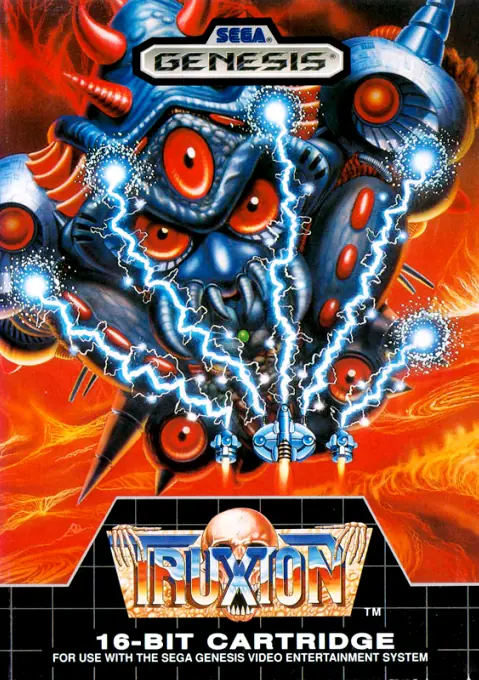
Truxton is a science fiction-themed vertically scrolling shooter where players assume the role of Tatsuo, taking control of the Super Fighter ship through five increasingly difficult levels, each with a boss at the end that must be fought, in a last-ditch effort to overthrow the invading Gidans, led by Dogurava. The Super Fighter is controlled over a constantly scrolling background, and the scenery never stops moving. The main ship only has two weapons: the main gun, which travels a max distance of the screen's height, and three bombs capable of obliterating any enemy caught within its blast radius.
Similar to Twin Cobra, there are three types of weapons that can be acquired by destroying incoming carriers, ranging from the red wide-reaching shot, the blue homing laser and the green straight beam. The ship's firepower is upgraded by picking up multiple "P" icons in a row, and can switch between any of the three weapons by collecting the respective color of each one. Other items can also be picked up along the way, such as 1UPs and speed increasers.
The game employs a checkpoint system in which a downed single player will start at the beginning of the checkpoint they managed to reach before dying. There are also hidden bonus secrets to reveal by meeting certain requirements during gameplay. Getting hit by enemy fire will result in losing a life, as well as a penalty of decreasing the ship's firepower and all medals collected to their original state. Once all lives are lost, the game is over unless the player inserts more credits into the arcade machine to continue playing. The game loops back to the first stage after completing the last stage, with the second loop increasing in difficulty.
Story
The plot summary of Truxton varies between each version, and is explained through supplementary materials. Taking place somewhere in space, an armada of Gidans, led by the evil Dogurava, is invading the fictional planet Borogo aboard five gargantuan asteroids. After surviving an attack on an orbiting Borogo cargo barge, pilot Tatsuo enters a remaining ship called the Super Fighter and challenges the Gidans in a desperate attempt to quell the alien invasion and divert their asteroid fortresses in the process.
Development
Truxton was the creation of programmer Masahiro Yuge, whose previous work for Toaplan included Tiger-Heli, Slap Fight, and Twin Cobra. Truxton was his first original project under the role of both producer and composer. Yuge wanted to create a scrolling shooter where players would become increasingly better the more they were able to remember specific stage designs and secrets, focusing on creating sections in levels that required a specific weapon to defeat certain enemies. Tatsuya Uemura stated that the project was developed in conjunction with Hellfire.
Many of the design choices, such as the memorization feature and its usage of secrets, were derived from ideas previously established in Slap Fight. The blue homing laser was based on a dream Yuge had, which featured a powerful laser that wiped out most enemies on the screen, and was implemented to be both the main weapon and a selling point. Level design was one of the main areas of the project, as Yuge did not want sections that could easily be memorized to the point of making them boring. "Safespots" were intentionally added to levels to allow breathing room for players. The lack of a cooperative two-player mode was cited by Yuge as being against the game's theme and would have made the memorization mechanic a pointless addition.
Naoki Ogiwara, Sanae Nitō, and Yuko Tataka acted as game designers in the development cycle. Ogiwara had already began work on designs for Truxton in secret during production of Twin Cobra due to his interest in creating science fiction artwork, which were finished after the latter was completed and gave inspirations to the team with enemy patterns. The Sega Genesis version was developed in-house by the same staff from the original arcade release after Sega discussed a conversion for the console with Toaplan. Uemura and Tataka have stated that working with the Genesis proved to be difficult due to several restrictions imposed by the console's hardware.
Reception
Truxton was met with mixed response from critics since its original arcade release. According to Masahiro Yuge, the game sold well in Japan, but proved to be less successful in western regions. Game Machine listed it as the most successful table arcade unit of November 1988, outperforming titles such as Scramble Spirits and World Stadium.
The Genesis version was well received when it was released, with Mean Machines summarising it as "a fine example of a pure, no-frills arcade blast". MegaTech said that although original features were distinctly lacking, "it's a good solid blast which offers plenty of action, speed and excitement". Likewise, the PC Engine version was also well received. In 1996, GamesMaster ranked Truxton 95th on their list of the "Top 100 Games of All Time".
Legacy
In 1992, the sequel Truxton II was released for arcades, and was later ported to the FM Towns. The rights to Truxton and other IPs from Toaplan are now owned by Tatsujin, a company named after the game's Japanese title, which was founded in 2017 by Masahiro Yuge and has been part of Embracer Group since 2022. The Super Fighter ship appears in Game Tengoku CruisnMix for Microsoft Windows, Nintendo Switch, and PlayStation 4. Artist Perry "Gryzor/Rozyrg" Sessions cited Truxton as one of the main influences for Super XYX.
In 2023, Tatsujin announced Truxton Extreme, a sequel to Truxton II. It was released for Microsoft Windows, Nintendo Switch 2, PlayStation 5, and Xbox Series X/S on 30 July 2026.