The articlegameplay, story, development, reception
Gameplay
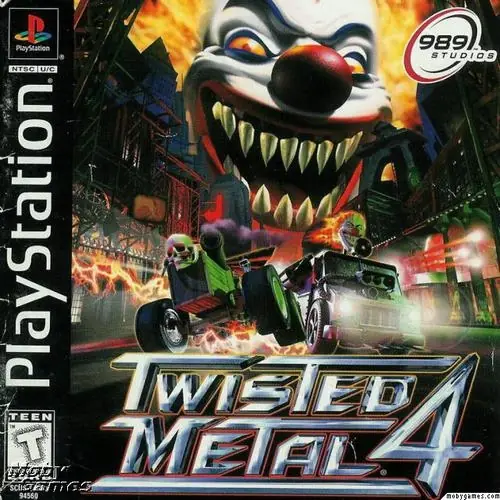
Twisted Metal 4 is a vehicular combat game in which the player selects an armed vehicle and fights other drivers in enclosed arenas until only one remains. The single-player Tournament mode has eight levels, with the player advancing by eliminating all opponents. At the end of each level, the player confronts a boss, usually an enhanced version of past contestants, with Sweet Tooth as the final boss. The player can be accompanied by a second human player or an computer-controlled ally.
The latter option allows the player to pool lives. The Deathmatch mode supports one-on-one or multiplayer contests against human or computer-controlled opponents.
Story
Twisted Metal begins as a traveling carnival led by Calypso, in which contestants fight in vehicles for a mysterious prize said to be a single wish, while those who lose forfeit their souls. Calypso claims the souls of defeated contestants, growing stronger with each one, and holds them in a ring. Sweet Tooth first encounters the carnival as a child and follows it until he eventually becomes a contestant. After proving successful in the competition, he wins and asks Calypso to make him the star of Twisted Metal. His desire for prominence eventually turns to envy, and he and a group of clown henchmen overthrow Calypso, taking control of the tournament and the ring.
Under Sweet Tooth, the competition again promises its winner a wish. Calypso enters as a contestant driving a nuclear missile launcher, seeking to reclaim the tournament and his ring. The playable contestants have separate endings based on their wishes rather than a single conclusion to the story. In Calypso's ending, he demands the ring after winning, but Sweet Tooth's henchman refuses to surrender it.
Development
989 Studios developed Twisted Metal 4 internally, having taken the series in-house for Twisted Metal III after original developer SingleTrac was sold to GT Interactive. The team did not receive the source code used for the first two games, which remained under SingleTrac's ownership. Jonathan Beard directed development and produced the game with Darrin Fuller and William Todd, while Jim Buck served as lead engineer and Chuck Doud as music director.
Programmer Michael Riccio recalled that the project had a development schedule of one year, with the team beginning to work longer hours and weekends after about six months. Buck said the changes to the arenas and handling addressed repeated criticism of Twisted Metal III, in particular its small stages, limited environmental interaction and tendency for vehicles to overturn. By September 1999, the vehicle physics had been revised to allow more airborne stunts, and cars showed visible damage when struck. Other planned additions included larger interactive arenas, new weapons and vehicles, stages made specifically for deathmatch, easier combination attacks and a larger role for Sweet Tooth.
Reception
Twisted Metal 4 received mixed reviews from critics, with an average score of 68% from 17 reviews on GameRankings. Reviewers for Game Informer, GameSpot and Official U.S. PlayStation Magazine welcomed its improvements over Twisted Metal III, particularly in its physics, level design and pacing. AllGame considered it an improvement over the third game, but it still preferred Twisted Metal 2. Reviewers for Electronic Gaming Monthly and GameFan were less impressed, criticizing the series for repeating a formula they felt had grown stale.
The controls and physics received differing responses. Game Informer praised the reduced tendency of vehicles to overturn, while IGN criticized their lack of weight and grip. Electronic Gaming Monthly and AllGame also reported that vehicles could become stuck against walls or other scenery. The larger arenas were praised for their varied layouts and interactive features, but GameRevolution found some later stages difficult to navigate.