
The articlegameplay, story, development, reception
Gameplay
Much of Utawarerumono's gameplay is spent simply reading the text that appears on the game screen, which represents either dialogue or narration from the protagonist's point of view. At times, the player will come to a "decision point" and may choose from a single or multiple options. Unlike many other visual novels, these choices do not affect the outcome of the story, but influence the order in which scenes play out.
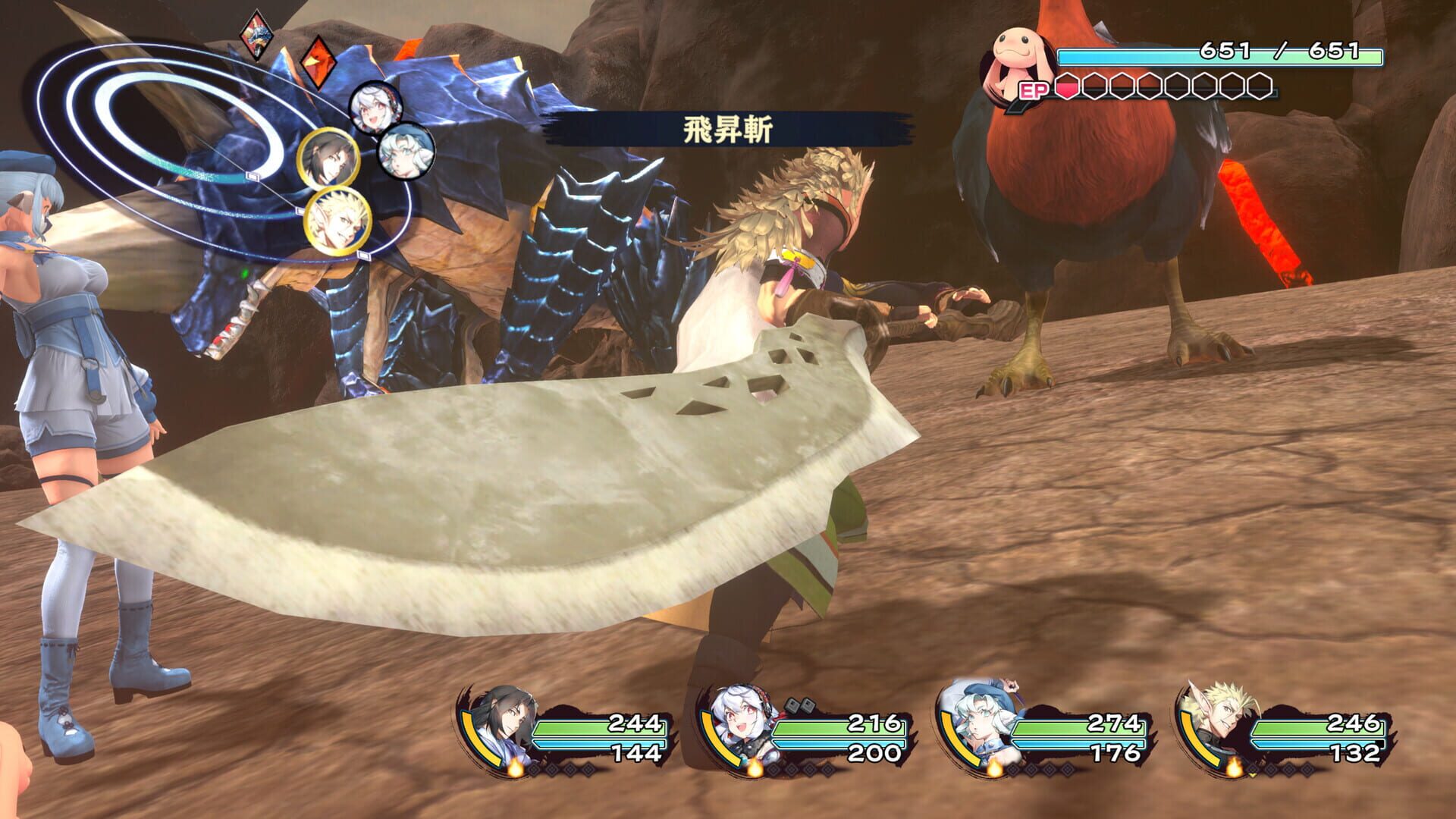
Utawarerumono also features a turn-based tactical role-playing battle system that centers on the player moving characters through a square-based grid to achieve objectives, which consist of either defeating a set number of enemies or moving one or all characters to a specific location. During each character's turn, the player may choose to have the character move, attack, or cast magic, of which only moving and attacking can be performed in succession, in that order. When a character attacks an enemy character, the player is given a chance to add additional attacks by clicking in the brief interval before a yellow circle on screen disappears. The number of attacks that the player can add to a character's attack is based on that character's current "technique" skill, and the maximum varies based on the character.
After adding a certain number of attacks, the character will perform a special finishing attack should they have the required abilities. As characters defeat enemies and participate in battle, they gain battle points which are used to increase their abilities.
At the start of the game, the player is given a choice of four difficulty levels, which affects the difficulty of the battles. After completing the game once, the player is given two even more challenging difficulty levels to choose from and may choose to skip the dialogue.
Story
Utawarerumono is a story centering around the masked protagonist, Hakuowlo, who one day is found by a family of two girls and their grandmother in a nearby forest close to their village. He is badly injured and is soon found to have amnesia, so they take him to their home and treat him until he is well again. Hakuowlo is soon accepted into their village where he stays and lives with them, but before long Hakuowlo finds that life in this village is being oppressed by the greedy ruler of the land their village resides in. When these actions escalate into disaster, Hakuowlo leads a rebellion that culminates in his assumption of the throne of a new country, born from the ashes of the old, and named Tuskur after the grandmother of the two girls who helped save his life.
After taking and consolidating power, Hakuowlo soon learns that peace is difficult to maintain, and finds himself fighting a series of bloody battles to protect the peace of his country and his people. Along the way, Hakuowlo meets strong warriors from other countries and tribes and welcomes them into his growing family. The passage of time brings both laughter and hardship, but with Hakuowlo leading the way, all others are confident in their future.
The story's genre is at first a fantasy-style story with heavy Ainu influence, but later develops science-fiction themes. While it initially appears to take place in a fantasy world full of magical beings and new species of humans, it is later revealed that it takes place in Earth's distant future.
Development
Washimi Tsutomu directed the Utawarerumono Windows game, Naoya Shimokawa was the producer, and Suga Munemitsu planned the scenario. Ama Tsuyuki provided the original character designs, and Matsuoka Junya, Takahiro Yonemura, and Shinya Ishikawa handled the music. Neko Iwashiro, Yokoo Kenichi, and Okawa Masato programmed the game. Lastly, AIC managed the production of the opening animation. Flight Plan helped in the development for the PlayStation 2 version.
The Utawarerumono series began as a Japanese video game for Windows on April 26, 2002, by Leaf and Aquaplus. A DVD-ROM edition was later released on December 12, 2003. The story was linear and contained no voice acting, and the original version of the game was never released outside Japan, although a fan translation patch for it exists. A PlayStation 2 port, titled Utawarerumono: Prelude to the Fallen (うたわれるもの 散りゆく者への子守唄, Utawarerumono: Chiriyuku Mono e no Komoriuta) and featuring a new battle system by Flight Plan (of the Summon Night series), was developed by Sting and released on October 26, 2006, in Japan.
This port introduced full voice acting and several other enhancements, including a new story arc, while adult graphics and scenes present in the original PC release were removed, and the game was rated for ages 15 and up. A PlayStation Portable version of the game, Utawarerumono Portable, was released on May 28, 2009. A remake for the PlayStation 4 and PlayStation Vita, also titled Utawarerumono: Prelude to the Fallen, was released on April 26, 2018, in Japan, and in May 2020 in the west by NIS America, with a Windows port published by Shiravune releasing on January 22, 2021.
Reception
Across the semi-monthly chart of top 50 best-selling bishōjo games sold nationally in Japan, the Windows version of Utawarerumono ranked first in the last two weeks of April 2004. It ranked second in the first two weeks and 27th in the last two weeks of May. It then ranked 16th and 29th in June before dropping out of the chart. The PlayStation version of the game sold over 82,000 units in four days. In an August 2007 survey conducted by Dengeki G's Magazine, Utawarerumono was voted the 15th most interesting bishōjo game by readers, tying with Kimi ga Nozomu Eien.
com, the six volumes of the DVD set for the anime adaptation of Utawarerumono were reviewed and rated by Chris Beveridge. He gave volume one a 'B+' rating, and praised the anime saying, "Over the course of the five episodes, the series drew me in more and more until I became completely engaged in it and wished I had not only the next volume but all of the volumes on hand. These episodes turn into "page turners" pretty quickly and do a very solid and entertaining job as the first chapter of a larger story." He also gave volumes two and three a 'B+' rating, volume four an 'A−' rating, and volume five and six an 'A' rating.
The anime received a mostly positive review from Stig Hogset of THEM Anime Reviews, saying, "A rather great fantasy piece. I can't really see it disappointing anyone." He gave Utawarerumono a four out of five star rating.
The tactical role-playing visual novel sequel, Utawarerumono: Mask of Deception, shipped over 100,000 copies on September 24, 2015, and sold 55,580 physical retail copies within its first week of release in Japan across PS3, PS4 and PS Vita platforms. Famitsu gave the game a review score of 32/40.
In the West, the PC releases of the sequel titles Utawarerumono: Mask of Deception and Utawarerumono: Mask of Truth were among the best-selling new releases on Steam in January 2020.