
The articlegameplay, story, development, reception
Gameplay
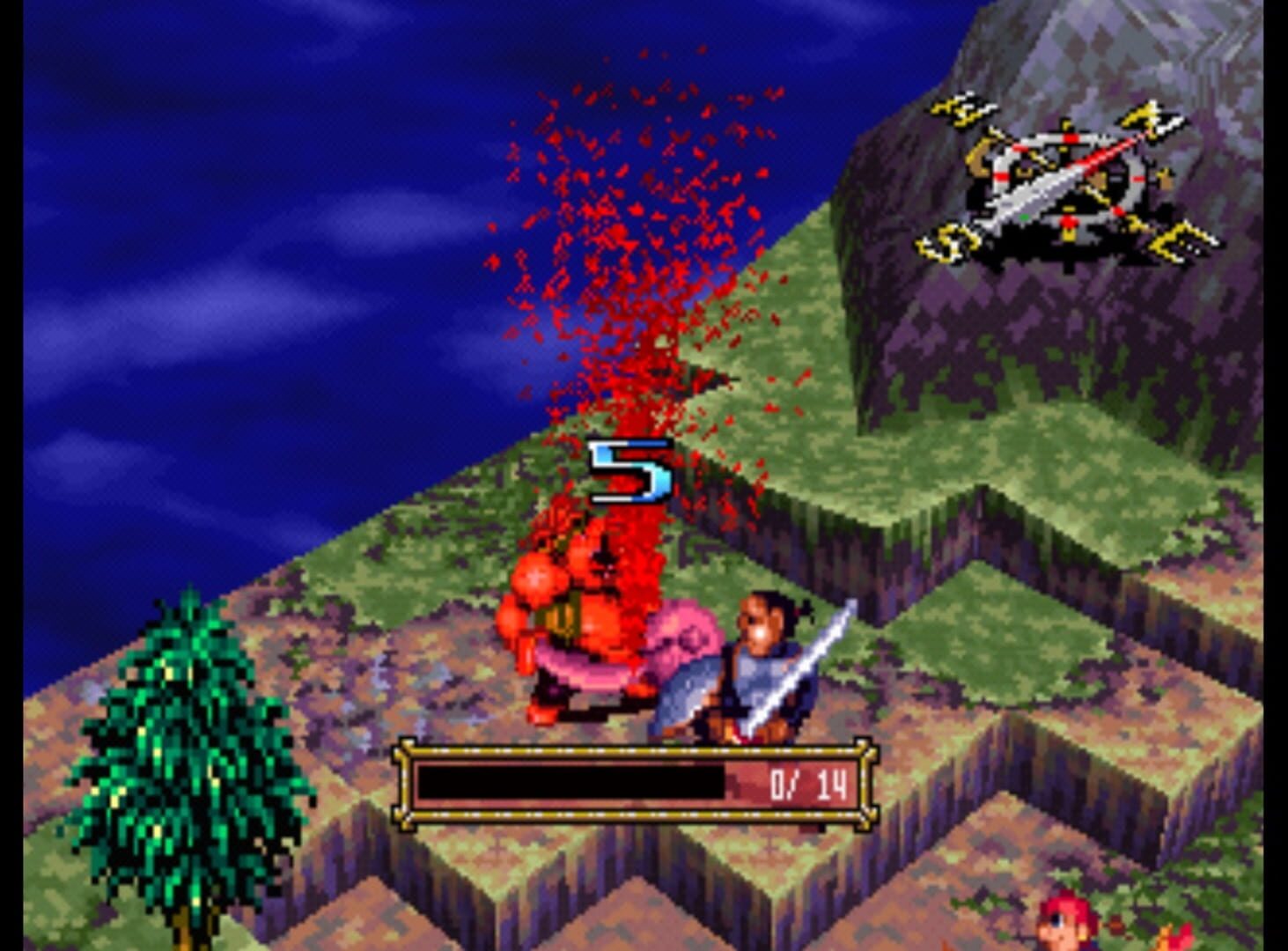
Gameplay is carried out through an isometric viewpoint. Battles are carried out on a series of grid maps, which include cells not accessible like water, trees and buildings. Although the environment is three dimensional with a perspective that can be rotated by the player, the characters are two dimensional sprites. A character's movement allowance for a turn can be used all at once or split, between two or more movements. Turns are on a side-by-side basis; the player moves all of their characters before the AI is allowed to take its turn.
Most stages are completed by killing all the enemy characters. Other stages have different victory conditions, such as killing one particular enemy character, moving characters to a specific location on the map, or killing certain enemies while saving others. In every battle, the death of the party leader results in an immediate loss. Losing other characters in the party causes the loss of gold.
Story
The descendants of Toroah the Messiah established the Holy Ashah Dynasty on Sostegaria, ruling through religion and military power. Arris the Sage led a rebellion, overthrowing the dynasty and forming the Republic of Ishtaria. The new republic faces challenges from corrupt officials.
Ash Lambert and his allies uncover a conspiracy involving General Magnus Dunbar and a magical stone. They confront Magnus and battle corrupt forces. Magnus reveals the stone's power and a plot against the government. Ash's group liberates Magnus and others, leading to confrontations with the Crimson Guard.
Reception
Vandal Hearts received primarily mixed reviews. Critics generally praised the incorporation of three-dimensional terrain and positioning into combat strategy, the sound effects, and the visual spectacle of the spells. However, most critics disapproved of the linear progression of the gameplay and story.
Reviews in both GameSpot and Next Generation likened Vandal Hearts to a bare bones reduction of the Shining Force games, eliminating the exploration, town wandering, and replay elements that had helped make those games classics. Next Generation nonetheless had a firmly positive overall assessment, arguing that "the lack of exploration is offset by the extremely engaging combat sequences." GameSpot instead considered it a "fatal flaw", and deemed Vandal Hearts a typical example of a fifth generation game with solid design and impressive graphics but less advanced gameplay than games of previous generations, though the reviewer highly praised the strategy involved in the battles. Robert Bannert at MAN!AC was positive about the game, but said it lacked depth and has little replay value. He cited the lack of hidden characters and an interactive storyline as weakness of the game, but praised the variety of the 3D terrain.