
- 60/100
- Players7 ratings
1987 · Toaplan · Platformer
Wardner
In Wardner, you take on the roll of a short, chubby guy whose name I am not
- Released
- 1987
- Platforms
- ArcadeFamicom Disk SystemFamily Computer Disk SystemSega Genesis
- Genres
- Platformer
- Developers
- Toaplan
- Publishers
- Taito
- Modes
- Single-player
- Perspective
- Side view
- Themes
- ActionFantasy
- Country
- Japan
- Age ratings
- GRAC ALL
About
Wardner is a 1987 platform game developed by Toaplan and published by Taito for arcades. Players assume the role of a child named Dover on a journey to rescue his kidnapped girlfriend Mia from the titular warlock. The game was later ported to the Famicom Disk System and Sega Genesis, with both ports featuring several changes and additions compared to the original version. Conversions for both the Nintendo Entertainment System and PC Engine were also in development but never released.
Wardner was met with positive reception from video game magazines since its release in arcades, though reviewers drew comparison with Capcom's Ghosts 'n Goblins due to its gameplay style, while the Genesis version was met with mixed reviews after launch. As of 2019, the rights to the title are owned by Tatsujin, a company founded in 2017 by former Toaplan member Masahiro Yuge, which is now an affiliate of Japanese arcade manufacturer exA-Arcadia, alongside many other Toaplan IPs.
›Story
The hero and his girlfriend got lost in the mysterious forest of Wardner. Suddenly the ruler of the forest, Wardner, transforms the heroes girlfriend and takes her deep into the forest. The hero sets out to traverse the forest to save his girlfriend.
Media

The articlegameplay, story, development, reception
Gameplay
Wardner is a side-scrolling action-platform game similar to Ghosts 'n Goblins and Rastan where players control Dover, the main protagonist, through five stages (six in the Genesis version) of varying themes set in a fantasy land. Dover must rescue his girlfriend Mia from the titular antagonist by defeating his servants, some of whom act as a boss at the end of a stage, in order to progress further on the journey.
Some of the levels featured are linear in nature, populated with obstacles and enemies, requiring the player to traverse the stage by running, jumping, climbing, shooting or dodging enemies. Other levels featured later in the game become more maze-like and exploratory, making the player take different routes to reach the end. Along the way, gold orbs can be picked up by defeating enemies to increase the player character's firepower, as well as money that is used in shops at the end of each stage to acquire protective items and new attacks, though some of them can also be obtained during the level.
Development
Wardner was released in arcades by Taito in 1987, while the North American version was distributed under the name Pyros. Osamu Ōta served as composer for the game's soundtrack under the alias "Ree", in one of his first video game roles prior to Twin Hawk and Snow Bros.. Former Toaplan composer Masahiro Yuge stated in a 2012 interview with Japanese publication Shooting Gameside that Ōta joined the company when their staff was small. Tatsuya Uemura stated in a 2009 interview that the project was created by Etsuhiro Wada and was also influenced by Wizardry. In June 1989, an album containing music from Wardner and other Toaplan games was published exclusively in Japan by Datam Polystar.
A port of Wardner for the Famicom Disk System, developed by Daiei Seisakusho, was released exclusively in Japan by Taito on 25 March 1988. A version for the Nintendo Entertainment System was developed and planned to be published by Sammy in North America under the name Pyross. This version was showcased to the public during the Summer Consumer Electronics Show 1990.
Reception
In Japan, Game Machine listed Wardner as the ninth most successful table arcade unit of October 1987, outperforming titles such as Arkanoid: Revenge of Doh and Black Tiger. Wardner was met with positive reception from critics, many of whom compared it to Capcom's Ghosts 'n Goblins. Mike Pattenden of Commodore User praised the presentation, visuals and challenge. Clare Edgeley of Computer and Video Games gave positive remarks to the gameplay and level design.
Likewise, both Robin Hogg and Cameron Pound from The Games Machine commended the visuals, action, and gameplay. Although Crash's Steve Jarratt and Julian Rignall noted its lack of originality, they praised the gameplay. Den of Geek, however, regarded it to be a solid but forgettable title from Toaplan.
Releases by platformdates and regions as published
Title IDsone per regional release, with its latest update
Box artone per regional release we hold art for
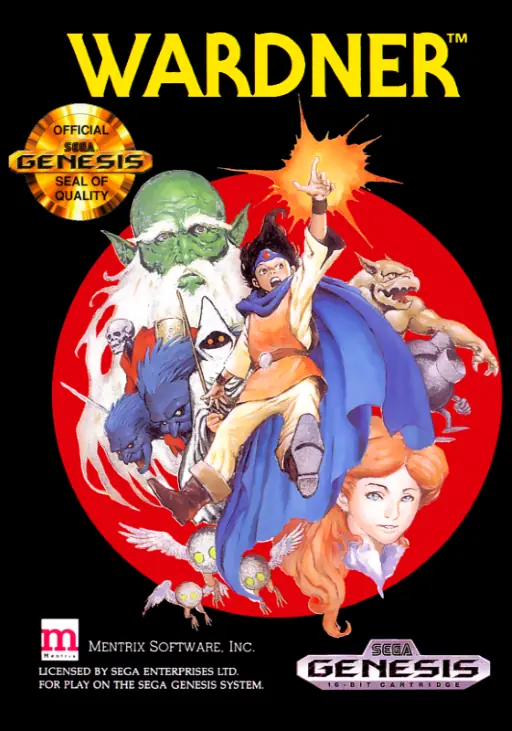
North America
Sega Genesis
Editions and related releases
- Included in
- Toaplan Arcade 2
Games like this
 85
Rayman Mini
2019 · iOS, macOS
Platformer · Often paired
 Sega exclusive71
Wiz 'n' Liz
1993 · Amiga, Sega Genesis
Platformer · Often paired
 77
New Zealand Story Revolution
1988 · Amstrad CPC, Arcade +8
Platformer · Often paired
 Nintendo exclusive
Mystery Quest
1987 · Port · Famicom Disk System, NES
Platformer · Often paired
 71
Rayman
2000 · Port · Atari Jaguar, Game Boy Advance +4
Platformer · Often paired
 Nintendo exclusive
Whirlo
1992 · SNES
Platformer · Often paired

Rayman 3: Hoodlum Havoc
2006 · Port · Digiblast, GameCube +5
Platformer · Often paired
 Nintendo exclusive72
The Magical Quest Starring Mickey Mouse
1992 · SNES
Platformer · Often paired
Collections3 collections
Platform libraries
- Famicom Disk System gamesGames
- Sega Genesis gamesLicensed games
Development status
- Cancelled NES gamesGames
Description adapted from its source, CC BY-SA 4.0.