
The articlegameplay, story, development, reception
Gameplay
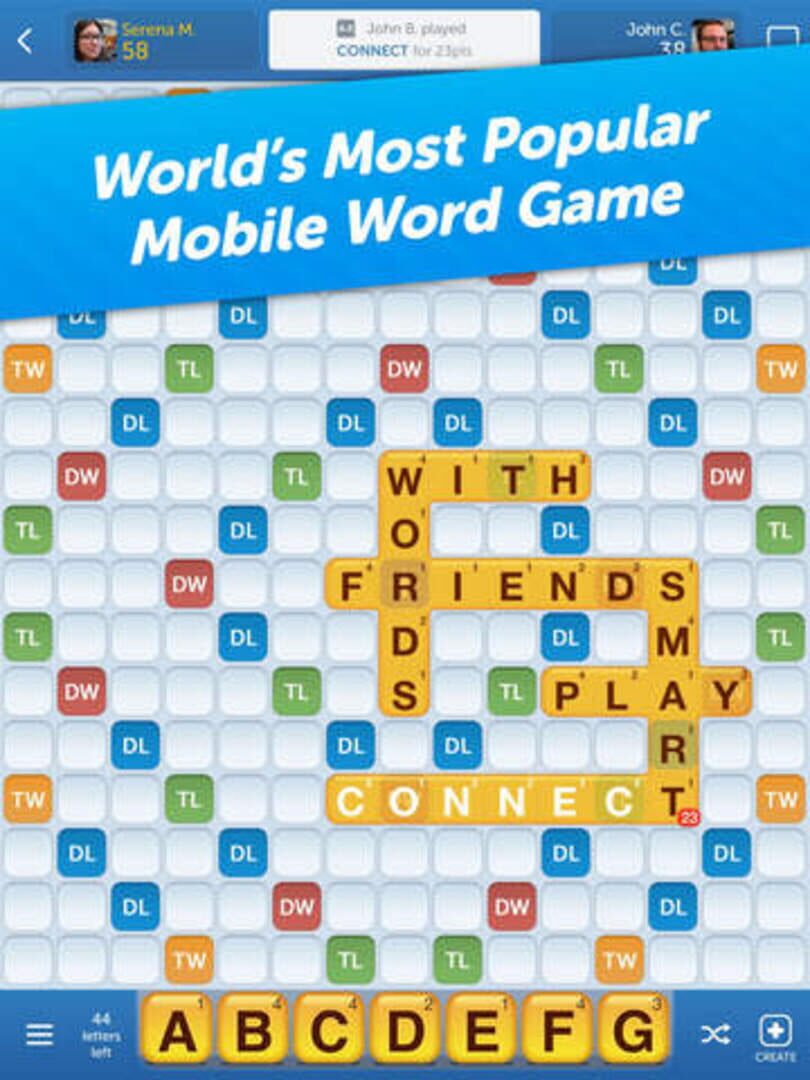
The rules of the game are mostly the same as those of two-player Scrabble, with a few differences such as the arrangement of premium squares and the distribution and point values of some of the letters (see Scrabble letter distributions and point values). Players are given seven randomly chosen letter tiles, which are replenished until all 104 tiles have been used. Players take turns forming words on the board or, instead of playing a word, may also choose to swap tiles with the pool of currently unused tiles or pass their turn. Players can form words either vertically or horizontally on the board. The player's aim is to score as many points as possible.
A letter placed on a DL or TL square doubles or triples the value of that letter on all words formed using that square. Similarly, the DW and TW squares double and triple the value of the new word(s) using that square. If a player uses all seven tiles on a single play (known as a bingo in Scrabble), 35 bonus points are added - this contrasts with the 50 bonus points in Scrabble. The different arrangement of premium squares can lead to scoring situations that would be rare or impossible in a typical Scrabble game. For example, it is possible to place a new word that simultaneously covers a triple letter score (TL) and a triple word score (TW), or a new word that covers a double word score (DW) and a triple word score (TW), which would be impossible or nearly impossible in a Scrabble game.
The game ends when a player plays every tile in his or her rack, and there are no remaining tiles to draw. The game also ends if three scoreless moves (i.e., passes or tile exchanges) are played in succession, unless the score is zero-zero. After playing the last tile, the opposing player will lose all the points equal to the amount of the remaining tiles. This number of points will be awarded to the player who played the last tile. At the end of the game, the player with the highest score wins.
There are various versions of Words With Friends. All versions allow players to resign their turn with the "resign" feature, pass their turn with the "pass" feature, swap out one or more tiles and forfeit the current turn with the "swap" feature, or look up what tiles remain with the "tile bag" feature. The "word strength" feature can be turned on or off, and enables players to see how strong their placed word is relative to all other word combinations available on the current board. In 2016, Zynga (temporarily) removed a feature called "hindsight" which allowed a player to pay for the opportunity to see what the highest-scoring moves on the board were after the play was made, but has since brought it back. In addition to the "hindsight" power-up, the game also offers other power-ups known as "swap+," "word radar," and "word clue."
Words with Friends accepts 173,000 words in the game. The word list used by the game is based on the Enhanced North American Benchmark Lexicon (ENABLE), with some additions from the developers.