
The articlegameplay, story, development, reception
Gameplay
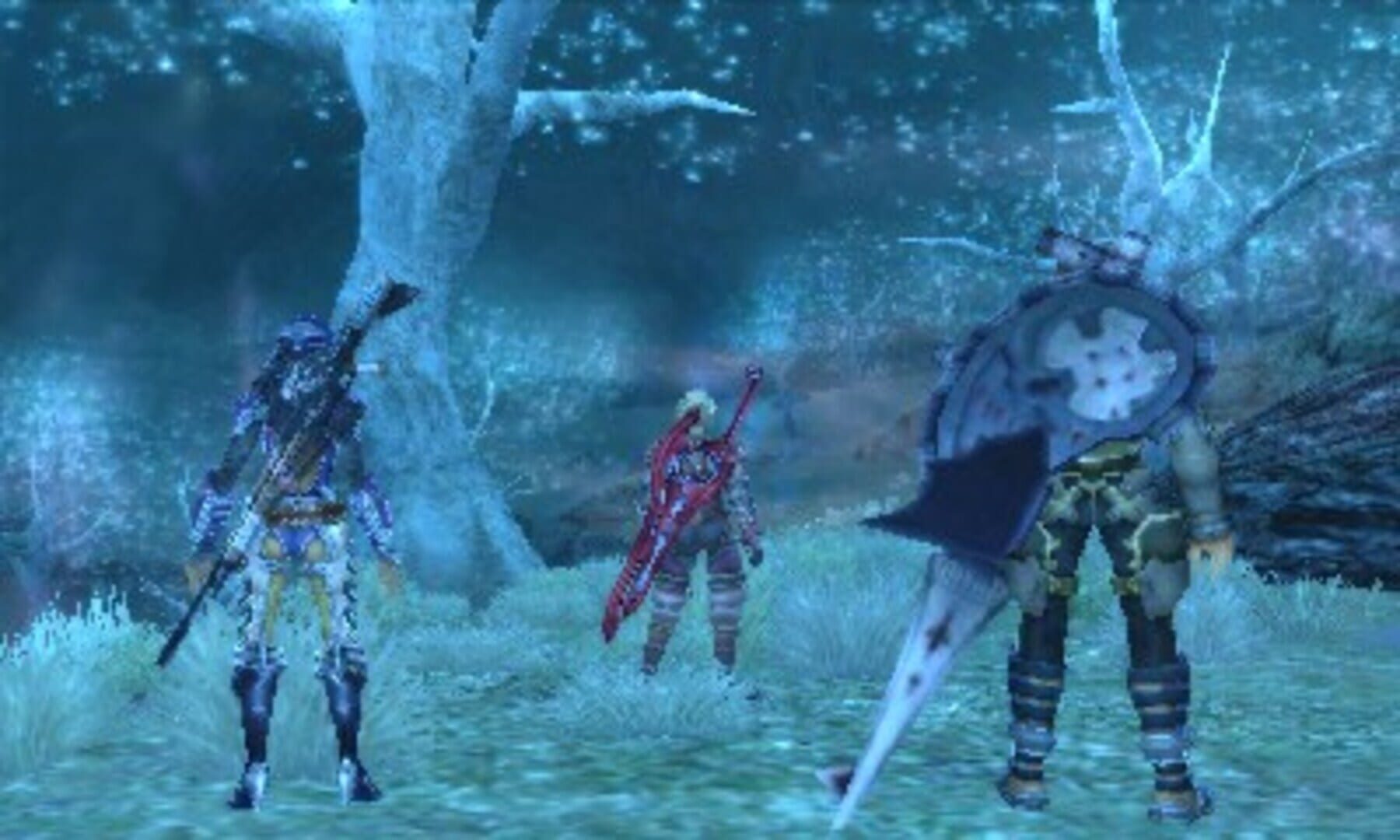
Xenoblade Chronicles is an action role-playing video game (RPG), in which the player controls one character out of a party of three using the Wii Remote and Nunchuk or the Classic Controller. The game employs an open world design, where players can freely navigate seamlessly interconnected environments. The game has a day-and-night time cycle, which often affects in-game events, quests, enemy strength, and item availability: for instance, stronger enemy types appear at night. While time flows automatically and a day cycle repeats about every ten minutes in real time, players can adjust the in-game clock to the desired time at any point.
Additionally, while the game is about exploration, areas called "Landmarks" aid in traversing the land by serving as warp points that allow the player to instantly return to that point at any time. The game also supports a "save anywhere" feature, where players can save at any point outside of battle. The game has a New Game+ mode, which maintains much of the player's progress from their initial playthrough into future playthroughs.
Story
The setting of Xenoblade Chronicles originates from a world that was nothing but an endless ocean until two titans, the Bionis and the Mechonis, came into existence and battled each other until only their frozen corpses remained. In the eons following their battle, they became the home for multiple forms of life. The Bionis is home to organic lifeforms, most prominently the humanoid Homs, who are virtually identical to humans in appearance and biology; the diminutive and furry Nopon; and the avian humanoid High Entia, whose lives span centuries. Conversely, the Mechonis is home to the mechanical humanoid Machina, whose lifespans span several millennia.
Life forms emit a substance known as ether, which can be used both as a form of magic and as a source of fuel. The Monado – the namesake of Xenoblade – is a mystical ether-controlling sword that the Homs wield in the battle against the Mechonis, which grants visions of the future to its wielder when fully controlled.
Development
Xenoblade Chronicles was developed by Japanese development company Monolith Soft, with Tetsuya Takahashi forming the original concept and serving as the game's executive director. In the 1990s, Takahashi had previously worked on Xenogears, then on the Xenosaga trilogy after founding Monolith Soft in 1999. Xenosaga was intended to be a six-part series, but low commercial performances caused the series to be halved. After these events, the entire development team was in a state of low morale.
The initial concept for Xenoblade Chronicles, of people living on the bodies of gigantic gods, came to Takahashi in June 2006. Struck by his idea, he immediately committed it to paper and showed the draft to other senior staff, who were favorably impressed. One of the staff, Yasuyuki Honne, thought that it would make a good 3D model and bought materials to create it. Construction began in July: during this period, younger staff acted as models so that Takahashi could establish which parts of the gods' bodies could be used as habitable and navigable environments in various poses.
Reception
Since its release, Xenoblade Chronicles has received critical acclaim with praise directed at its story, characters, themes, combat, music, voice acting, and scale, earning perfect scores from Digital Spy, Joystiq, GamePro and RPGamer, and near-perfect scores from most other video gaming websites and magazines. The game received "universal acclaim", according to review aggregator website Metacritic.
The story was cited by many as being innovative and enjoyable despite a fairly standard premise, while its open nature was seen as a welcome change for the genre: IGN critic Keza MacDonald said that she had been shocked out of expecting Japanese RPGs to be similar to the linear and story-driven Final Fantasy XIII. Its battle system and handling of quests also received praise, with the latter being seen as a great improvement for the genre due to its user-friendly workings. The one point that generally drew criticism were the graphics, with multiple critics disappointed that they lacked the polish of other contemporary consoles. IGN, Eurogamer and Edge Magazine cited the game as a triumphant comeback for the JRPG, and a prime example of the genre. The battle system, and to a degree its general gameplay, was favorably compared by multiple critics to that used in Final Fantasy XII.
Legacy
Shulk has been featured as a playable character in the Super Smash Bros. crossover fighting game series, appearing in its Nintendo 3DS and Wii U and Ultimate installments. Gaur Plain, a location in the game, appears as a stage along with several music tracks; one of the game's recurring antagonists, Metal Face, appears as a hazard on said stage; Dunban and Riki accompany Shulk during his Final Smash, with Fiora appearing as part of the Final Smash in Ultimate. Additionally, Riki appears as an Assist Trophy, using his own Arts to disrupt opponents. Fiora was later featured as a playable character in the crossover game Project X Zone 2, representing the Xeno series alongside Xenosaga character KOS-MOS, opposite Metal Face as an enemy character.
By using experience gained during development of Xenoblade Chronicles and listening to feedback on the game, Takahashi and the team began work on a spiritual successor for the Wii U. Titled Xenoblade Chronicles X, it was released worldwide in 2015. A parallel story for the Nintendo Switch, Xenoblade Chronicles 2, was released worldwide in December 2017, and Shulk and Fiora appear as optional Blades to recruit via the DLC expansion pass. Both Xenoblade Chronicles and Xenoblade Chronicles 2 received a sequel, Xenoblade Chronicles 3, in 2022.


