The articlegameplay, story, development, reception
Gameplay
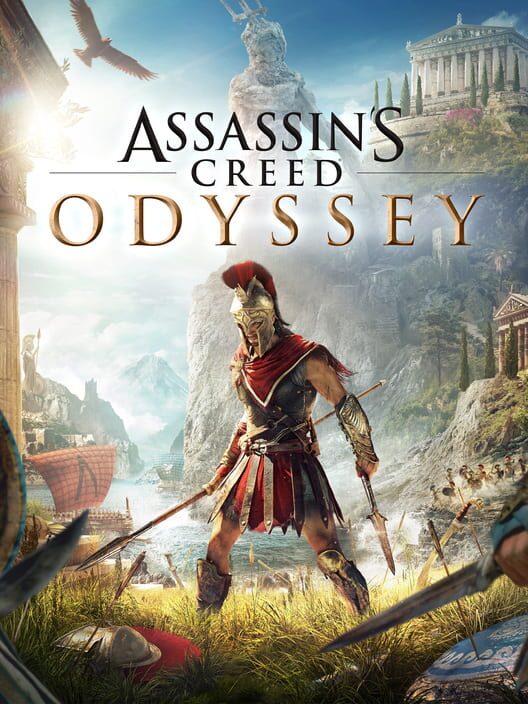
Assassin's Creed Odyssey is an action role-playing video game played from a third-person perspective. At the beginning of the game, the player can select to play as either Alexios or Kassandra, Greek mercenaries and descendants of the Spartan king Leonidas I. In addition to completing the story campaign, players can freely explore a large open world set in Greece on foot, boat, or on horseback. As the player explores the world, they will encounter various non-playable characters (NPCs) who give players side missions to complete.
They also discover locations of interests, clear out fortresses and camps, explore tombs and shipwrecks, and collect hidden treasures. Synchronization points in various landmarks in Greece, which serve as fast travel points, can also be unlocked. Players can also collect special collectibles and various crafting resources, such as iron ore, wood, leather, metal, and precious gems, through exploration and hunting wildlife. Other side activities players can undertake include competing in a gladiatorial arena and completing time-limited bounties and contracts.
Unlike the previous games in the series, Odyssey offers two modes of gameplay: Guided mode shows the player the locations of their objects immediately using waypoints, while Exploration mode tasks players to find out the locations themselves after being given brief clues from other NPCs.
While the main campaign missions follow the mercenary as they reunite their family and stop the Cult of Kosmos, additional questlines task the players to defeat mystical creatures from Atlantis and take down cultists. As the game is set during the Peloponnesian War, Athens and Sparta control various parts of Greece. An area can be weakened if the player assassinates the nation leader, defeats members of their army, burns down war supplies, or pillages their nation chests. When a region is weakened, players can join a conquest battle to aid either the attacking or the defending side.
Winning a battle will earn the player valuable loot, gear and experience points. Joining the attacking team is a more challenging experience but it will offer more gameplay benefits. A bounty is placed on the player character if they commit a crime such as stealing or hurting an innocent bystander in public. NPCs called Mercenaries will then arrive to hunt the player character, who can either kill the mercenary, pay the bounty, or assassinate the character who placed the bounty on them.
Each area has a recommended level. The player may be easily overpowered if they venture into an area too early. However, the game's difficulty is scaled in accordance to the player's level. When interacting with other NPCs, players can select various dialogue options, including the option to develop a romantic relationship with particular NPCs.
At key moments of the game's campaign, players make crucial decisions which can affect the course of the story and lead to several different endings.
There are two modes of melee attack—light attacks are fast but weak, while heavy attacks are slow but strong. Players can also dodge enemy attacks, or parry them. The player character can use different types of melee weapons such as spears, heavy blunt weapons, daggers, swords, and bows and arrows to defeat enemies. The player may choose to equip armour, boots, helmets and gloves.
The game features a weapon and gear system in which each weapon and piece of armour the player wears has different statistics and effects which provide a range of advantages. These can be equipped and upgraded individually, with additional gameplay benefits imbued into the weapons through engraving. The strength and power of these weapons depend on their level as well as their rarity. The rarer the weapon, the more powerful it is, and the cost of upgrading it scales to its level.
The player character also commandeers a warship named Adrestia to explore the Aegean Sea. Players can launch arrows and javelins against hostile ships, cleave opponent ships directly, and command the crew to brace when they are attacked. When the health of enemy ship is nearly depleted, the player character can initiate naval boarding. Successful boarding provides the player with additional resources and restores the health of the Adrestia.
The ship is upgradable; the player can improve the strength of the hull, boost the stamina of the rowers and customize their crew. While the player is exploring the sea, they may encounter Alpha ships, which are essentially enemy bosses that the players can defeat, as well as other mercenaries if the player's bounty is high enough.
Stealth and open combat are equally viable choices for completing objectives. The player can use Leonidas' spear to silently assassinate enemies, or knock them out in order to recruit them to join the player's crew. The bodies of incapacitated enemies can be hidden to avoid alerting other enemies. The player can also call Ikaros, a golden eagle companion, to scout an area by highlighting enemies and objects.
The player character also has the ability to draw an enemy's attention by whistling. As with other Assassin's Creed games, the player character is an expert in free running and can climb nearly all structures. As the player completes quests, they earn additional experience points (XP), which allows the player to unlock new skills and abilities. The three skill trees are "hunter," which focuses on ranged attacks through the use of a bow & arrow, "warrior," which focuses on weapons-based combat, and "assassin," which focuses on stealth and silent take-downs.
Examples of the skills the player can unlock include "Spartan Kick", which can knock an enemy back, and "Rush Assassination", which allows the mercenary to throw Leonidas' spear from afar against enemies. Some skills have a cooldown time, and others can only be used when the player's adrenaline bar fills up. This can be achieved by inflicting damage or dodging and parring attacks.
Story
As with previous games in the series, Odyssey features a narrative set in the modern-day, which follows Layla Hassan, an Assassin and former Abstergo researcher who was introduced in Origins. Assisted by fellow Assassins Victoria Bibeau, Kiyoshi Takakura, and Alannah Ryan, Layla's goal is to find the Staff of Hermes Trismegistus and the lost city of Atlantis by using data processed by her portable Animus device. The device recounts a secret mythological history set during the Peloponnesian War, which was fought between the city-states of Greece. The game's historical plot is set in 431–422 BC, four centuries before the events of Assassin's Creed Origins and the creation of the Hidden Ones, the forerunners to the Brotherhood of Assassins.
The game's main storyline follows the player character, the elder of two siblings known as the Eagle Bearer, a legendary mercenary with Ikaros as a constant companion. As a child, the Eagle Bearer was exiled from Spartan society after they attempted to stop a Spartan elder from throwing their younger, infant sibling from Mount Taygetos at the urging of the Pythia, who determined that the child, if allowed to live, would be responsible for the potential glory or downfall of Sparta. As punishment for inadvertently sending the Spartan elder falling to his death, they were thrown off the mountain by their father Nikolaos, who was compelled to do so by the Spartan leadership. They survived the fall and ended up in the care of a con man named Markos, based in Kephallonia, where they work various odd jobs under his direction.
As a wandering mercenary or misthios, the Eagle Bearer has opportunities to fight for both the Delian League, led by Athens, and the Peloponnesian League, led by Sparta. In conjunction with the Eagle Bearer's attempts to reunite their fractured family, parallel quest lines deal with the destruction of the Cult of Kosmos (a secret organization spanning the Greek world) and the discovery of artifacts and monsters from Atlantean times.
The game features a number of historical personages players can encounter and interact with, including Alkibiades, Aristophanes, Euripides, Democritus, Sokrates and many others. It also includes historical and mythical Greek locations such as the Agora of Athens, the statue of Zeus at Olympia, Lesbos, and Macedonia. The game features several creatures from Greek mythology, such as Medusa, the Cyclops, the Sphinx, and the Minotaur, depicted here as experiments of the Isu, the same race that created humanity and most of the artifacts encountered throughout the series.
Odyssey's story begins in 480 BC, where King Leonidas leads the Spartan army against a Persian charge during the Battle of Thermopylae. The skirmish is won, but a captured enemy informs Leonidas that the Persian army has learned of the mountain path and will surround the Spartans by morning. Nevertheless, Leonidas resolves to hold off the Persian advance.
In 2018, Layla Hassan recovers Leonidas' spear. She extracts the DNA of his grandchildren, Alexios and Kassandra, from it to use in her Animus to find the location of the Staff of Hermes Trismegistus. Whichever sibling is selected by the player is designated as the Eagle Bearer.
In 431 BC, at the onset of the Peloponnesian War, the Eagle Bearer is hired by a mysterious merchant named Elpenor. The plot is to assassinate the "Wolf of Sparta" in the city of Megaris. After befriending a naval captain named Barnabas, the Eagle Bearer leaves Kephallonia having been given command of his ship, the Adrestia. In Megaris, the Eagle Bearer learns that Nikolaos is not their biological father and has another adopted son, Stentor.
They also learn that their mother Myrinne left Nikolaos and Sparta shortly after the incident at Mount Taygetos. The Eagle Bearer travels to Phokis to confront Elpenor, who reveals himself to be a member of the Cult of Kosmos, who are aware of their lineage. Disguised in Elpenor's mask and robes after killing him, the Eagle Bearer infiltrates a secret Cult meeting in Delphi, where they discover that not only is the Cult targeting their family, but their younger sibling had survived the fall from Mount Taygetos and subsequently manipulated by the Cult into becoming their champion known as Deimos. Accompanied by Barnabas and Herodotos, the Eagle Bearer embarks on an extended journey across the Greek world.
Eventually they reunite with Myrinne, who had assumed the alias of Phoenix, the oligarch of the polis of Naxos. Myrinne persuades her eldest child to convince the Spartan regime to reinstate their citizenship and ancestral estate, while they continue to undermine the Cult's activities in the Greek world together.
At the Battle of Pylos, The Eagle Bearer meets Deimos. The encounter leads to a fight which results in The Eagle Bearer's capture. They are taken to Athens, where the Cultist Kleon enjoys popularity as leader of the city-state following the death of his rival Perikles years prior. Thwarting Kleon's plans, The Eagle Bearer escapes captivity with the help of their Athenian allies.
At the Battle of Amphipolis, The Eagle Bearer joins Brasidas' Spartan forces to confront Kleon's Athenian army. During the battle, the leaders of both armies die, ushering in the end of the first half of the Peloponnesian War. Afterwards, the Eagle Bearer returns with Myrinne to Mount Taygetos to confront Deimos. Depending on key decisions made by the player at predetermined points of the game's narrative, the Eagle Bearer either redeems or kills Deimos.
Their actions have a direct bearing on the fates of their extended family members and determines whether they will have a successful family reunion for the main plotline's epilogue.
After eliminating the Cult, the Eagle Bearer returns to the sanctuary in Delphi, where they find the Cult's pyramid-shaped artifact and Aspasia, who reveals herself to be the Cult's original leader. Disgusted by what the Cult had become as a result of Deimos' influence, Asp
Development
Assassin's Creed Odyssey was developed by Ubisoft Quebec. Development of the game commenced shortly following the release of Assassin's Creed Syndicate (2015). The game marked the transformation of Assassin's Creed from an action-adventure stealth game to an action role-playing game, a transition that began with Assassin's Creed Origins (2017), developed by long-time series developer Ubisoft Montreal. Origins marked the series' transition into a larger open world with a larger emphasis on player's progression, while Odyssey further facilitated this transition by introducing role-playing elements and choices.
Origins was released a year earlier than Odyssey, and this allowed the Quebec team to incorporate changes to the game after listening to players' feedback. Similar to other Ubisoft games, numerous other developers from around the world participated in the game's development. The game was co-developed by Ubisoft's studios in Montreal, Bucharest, Montpellier, Singapore, Shanghai, Chengdu, Kyiv, and Pune. External studios including Spearsoft and Technicolor also provided additional assistance.
The game was declared gold on September 14, 2018, meaning it was being prepared for duplication and release.
Similar to other games in the series, Odyssey was inspired by history. Ancient Greece was one of the most requested regions by fans, and the era of the Peloponnesian War was chosen as the setting because it allowed the team to introduce well-known historical figures such as Socrates, Leonidas and Hippocrates. The works of Herodotus, considered the first historian in the Western world, served as an important inspiration and foundation for the team when they were creating the game's world and story. To ensure that the game feels historically authentic, the development team initially examined mainstream depictions of Ancient Greece, including films, paintings, and video games, and later embarked on a ten-day field trip to Greek locations including Sparta, Delphi, Olympia, and Athens.
Three scouting groups accompanied by historians took more than 13,000 photos and videos during their field trip for research, and later the team made use of Google Street View to study Greek ruins. As a result, the game's art style intentionally deviated from popular depictions of ancient Greece, often filled with desaturated and monochromatic colors, with each game region instead having a rich and unique visual characteristic. The team was divided into a world design team, focused on making the world as historically accurate as possible, and a level design team, focused on what was most enjoyable for the players. Both teams were guided by Stéphanie-Anne Ruatta, an in-house historian for Ubisoft.
In addition, the team consulted historians in the UK, Canada, and Greece.
Despite this, some parts of the game deviated from history. For instance, while real-life Spartans led minimalist lifestyles, the team added a lot of landmarks and decorations to Spartan cities in an effort to make them grander and more warrior-like in order to align with players' expectations. As some of the locations were already destroyed in real life, the designers created these buildings and landmarks themselves. Since the game was set farther in the past than most of the other games in the series, the team had much less material to rely on and had to introduce more original characters.
As the game is set in ancient Greece, the team felt compelled to feature Greek mythology predominantly in the game. The monsters that Heracles encountered in his adventures were used as the foundations for the creatures featured in the game. Sphinx, the Cyclops, the Minotaur, and Medusa were chosen as bosses as the team believed that they were the most well-known monsters from the Greek mythology. According to Ruatta, Greece's status as the birthplace of democracy and philosophy was contrasted with landmarks based on Greek gods and mystical figures.
This contrast helped reflect the conflict between "chaos" and "order," which is a central theme established throughout the Assassin's Creed series.
According to world director Mel MacCoubrey, the game is an "epic Greek tragedy" and features a personalized story about "a family that has been torn apart". MacCoubrey described the two potential player characters as "compassionate," "strong-willed," and "passionate". The story also discusses how the two characters, Alexios and Kassandra, find their place in the world and transcend to the status of Greek heroes. Alexios and Kassandra were portrayed by Michael Antonakos and Melissanthi Mahut respectively.
Antonakos joined the cast before Mahut. The two met each other in Quebec City and discussed the two characters' perspectives of the Greek world and their family ties. During the audition process, the team were looking for Greek actors, or actors with Greek ancestry. Elias Toufexis was chosen to portray both Leonidas and Nikolaos.
During his audition, he was asked to read out a script from The Godfather with a Greek accent instead of the game's actual script to ensure that the game would not be leaked early. In 2020, a report from Bloomberg alleged that plans for leading female characters in multiple Assassin's Creed games were scrapped or minimised due to a perception that games won't sell without a strong male lead. Odyssey's team originally pushed for Kassandra to be the sole lead character but was told that wasn't an option. The team also added romantic interests into the game.
According to creative director Jonathan Dumont, the romance featured in the game was optional and the tone was kept relatively light-hearted. Characters can be romanced regardless of the gender of the player characters. While the team believed that these options made the players' journey more personalized, it is up to the player to decide if they want to pursue a relationship.
To add player's agency, players need to make important choices during certain points of the game. The team created mor