
The articlegameplay, story, development, reception
Gameplay
Arkham Origins is an open world action-adventure game incorporating stealth game tactics. Batman can use his cape to glide around Gotham City and the grapnel gun's retracting rope to attach to hard-to-reach ledges and extend his flight. Some gadgets from previous Arkham games are present at the start of Arkham Origins, while others become available during play. Returning gadgets include the Cryptographic Sequencer, used to hack security consoles; the Batclaw, used for hooking onto surfaces; the Batarang, a throwing weapon; the Remote Batarang, its remote-controlled counterpart; Explosive Gel, used to destroy weak surfaces and knock down enemies; Smoke Pellets, used for stealthy exits and entrances; the Disruptor, which can remotely disable guns and explosive mines, and the Grapnel Accelerator, an earlier version of the Grapnel Boost. New equipment in Batman's arsenal include the Remote Claw; this allows Batman to target two objects and pull them together, allowing him to throw enemies into each other or hit them with objects (tethering two walled points creates a tightrope for Batman to cross); Shock Gloves, which allow Batman to block electric attacks, disable some enemies and stun shielded ones, and short-circuit objects, and the Concussion Detonator, capable of stunning large enemy groups.
The game introduces a fast travel system, allowing Batman to remotely summon his plane (the Batwing) to transport him to other areas of the game world quicker than gliding or grappling could. Enemy tower installations prevent Batman from summoning the craft in some areas and must be disabled to make the Batwing (not player-controlled) available. Some towers may be disabled only when the player has the necessary equipment.
Players can traverse enemy-controlled areas by stealth or combat. Using an enhanced version of the series' Freeflow combat system, combat introduces a tracking system assessing the players' efficiency and highlighting battle achievements (such as avoiding damage and using gadgets). Chaining attacks to maintain momentum, performance is rewarded with experience points. These points can be used in a branching upgrade system to enhance Batman's abilities and gadgets, allowing players to upgrade several paths or specialize in one.
Enemy attacks are prompted with a warning icon, indicating that the attack can be countered. Enemies are armed with weapons such as knives, lead pipes, and shields. The game introduces new enemy types: the Martial-Artist (capable of blocking, evading, and countering Batman's attacks), the Armored Enforcer (invulnerable until he is dazed and de-armored) and Venom-infused henchmen (who possess superhuman strength, allowing them to grapple Batman and launch attacks which cannot be countered). Some enemies are armed with guns, which can damage Batman, and a player can use stealth predatory tactics to tilt the odds in their favor.
Many areas feature stone gargoyles or high outcrops, helping Batman remain concealed while setting traps and knocking out enemies.
The game emphasizes Batman's detective skills; for example, he can scan a crime scene with Detective Vision (displayed in first-person perspective) to highlight points of interest; holograms act out theoretical scenarios of the crime. The crimes can be reviewed via Batman's link to the Batcomputer in the Batcave; this allows a player to view virtual recreations of the scene from different angles (with the ability to move back and forth through the crime's timeline), view it in slow motion or pause while looking for clues to solve the crime. Small (and large) crime scenes are distributed throughout Gotham City. Reviewing the downing of a helicopter, Batman is presented with false and accurate clues; investigation of the scene can reveal that the helicopter was shot, allowing Batman to trace the bullet's trajectory to a murdered police officer and another crime scene.
When a crime is solved, the player is shown a Batman-narrated rundown of the crime. The Batcave is also a hub where Batman can change costumes, upgrade his equipment and access challenge maps to practice combat (these maps were accessed separately in previous games). After completing the story mode a New Game Plus mode is unlocked, enabling a player to replay the game with all their acquired gadgets, experience, and abilities; enemies are tougher, and the icon warning players of attack is disabled. Completing New Game Plus unlocks I Am the Night mode, where the game ends if Batman dies.
Arkham Origins offers side missions, including Crime in Progress (where Batman can assist the Gotham City Police Department (GCPD) by rescuing police officers from a gang or keeping an informant from being thrown to his death). Most Wanted allows Batman to pursue villains outside of the main story (such as Anarky, who plants bombs around the city). The Dark Knight system offers tasks of escalating difficulty which improve stealth and combat. Batman's radio scanner also allows him to locate side missions; completed missions are rewarded with experience points and upgrades to Batman's equipment.
The game features collectible objects and puzzles similar to the Riddler challenges of previous games (orchestrated by Enigma before assuming his Riddler identity). Collectible objects appear, similar to those in previous games. A "1 vs. 100" mode in the game's challenge maps challenges the player to survive in combat against 100 increasingly difficult enemies.
On compatible systems, the Windows version uses Nvidia's PhysX software engine to produce more realistic, dynamic interactions with the game world. With PhysX enabled, some areas contain additional snow or fog (which reacts to Batman moving through it); with PhysX disabled, the effects are lessened or absent.
Arkham Origins introduces a multiplayer component to the series. Invisible Predator Online revolves around a gang war between supervillains Joker and Bane, in one of four choosable maps voted by players before e
Story
Arkham Origins features a large ensemble cast of characters from the history of Batman comics. The main character is Batman (Roger Craig Smith), a superhero trained to the peak of human physical perfection and an expert in martial arts who is aided by his butler, Alfred Pennyworth (Martin Jarvis). Arkham Origins brings Batman into conflict with sadistic, brutal crime lord Black Mask (Brian Bloom). The most powerful man in the city and ruler of Gotham's criminal underworld, Black Mask has vast wealth and resources, has eliminated his opposition and is consolidating his power.
His ebony mask conceals his identity, allowing him to operate publicly as Roman Sionis (head of Janus Cosmetics). Black Mask has a bounty on Batman, which attracts eight accomplished assassins: the physically imposing Bane (JB Blanc); expert marksman Deadshot; veteran mercenary Deathstroke (Mark Rolston); poisonous contortionist Copperhead (Rosa Salazar); the pyromaniac Firefly (Crispin Freeman); the highly charged Electrocutioner (Steve Blum); deformed criminal Killer Croc (Khary Payton), and master martial artist Shiva (Kelly Hu).
Batman is considered an outlaw by the Gotham City police, and is pursued by Captain James Gordon (Michael Gough), Detective Harvey Bullock (Robert Costanzo) and corrupt GCPD officials Commissioner Gillian B. Loeb and SWAT team leader Howard Branden. Other characters include the psychopathic Joker (Troy Baker); black-market weapons dealer Penguin (Nolan North); the mind-controlling Mad Hatter (Peter MacNicol); anti-government, anti-corporate anarchist Anarky (Matthew Mercer); rogue hacker Enigma (Wally Wingert); Alberto Falcone; Gordon's teenage daughter Barbara, and Blackgate warden Martin Joseph (Khary Payton). The story takes place before Batman's partnership with Robin (Josh Keaton)—although Robin is a playable character outside the main story—and before Barbara becomes Batman's ally, Oracle.
Dr. Harleen Quinzel (Tara Strong), Gotham News Network (GNN) reporter Vicki Vale, Amanda Waller (CCH Pounder), Quincy Sharp (Tom Kane), and Calendar Man make cameo appearances in the game. Mr. Freeze (Maurice LaMarche) appears in the downloadable content, Cold, Cold Heart.
The events in Arkham Origins take place about eight years before Batman: Arkham Asylum, in midwinter Gotham City. Batman, an experienced crime-fighter in the second year of his career, is not yet the veteran superhero of Arkham Asylum and Arkham City. He is a mysterious force; even the police do not know whether he is a vigilante, a myth or a supernatural being. Batman has fought ordinary criminals and gangsters and is accustomed to being stronger and faster than his opponents.
However, on a snowy Christmas Eve he is confronted with more dangerous foes: eight professional assassins hoping to collect a $50-million bounty placed on Batman's head by Black Mask. Villains (including the Joker) take advantage of the assassins' arrival to launch their schemes, and Black Mask's henchmen instigate a rise in crime and gang activity in the city.
The Gotham City Police Department is aware of "the Batman", and does not condone his approach to crime-fighting. Led by Commissioner Loeb, the GCPD is thoroughly corrupt; Branden and his SWAT team are hunting for Batman to claim the bounty for themselves. The incorruptible Captain James Gordon is one of the most unpopular members of the force. Batman's relationship with Alfred is strained; the butler, an overbearing parental figure, reminds him of his parents' deaths and Alfred sees Batman as a spoiled child squandering his inheritance on a vigilante crusade.
Old Gotham, the section of Gotham City which will become the Arkham City prison, is not yet walled off and has slums, low buildings, a shopping mall, and docks (where Penguin's ship the Final Offer is moored). On the Final Offer, Penguin has added a casino, a fighting pit, and a sales floor with weapons and ammunition. Across the bridge from Old Gotham is New Gotham, a modern metropolitan area filled with towering skyscrapers.
On Christmas Eve, Batman intervenes in a jailbreak at Blackgate Penitentiary led by Black Mask, who executes Police Commissioner Loeb before escaping. Left to battle the assassin Killer Croc, Batman prevails but learns Croc is only the first of eight killers drawn to Gotham by a $50 million bounty Black Mask has placed on him. Seeking Black Mask's whereabouts, Batman tracks the Penguin to his ship, where he defeats Deathstroke and Electrocutioner. Penguin reveals that Black Mask has allegedly been murdered at an apartment complex. Investigating, Batman discovers the victim was an impostor and that the crime involved a criminal known as the Joker.
To learn more, Batman infiltrates the GCPD to access its criminal database. While escaping, he encounters Captain James Gordon—who is distrustful of Batman—and a corrupt SWAT team eager to collect the bounty. With advice from Gordon's daughter Barbara, Batman accesses the sewers beneath the precinct to establish permanent database access, where he finds Black Mask's men planting explosives. Using the database, he deduces that Black Mask has been kidnapped by Joker, who is targeting the Gotham Merchants Bank.
At the bank, Black Mask unmasks himself as the Joker, revealing he had assumed Sionis's identity days earlier to seize his empire and impose the bounty. Batman pursues him to the Sionis Steel Mill, where he frees the real Black Mask and defeats Copperhead.
Tracking the Joker to the Gotham Royal Hotel, Batman finds the building rigged with explosives, its staff murdered, and guests taken hostage. Joker mocks the assassins for failing to kill Batman, throwing Electrocutioner to his death. Batman claims his electric gloves and continues through the hotel. While most assassins depart, Bane remains, anticipating Batman will come to the Joker.
On the rooftop, Batman battles Bane; worried for his safety, Alfred alerts the police so they will intervene. Bane flees by helicopter,
Development
By July 2012, Warner Bros. Interactive Entertainment (WBIE) was planning Rocksteady Studios' next Batman game as a prequel based on the Silver Age of Comic Books, featuring Superman, Wonder Woman, Green Lantern, and the Flash. The game would explore Batman's first confrontation with the Joker, with a release date no earlier than 2014. In August 2012, Paul Dini said he would not be involved in writing a sequel to Arkham City.
He did not write any of that game's downloadable content (including the story-based Harley Quinn's Revenge DLC) and said that Warner Bros. and Rocksteady suggested he accept other work if offered. Dini added that he had taken on other projects, preventing his involvement until 2013. In February 2013, it was reported that a new game in the Batman: Arkham franchise would be released by a developer other than Rocksteady.
The development of Batman: Arkham Origins began in late 2011 by Canadian development studio WB Games Montréal (WB Montréal), and the game was announced on April 9, 2013. WB Montréal was chosen to develop the game given the amount of time Rocksteady, developer of the first two Arkham games, needed to create Arkham Origins's successor, Batman: Arkham Knight, which would have resulted in "a long time without an Arkham game." WB Montréal had worked on the Wii U adaptation of Batman: Arkham City, familiarizing itself with the modified Unreal Engine 3 development engine used by Rocksteady. WB Montréal decided not to heavily modify the established combat system (believing it already worked well) but introduced new enemy types with opportunities for new tactics and combat moves to defeat opponents.
The plot was partly inspired by the comic-book series Batman: Legends of the Dark Knight and the graphic novel Batman: Year One, detailing the first year of Batman's career, with Arkham Origins described as a "Year Two" story. Parts of the plot (such as Batman's relationships with the Joker, Gordon, and the game's Christmas setting) was partly inspired by Batman: The Man Who Laughs, Batman: Turning Points, and Batman: The Long Halloween, respectively. The story is written by Dooma Wendschuh, Ryan Galletta and Corey May, with input from DC Comics and comic-book writer Geoff Johns. Eric Holmes acted as Arkham Origins' creative director.
Explaining the decision to develop a prequel, Holmes said while the Batman of Arkham Asylum and Arkham City is comparable to his comic counterpart—a fully formed, experienced character— Arkham Origins could explore other aspects of the character (such as his lack of experience and greater vulnerability). The game was considered 80 percent complete by January 2013, and WB Montréal used the remaining development time to tweak the final product.
By April 2013 the developers had decided not to use veteran Batman voice actor Kevin Conroy in the role, preferring a younger voice for Batman's early career. In May, Roger Craig Smith was announced as the voice of Batman and Troy Baker as the Joker. Conroy said at the 2013 Dallas Comic Con that he had been working on "the next Arkham", inspiring speculation that he would reprise his role as Batman in Arkham Origins; however, in June it was confirmed that Conroy would not be in the game. In July, it was announced that Arkham Origins would be the first game in the Arkham series to feature multiplayer gameplay.
The multiplayer game was produced by independent British developer Splash Damage under creative director Alastair Cornish, separately from WB Montréal's work on the main game. The Wii U version of the game is single-player, with Warner Bros. saying that the team was focused on platforms with the largest multiplayer audience.
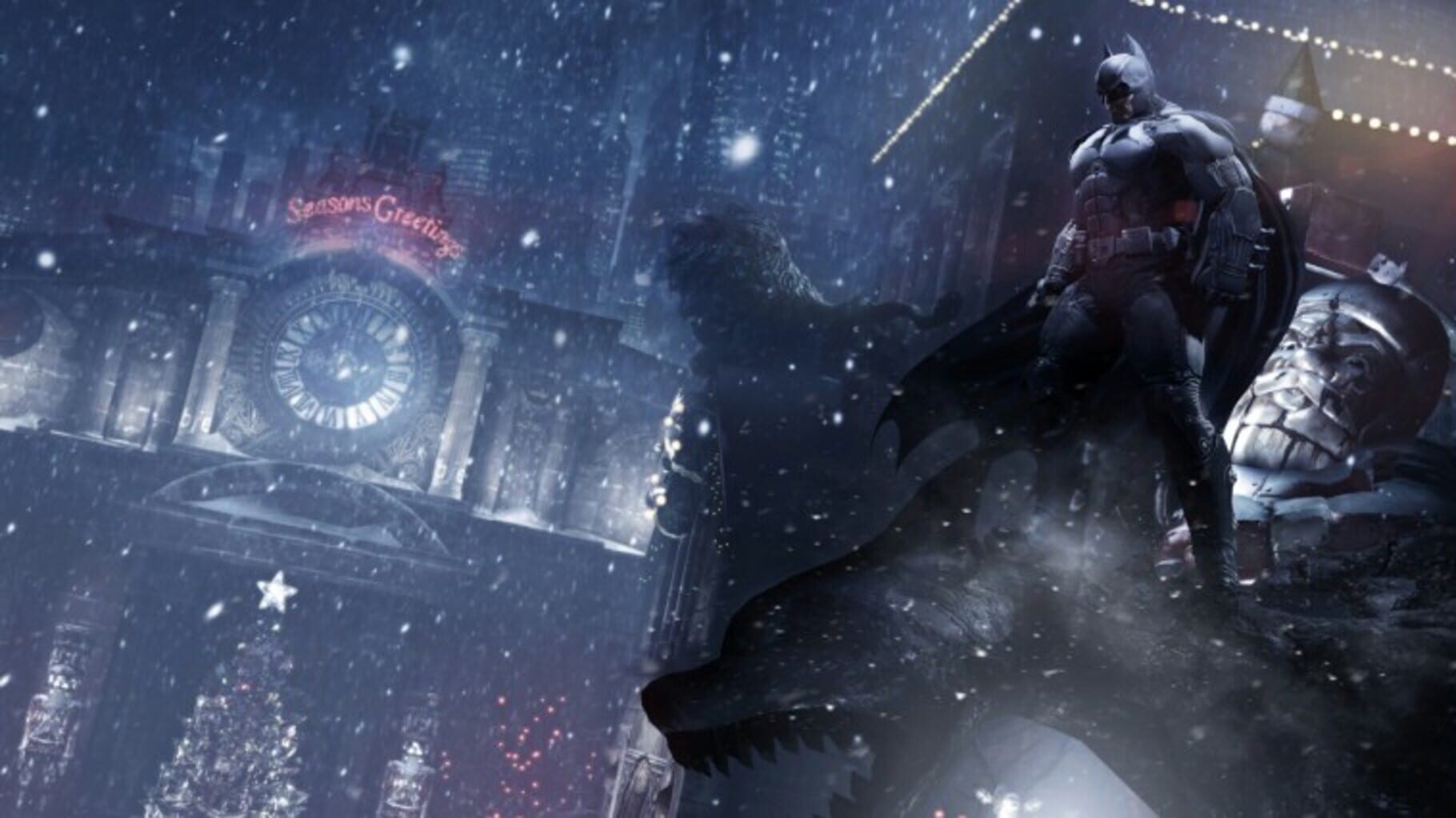
Holmes described the Christmas setting as a juxtaposition between the joyful time of the year and the grim world of Gotham City, including decorative Santas near Gothic gargoyles and Christmas lights in dark alleys. The city is dislodged from time and space, contrasting 1930s (and older) buildings with Batman's futuristic technology. The New Gotham area was designed for vertical movement, allowing the placement of enemies above and below Batman to create areas dense with activity. The game features high contrast between darks and lights, with exaggerated shadows and few balancing colors. The city was divided into residential, industrial, and commercial neighborhoods, which were decorated accordingly: the industrial setting is bleak, the commercial area has corporate decorations and the residential neighborhoods have lights in their windows.
Designers aimed to make the younger Batman's outfit look "assembled versus manufactured", pieced together from several sources. Holmes said, "[Batman's suit is] not something that was made in a factory. He's taken pieces of tech either he's invented, he's fabricated, or things from the Wayne facilities, and he has made this costume out of these pieces." To emphasize the mystery and fear instilled by Batman in this early stage of his career, art director Jeremy Price and the design team used silhouettes and film noir-style low-key lighting to make the character more imposing.
The name "Batman" is used sparingly in this game to emphasize his urban-legend status and the lack of understanding of the character. It was suggested that Batman occasionally make unavoidable mistakes during gameplay because of his inexperience (such as tripping or missing with batarangs), but this idea was discarded as inconsistent with the character. His inexperience was instead personality-based: learning how to be the city's protector and overcoming his obsession with vengeance. In designing Batman's abilities and gadgets, the gameplay took precedence over narrative consistency with the previous games; the designers thought that removing features players had already experienced in those games would make playing Arkham Origins feel less empowering.
Holmes acknowledged that Black Mask is not as well known as some of Batman's other villains (such as the Joker and
Reception
Batman: Arkham Origins was displayed at the 2013 Electronic Entertainment Expo (E3), and received two Game Critics Awards nominations: Best Action/Adventure Game and Best Console Game. It was also recognized at the expo for "Best Videogame" by Forbes; "Best Action Game" by Game Informer; "Best Comic Book-Related Game" by Newsarama and "Best Xbox 360 Game" by IGN.
Batman: Arkham Origins received "mixed or average" reviews from critics on all platforms except on PlayStation 3, which received "generally favorable" reviews, according to the review aggregator website Metacritic.
Arkham Origins was considered an incremental installment for the series, rather than a transformative one. GameSpot said that Arkham City expanded on Arkham Asylum by applying the game mechanics to a larger open-world setting, but criticized Arkham Origins for replicating Arkham City without moving the series forward. Other critics agreed, saying that the game's well-received elements from the previous game were not significantly developed or augmented and it was routine rather than inspired. However, other reviewers rated it on a par with Arkham City.
Critics cited Arkham Origins' handling of the genesis of Batman's relationships with his adversaries and allies and its question of whether Batman's presence enhances crime in Gotham City as the game's greatest assets. Scenes with the Joker received the most praise, with Polygon saying that although he was also a central antagonist in previous Arkham games, the story shone new light on the character; GameSpot called the story surprising in its exploration of the bond and similarities between Batman and the Joker. The story was criticized for lacking a cohesive narrative (particularly the opening plotline of assassins hunting Batman, largely forgotten by the game's end), but EGM said that when it works, the story was worthy of any Batman film, TV show or comic book.
The game world was well received for its number and variety of side missions and distractions but its scale was criticized as unnecessarily large, with GameSpot describing it as "bigger just for the sake of being bigger"; Joystiq described the city as unattractive, with the expanded play area increasing the commute but not the enjoyment. Others criticized changes in navigating the city; some areas prevented grappling, slowing (or stopping) travel. Polygon called the world more linear, with fewer chances to revisit areas with new gadgets to open new paths and deviation from the most obvious path necessary only to find collectibles. However, some reviewers considered the city's vastness and activities engrossing.
Kotaku criticized the side quests as "busy work" for not advancing the narrative or providing appropriate rewards. Others found the use of previous elements tedious, with replacements, simply mimicking the old (such as the glue grenade, with an identical purpose to Arkham City's ice grenades).
Detective Mode, allowing the investigation of crimes, was not considered an improvement by Kotaku and GameSpot; while they considered it a good idea, its execution was minimal since a player simply looks for the next highlighted piece of evidence rather than solving a puzzle. Game Informer liked it, saying that they were complicated and showed how Batman analyzes a crime scene. The combat system received mixed reviews. The shock gloves were criticized as overpowered and making fights too easy, allowing Batman unblockable attacks (instantly disabling most opponents) and removing the need for tactics.
Reviewers said that changes to combat punished more than challenged; greater enemy numbers and variety made sustaining an attack difficult, and (combined with an array of gadgets that hindered—rather than damaged—enemies) made encounters long and repetitive. Joystiq noted that the game emphasized combat over stealth. Kotaku called the combat rating system distracting screen clutter which broke the player's concentration, but GameFront said that the system was positive reinforcement for successful fights. The stealth sections were considered of similar quality to previous installments; their unchanged function left the methods of obtaining victory the same, making for a rote experience.
The Remote Claw was criticized for making stealth sections too easy, allowing multiple enemies to be disabled without moving from the player's starting position.
Critics agreed that Arkham Origins' boss battles were one area of improvement over its predecessors; they offered dynamic, multiphase conflicts with their own stories. While not considering all equally fun or impressive, reviewers said that their variety and unpredictability provided excitement. Less-notable characters from the comics were considered less compelling than more-popular characters.
The multiplayer component was criticized, with Polygon calling it one of the least necessary multiplayer additions to a typically single-player experience. The gameplay was described as a mediocre shooter, incapable of supporting the necessary use of guns by its villains and with poor control of movement. GameSpot noted that poor weapon accuracy and movement controls made the thugs seem weak and inept while playing as the heroes lacked empowerment because of more restrictive combat ability and less resistance to damage. Other reviewers called the experience fun and hectic, but lacked sufficient depth to retain long-term interest.
The main voice cast was well received. Troy Baker was praised as the Joker, for his performance and as a worthy replacement for longtime previous voice actor Mark Hamill, but at the same time was criticized for his interpretation's replicating Hamill's. Dooma Wendschuh, Ryan Galletta, and Corey May were nominated for the Outstanding Achievement in Videogame Writing award by the Writers Guild of America. The game's cinematic content, under the direction of supervising sound editor Alain Larose, received a Golden Reel Award nomination for Best Sound Editing in I