
2015 · HAL Laboratory · Platformer · Puzzle
BoxBoy!
Nintendo exclusive
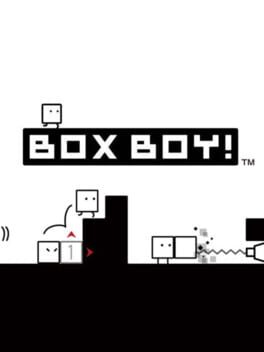
Box Boy! is a platform game in which players control a box-shaped character named Qbby as he makes his way through each level. The source of the game's mechanics come from Qbby's ability to spawn boxes out of his body, the number of which varies between each level. These boxes can spread out in whatever direction is possible to make various shapes and can either be carried or thrown and pushed around.
- Released
- 2 April 2015
- Platforms
- Nintendo 3DS
- Genres
- PlatformerPuzzlePuzzle-platformerStrategy
- Developers
- HAL Laboratory
- Publishers
- Nintendo
- Series
- BoxBoy!
- Modes
- Single-player
- Perspective
- Side view
- Themes
- FantasyScience fictionHistoricalEducational
- Country
- Japan
- Age ratings
- ESRB EPEGI 3CERO A
- Languages
- English, French, German, Italian, Japanese, Spanish (Spain)
- Entry
- #1 in BoxBoy!
- Time to beat
- 4.5hmain story
About
BoxBoy! is a 2015 puzzle-platform game developed by HAL Laboratory and published by Nintendo for the Nintendo 3DS. It is the first installment in the BoxBoy! series.
Players control Qbby, a square-shaped character who can produce a string of connected boxes. The boxes are used to overcome obstacles in stages that Qbby must be guided through.
Keywords
- aliens
- death
- robots
- spaceship
- flight
- time limit
- edutainment
- blocks
- pixel art
- base building
- teleportation
- giant insects
Media
The articlegameplay, story, development, reception
Gameplay
BoxBoy! is a puzzle platform video game in which players control a square-shaped character named Qbby. The goal of the game is to guide Qbby through a series of obstacle-filled stages that are divided into sets called worlds. Each world is focused on a particular gameplay theme: for example, one world introduces stages that contain deadly lasers, and another introduces cranes for transporting Qbby around.
The central gameplay mechanic is Qbby's ability to create boxes and make use of them to clear the obstacles. Boxes are created one at a time as a connected string and the maximum number of boxes in a string varies between each stage. Qbby can detach the string of boxes then push it to different positions. The boxes can be used to overcome obstacles, such as creating a bridge to pass bottomless pits or building staircases to reach higher platforms.
Development
BoxBoy! was developed by Japanese video game company HAL Laboratory. It was a small experimental project in development while the studio was working on Kirby: Triple Deluxe and Kirby and the Rainbow Curse. The project plan for BoxBoy!
was conceived in July 2011 by employee Yasuhiro Mukae, who would later serve as the game's director. , Mukae had never designed or directed a game, but his interest in undertaking these roles prompted him to start planning a project. His lack of experience and the difficulty of designing a game with a large scope led him to plan a game that was simple and compact. The concept of BoxBoy!
Reception
BoxBoy! received generally favourable reviews from critics according to review aggregator website Metacritic.
Some reviewers highlighted that the early stages in BoxBoy! felt too basic, and consequently, the game did not make a great first impression. GameSpot writer Justin Haywald described the simplicity of the game's initial puzzles as "almost off-putting". However, he was satisfied with the more elaborate stages presented after progressing through the game, calling the puzzles "ingenious" and praising the intelligent use of the box-manipulation mechanic.
Releases by platformdates and regions as published
Title IDsone per regional release, with its latest update
In the same series

Games like this

Colobot
2001 · Linux, Windows
Strategy · Robots
 81
Street Fighter X Mega Man
2012 · Windows
Platformer · Robots
 Nintendo exclusive74
Mighty Switch Force! 2
2013 · Nintendo 3DS, Wii U +1
Platformer · Puzzle
 Timed Nintendo80
VVVVVV
2010 · Android, Commodore 64 +10
Platformer · Puzzle
 83
Street Fighter II
1991 · 3DO, Amiga CD32 +15
Robots · Time limit
 PlayStation exclusive81
Ratchet & Clank
2002 · PlayStation 2, PlayStation 3 +1
Platformer · Robots
 84
Owlboy
2016 · Linux, Nintendo Switch +4
Platformer · Puzzle
 Nintendo exclusive77
Wario Land 4
2001 · Game Boy Advance, Nintendo 3DS +1
Platformer · Puzzle
Collections2 collections
Publishers
- Nintendo 3DS games (0–M)Games
- Nintendo handheld gamesNintendo 3DS › eShop exclusives
Description adapted from its source, CC BY-SA 4.0.