The articlegameplay, story, development, reception
Gameplay
Contra III is a side-scrolling run and gun game akin to the series' predecessors. Players take on the role of commandos Bill Rizer and Lance Bean fighting off an alien invasion on Earth. It can be played in single-player or a two-player cooperative mode. There are six stages in total; four are side-scrolling while two are presented in an overhead perspective using the Super NES's Mode 7 rendering mode.
In the side-scrolling stages, the player progresses by running, jumping, and shooting at enemies. In the overhead stages, the player navigates across the stage to find and destroy predetermined targets. The stages each feature unique controls, giving the player the ability to rotate the screen to navigate. All stages have a boss at the end and occasionally a mid-stage boss.
The player will lose a life by coming into contact with enemies or their projectiles, or falling down a pit.
The player is equipped with two machine guns that can be swapped at will and upgraded with power-ups. These power-ups are typically dropped from flying pods and include alternate shot types: homing missiles, torpedoes, a flamethrower, a laser, and a spread shot. Picking up a power-up will replace the shot type of the gun equipped, and losing a life will result in losing the power-up from the gun equipped. Bombs and a temporary barrier shield may also be dropped.
The player has limited bombs, and using them will damage all enemies on the screen. The player can also perform a spinning jump, firing both guns in an aerial somersault. However, during this move, both of the player's weapons will be at risk of being lost upon losing a life.
The Japanese version of the game is easier than the other ones thanks to having unlimited continues and the final boss appearing when it is played on normal difficulty.
Development
Contra III was developed by Konami with a team led by Nobuya Nakazato. Although this was Nakazato's third year at Konami, Contra III is the first Contra game he worked on, having only previously done informal playtesting for Super C (1990). He believed the original arcade version of Contra (1987) was difficult to play because of its vertical screen, but he did enjoy the Famicom port. Nakazato's team worked in Konami's new offices in Tokyo, seated next to the arcade team that had developed Contra.
Nakazato shared progress on Contra III with the arcade team and received positive feedback. In early coverage, the game was known as Contra IV. Nintendo Power reported the name change to Contra III in its coverage of Winter CES in 1992.
Nakazato believed Contra had a low-budget movie theme. To emphasize this, he asked the sound team to change the music as the stages progressed to give a cinematic style. He also believed the action in earlier Contra games is too realistic, so for Contra III he wanted to include more comical elements. He was concerned the change may upset series fans, but believed it would be more entertaining.
One scene added to accomplish this is a sequence where the player hangs from flying missiles. This strains the Super NES's sprite capabilities, so the team used background tiles to draw the helicopter and missiles in the scene. Making the graphics appear to move like sprites in the foreground required clever programming tricks. The Super NES allowed for "raster scrolling", which allowed the programmers to change the graphics for each scanline.
The programmers shifted the vertical sync and cut off the sprites at the scanline. The restriction is that graphics can only move horizontally along the scanline to achieve the illusion that they are actually sprites in the foreground.
Nakazato was concerned the traditional pattern of weak enemies followed by a boss fight was becoming mundane and did not want players to feel "in for the long haul" every play session. To combat this, he established a key concept for something interesting to happen every three screen scrolls. This made the game content feel more dense and gave it a "boss rush" type feel. Nakazato believed Contra III's fast-paced action was going against the trend of home console games shifting to slow-paced strategy and role-playing games, and is good for quick-starting stress relief.
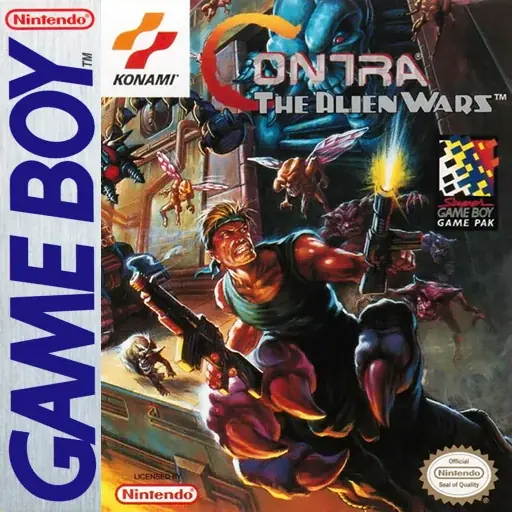
Contra III was released in Japan on February 28, 1992, and North America on March 26. In Europe, the game was retitled Super Probotector: Alien Rebels and released on September 12, 1992. In Super Probotector, the gameplay and story remained mostly the same, but the designs of the player characters were changed to resemble robots. Due to technical differences in PAL Super NES systems, Super Probotector has a slightly slower framerate.
Reception
The Super NES release of Contra III received considerable praise for its visuals and sound design. Its use of Mode 7, sprite scaling, and sprite rotation was commended for being well-integrated with the gameplay and not a gimmick. Electronic Gaming Monthly (EGM) wrote that these special effects pushed the limits of the Super NES hardware. Along with Computer and Video Games (CVG), they admired the use of Mode 7 on the top-down stages, with EGM extending their praise to the boss design on those stages.
Both magazines also praised the soundtrack, with CVG calling it a combination of orchestral and rock music. Mean Machines wrote that the score rivaled that of ActRaiser (1990). Critics also praised the gun and explosion sound effects for enhancing the atmosphere, though Mean Machines believed they sometimes drowned out the music.
Critics found the gameplay enjoyable and a good challenge. CVG called it a cross between Strider (1989) and Midnight Resistance (1989), and enjoyed the athletic climbing ability of the characters. Along with EGM, they believed the top-down stages added good variety. Mean Machines called the game "ultra-addictive, arcade quality blasting action."
EGM dubbed Contra III its "Game of the Month" and said it matched the quality of arcade games. Zero agreed, writing that "everything about this game speaks coin-op quality."
In retrospective reviews, IGN called it "arguably the best installment in the Contra series" and "one classic that deserves its place in the video game hall of fame". GameSpot also called it one of the best in the series. Both noted its satisfying level of difficulty but said the game was somewhat short compared to modern games. USgamer wrote that it was a good challenge and "practically synonymous with SNES ownership".
Eurogamer called Contra III "exemplary" and debatably one of the best games in its genre. In 2009, Official Nintendo Magazine ranked the game 51st in a list of the greatest Nintendo games, calling it "Hectic, relentless and very challenging".
In 1997 EGM ranked the Super NES version the 8th best console game of all time, remarking that "This game has everything: huge bosses, Mode 7 stages, ultradeep gameplay - all wrapped up in a beautifully atmospheric post-apocalyptic package." In 1995, Total! rated the game 15th on their "Top 100 SNES Games." Nintendo Power ranked it as the third best Super NES game of 1992.
In 2018, Complex listed Contra III as the 21st best Super Nintendo game. They praised its intensity and wrote: "If not for [Contra: Hard Corps], this would be the best Contra in the entire series, by far." IGN ranked the game 24th in their "Top 100 SNES Games of All Time."
Legacy
Contra III is director Nobuya Nakazato's first project in the Contra series, later acting as producer and director. Programmers Hideyuki Suganami and Mitsuru Yaida left Konami shortly after Contra III to work at the then-newly-founded Treasure, where they helped develop Gunstar Heroes (1993) and Alien Soldier (1995), which both expanded on the run and gun game formula defined in Contra III.