
The articlegameplay, story, development, reception
Story
The series revolves around an elite high school, Hope's Peak Academy (希望ヶ峰学園, Kibōgamine Gakuen), which, every year, scouts "Ultimate" students (超高校級, chō-kōkō-kyū; lit. Super High School Level), talented high school students who are at the top of their field, along with one "Ultimate Lucky Student" who is chosen by lottery. The three games, Danganronpa: Trigger Happy Havoc (2010), Danganronpa 2: Goodbye Despair (2012), and Danganronpa V3: Killing Harmony (2017) have similar premises. Sixteen talented students who stand out in different fields are trapped by a bear-like machine, Monokuma.
The cast is trapped for the rest of their lives in an establishment, and the only way to return home is by killing another person and avoiding being found guilty during the class trials. The video games' narratives are connected by related media, expanding the story between titles.
The first game was ported to iOS and Android in August 2012, with new features such as retina display support, touchscreen controls, and a new image gallery. Two smartphone games, Danganronpa: Monokuma no Gyakushū (ダンガンロンパ モノクマの逆襲; lit. Danganronpa: Monokuma Strikes Back) and Alter Ego (アルターエゴ, Arutāego), were released for Android devices on April 27, 2012, and iOS devices on May 23, 2012. Following the Japanese release of Danganronpa 1-2 Reload, a PlayStation Vita port of the game and its sequel, Danganronpa 2: Goodbye Despair, NIS America released the Vita version of Trigger Happy Havoc in North America and Europe in February 2014.
Spike Chunsoft later released the game on Steam in February 2016. NIS America also released Danganronpa 1-2 Reload for PlayStation 4 in North America and Europe in March 2017, and Japan on May 18, 2017. Another compilation for the Nintendo Switch titled Danganronpa Decadence was released in 2021. Besides the trilogy, the compilation offered a new title called Danganronpa S: Ultimate Summer Camp, expanded from the two extra modes of Danganronpa V3.
The spin-off, Danganronpa Another Episode: Ultra Despair Girls, takes place between the events of the first two games, follows series protagonist Makoto Naegi's younger sister, Komaru Naegi, accompanied by Toko Fukawa, as both of them trek through a city overrun by murderous Monokumas, and fighting against a group of children calling themselves the Warriors of Hope. This game was also adapted into the manga Genocider Mode.
Gameplay in the main Danganronpa games is split into various chapters which each consist of three sections: Daily Life, Deadly Life, and Class Trial. Daily Life follows a standard visual novel style as players explore the school grounds, converse with characters, and progress the story. During designated "Free Time" sections, players can interact with a character of their choice, learning more about them through intimacy events and earning new skills that can help them in the Class Trial. Deadly Life is the post-murder investigation part of the story, in which players search for clues and gather evidence for the Class Trial.
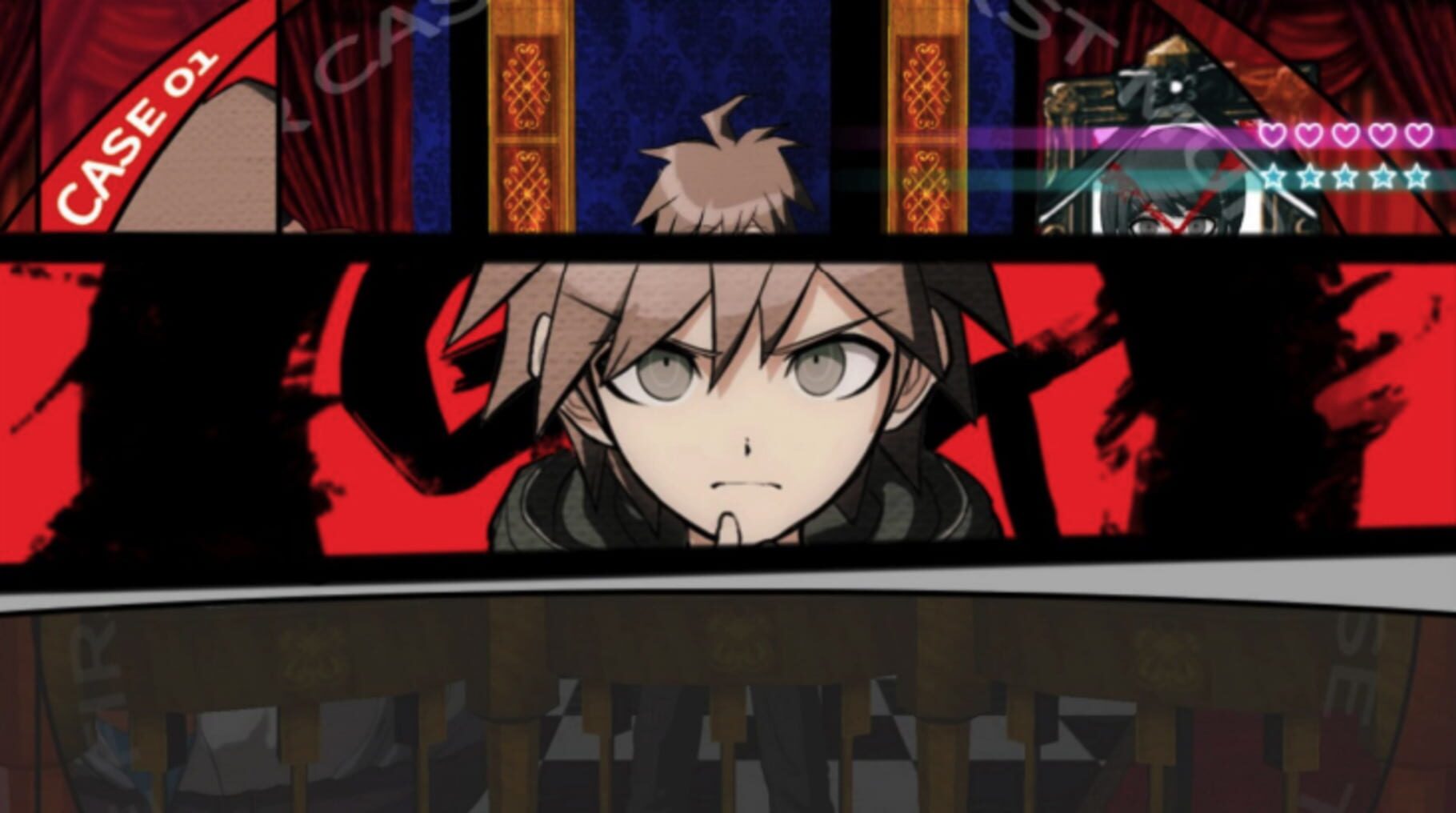
The Class Trial is the main section of the series, in which the students attempt to determine the culprit. This involves various types of mini-games, the most common of which is the Nonstop Debate. Here, the characters discuss the case in real-time, and the player must spot contradictions in their statements and shoot them using "Truth Bullets" containing the corresponding evidence. These sections are broken up by assorted minigames including spelling out clues, rhythmically fighting against suspects, and piecing together comic books depicting the case.
The spin-offs Danganronpa Another Episode: Ultra Despair Girls and Danganronpa: Unlimited Battle use different types of gameplay. The former is a third-person shooter in which the protagonist, Komaru Naegi, uses a megaphone to issue commands at most of the electronic objects in-game, including Monokuma Robots and switches. Unlimited Battle is an action game where players use touchscreen controls to fling a team of four of the Danganronpa characters at enemies.
Development
While at Spike, Kodaka proposed an idea to the company that was known as Distrust. The concept was similar to that of Danganronpa, a battle royale style death game in a closed environment between high school students, but the idea was too gruesome and was consequently scrapped. After tweaking the concept, Kodaka successfully pitched it to the company and the game went into production, becoming Danganronpa. The word "Danganronpa" originated from character designer Rui Komatsuzaki which was first written in kanji but it was later taken to katakana for the logo.
Kodaka cites David Lynch as a major inspiration when making the games. He stated "As opposed to being about death, these are games about playing for your life, since killing is much less purposeful without a motive to justify it. ".
The first game in the series, titled Danganronpa: Kibō no Gakuen to Zetsubō no Kōkōsei, was produced by Yoshinori Terasawa, who was inspired by movies such as Saw and Cube. The game uses a distinct "pop art" style featuring fluorescent pink blood. The game's scenario was written by Kodaka, with character designs by Rui Komatsuzaki. In February 2014, Kodaka revealed on his Twitter account that the story of Danganronpa was inspired by the Sega Dreamcast game Illbleed, as he loved how "crazy" it was.
The game was originally conceived as a basic visual novel but, as visual novels were growing less popular, new gameplay elements were added to make it stand out. Due to budget issues, some lines were not given voice acting which left voice actress Megumi Ogata with the desire to make some important lines in retrospective. She felt a similar feeling with the anime adaptation as she felt it was too trimmed. Kodaka claimed some lines were not befitting to protagonist Makoto Naegi such as when the player is exploring an area.
As a result, he also felt they would have added more fitting lines if Spike had the budget for the game.
The game was originally released on PlayStation Portable in Japan on 25 November 2010, and was later ported to iOS and Android devices on 20 August 2012. Prior to the game's release, the company released various promotional material, including a playable demo and trailers, which depicted a different victim from the final game. Two smartphone applications, Danganronpa: Monokuma no Gyakushū (ダンガンロンパ モノクマの逆襲; lit. Danganronpa: Monokuma Strikes Back) and Alter Ego (アルターエゴ, Arutāego), were released for Android devices on 27 April 2012 and iOS devices on 23 May 2012.
After the making of the first Danganronpa game, there were no plans for a sequel. However, the team split up into different groups to make other projects. Initially reluctant, Kodaka was attracted by the idea of creating the novels Danganronpa Zero. Terasawa approached Kodaka with the idea of a sequel in a few months.
Kodaka wrote both Zero and Goodbye Despair at the same time. In retrospect, Kodaka considers the novels as needing more structuring work when comparing it with the game. He wrote elements he was doubtful from the first game into the novel as well as more hints towards Goodbye Despair. As a result, Kodaka recommends gamers first read Zero before playing the sequel.
The sequel, Danganronpa 2: Goodbye Despair, was released for PSP in Japan on 26 July 2012, featuring various gameplay additions.
On 10 October 2013, Spike Chunsoft released Danganronpa 1・2 Reload (ダンガンロンパ1・2 Reload), a compilation of the first two games, for the PlayStation Vita. Along with higher resolution graphics and touch-screen controls, the compilation added an additional 'School Mode' to the first game, based on the second game's 'Island Mode'. On 6 July 2013, NIS America announced they would be releasing the Vita version of the first game in English under the name Danganronpa: Trigger Happy Havoc, featuring both English and Japanese audio. This version was released in North America on 11 February 2014, and in Europe and Australia on 14 February 2014.
The Vita version of the second game, titled Danganronpa 2: Goodbye Despair, was released in North America and Europe in September 2014. Both games were later ported to Steam in 2015 and were released for PlayStation 4 in 2017.
On 9 September 2013, Spike Chunsoft announced a spin-off title of the series, Danganronpa Another Episode: Ultra Despair Girls, which was released on Vita on 25 September 2014 and was released in North America and Europe in September 2015. A free-to-play spin-off game, Danganronpa: Unlimited Battle, was released for iOS in Japan on 7 January 2015. In March 2015, writer Kodaka Kazutaka revealed that Danganronpa 3 was in early development. The game was revealed in September 2015 as Danganronpa V3: Killing Harmony for PlayStation 4 and Vita, which was later released in 2017.
A Steam port of Danganronpa V3: Killing Harmony was also in 2017. The game was developed at the same time as the production of the anime series Danganronpa 3: The End of Hope's Peak High School, which Terasawa and Kodaka described as being difficult; they still try to develop both projects without making any compromises, as such an opportunity does not arise often. The "V3" in the game's title was chosen to differentiate it from the anime. Terasawa and Kodaka described the game's production level as being much higher than that of previous games in the series.
With Killing Harmony completed, Kodaka claimed that he would take a break from the franchise in a similar fashion to the Back to the Future film series, which consists of three installments.
A free virtual reality technical demo based on the first game, titled Cyber Danganronpa VR: The Class Trial, was released for PlayStation Plus users in Japan for the PlayStation VR on 13 October 2016. A crossover prequel with Otogirisō to the first game, titled Kirigiri Sou, was released for PC users in Japan on 25 November 2016. In 2017, Spike Chunsoft started hiring staff for a new Danganronpa game. In July 2020,
Reception
The series was a commercial success. As of 7 November 2018, the game series had sold over of 930,000 units in Japan. The best-selling Danganronpa game in Japan is Danganronpa: Trigger Happy Havoc, which sold a total of 258,250 units on the PlayStation Portable. In Europe and the United States, combined sales of the first two games on PlayStation Vita, Trigger Happy Havoc and Goodbye Despair, have surpassed 200,000 copies sold as of April 2015.
Spike Chunsoft reported in March 2018 that the two games each sold an additional 200,000 units through Steam. By 2025, the series reached 10 million copies sold worldwide.
USGamer claimed that the popularity behind Danganronpa not only comes from the plot and gameplay but also the "zany, multifaceted characters" who are both expressive and distinctive. The tension provoked by the trials was said to be the most important part of the gameplay, as the player feels confused about what character could have been the murderer of a case. Hardcore Gamer said the game has an "uncanny ability to leave its players slack-jawed at the sights of the unraveling plot points." Destructoid praised its art style and well thought out story.
The media focused on the art style and character designs, which they felt helped to easily tell apart characters and enjoy their interactions with leads. A major praise in regards to the narrative are the twists revealed through class trial like Nagito Komaeda's true character in Goodbye Despair or Kaede Akamatsu's last action in Killing Harmony. This also led to articles focused on the game's strongest characters based on intelligence or major role in the series. However, the trials have often received criticism for being easy to solve.
The latest game, Killing Harmony, attracted divisive comments from fans due to its ending which involves the characters being aware of their fictional nature and the emotional catharisis they have suffered as a result of the series' popularity.
The cast in general was well received with several of them often being the subject of cosplay based on their distinctive designs, with multiple favoriting Junko Enoshima and series' mascot Monokuma. In November 2019, a Monokuma costume created controversy in Austin, Texas, after drag queen Erika Klash was denied entry to a Whataburger while dressed as the character, after performing in-character at the Austin International Drag Festival at the club Elysium for five years. Klash later received an apology from a Whataburger representative over the incident, both in-person and on Twitter. The reveal in the first game of one characters' gender, who had been cross-dressing, received mixed reception from some critics, who called the discovery "a cheap plot device".
The series has won multiple awards, including the first one: GameFan as Game of the Year, Best Sony Portable Exclusive Game, and Best Adventure Game. Game Informer awarded it Best Vita Exclusive, Best New Character (Monokuma) while RPGFan gave it the "Best Story", and "Best Graphic Adventure", while Goodbye Despair received Famitsu's Game of the Year (Readers), Hardcore Gamer's Best PS Vita Game, "Best New Character" (Monokuma), and "Best Adventure Game", while in the Japan Game Awards it won the "Award of Excellence". In 2017, Famitsu readers voted Danganronpa among the top four adventure games of all time, along with Steins;Gate, 428: Shibuya Scramble and Phoenix Wright: Ace Attorney. Killing Harmony won the Excellence Prize at the Famitsu Awards and the award for "Best Plot Twist" in Game Informer's 2017 Adventure Game of the Year Awards.
In a Famitsu poll celebrating the franchise's tenth anniversary, the series remained more popular within female players than male players. The survey also included the fact that Danganronpa is mostly popular within young adults despite the magazine claiming the game were created to appeal to older gamers.
In 2014, The 19th Animation Kobe committee chose Seiji Kishi to receive their Individual Award for the stretch of his career including Danganronpa: The Animation, Arpeggio of Blue Steel, and Hamatora. GamesRadar writer Kenneth Shepard acclaimed the End of Hope's Peak Academy series, stating that despite the franchise changing media from games, the narrative was appropriate for the television series. He added that he felt that the anime managed to bring closure to Makoto's story arc and felt his story easy for newcomers rather than just returning players. The finale of the series' Hope Arc earned positive reception for how it handled the respective finales of Makoto's and Hajime's/Izuru's journeys, despite lacking the appeal the original games had in the usage of antagonists.
According to Kodaka, Ace Attorney's success in North America was due to how it distinguished itself from most visual novels with its gameplay mechanics, which Danganronpa later built upon and helped it also find success in North America. He further noted that the team behind the games were surprised by the popularity of the three games, claiming they were not expecting Danganronpa to become popular games. As a result, he found that the franchise was so successful that it approached Atlus's role-playing game series Persona, although Persona still being vastly more popular. Anime director Tomohisa Taguchi was so impressed by Kodaka's work on Danganronpa that he collaborated with him on the anime Akudama Drive.


