The articlegameplay, story, development, reception
Gameplay
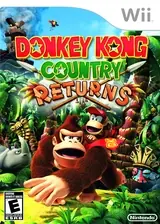
Players take control of the series's protagonist Donkey Kong, as well as his friend Diddy Kong in certain situations, with many traditional elements of the Donkey Kong Country series returning, including mine cart levels, the ability to swing between vines and collect bananas, the golden "KONG" letters and puzzle pieces. New gameplay elements include levels in which the characters and foreground environments appear as silhouettes, spawning several new gameplay mechanics. In single-player mode, players can only play as Donkey Kong, although Diddy Kong rides on Donkey Kong's back, and Donkey Kong can use Diddy's jetpack to jump further. Multiplayer mode enables a second player to control Diddy Kong.
If a player's character dies in two-player mode, it can be brought back by using the other character to hit a "DK Barrel" that floats into view, a mechanic similar to the one used in New Super Mario Bros. Wii. To avoid problems arising from differences in the players' skills, Diddy can hop on Donkey's back to take on a more passive role, while his jetpack can be used to make his partner's jumps easier. Both Donkey and Diddy can pound the ground to defeat enemies and unveil secret items.
The game has two control schemes, with the standard system using the Wii Remote in conjunction with the Nunchuk, while a more classical approach requires that the Wii Remote be held sideways. Both methods use motion controls for the "Ground Pound" move. In addition to common series elements like secrets and unlockables, there is also an optional time attack mode. Two animal buddies, Rambi and Squawks, appear and assist Donkey Kong at certain points in the game.
The game also utilises the "Super Guide" feature that previously appeared in New Super Mario Bros. Wii and Super Mario Galaxy 2. If the player loses eight lives in a single level, they will be given the option to allow a white-colored Donkey Kong named Super Kong to take over and complete the level for them, but Super Kong will not look for collectible items, nor will he show the player where they are. He also keeps anything he happens to collect, so the player is not rewarded for these items.
After beating Tiki Tong, an additional stage called "The Golden Temple" is unlocked. In order to play the stage, the player has to find objects called "Rare orbs" hidden in each world's temple. Upon completing the Golden Temple, a new mode is unlocked known as the Mirror Mode. In this mode, the stages are flipped, Donkey Kong only has one unit of health, he cannot use items bought from Cranky Kong, and he cannot get any help from Diddy Kong.
Story
The game's story revolves around creatures known as Tikis, which are new to the series. The different types of Tikis fill the role of the antagonists in the story, replacing the Kremlings from Donkey Kong Country. Cranky Kong (Takashi Nagasako), who owns shops throughout the island, is the only Kong family member that appears other than Donkey (Nagasako) and Diddy (Katsumi Suzuki). The story begins as the protagonists are awoken by a volcanic eruption on Donkey Kong Island, after a group of evil Tikis known as the Tiki Tak Tribe arrive and play music to hypnotize the animals into stealing Donkey Kong and Diddy Kong's bananas.
Since Donkey Kong is resistant to the Tikis' music, he works with Diddy Kong to retrieve their hoard of bananas from the Tikis. Throughout the game, the pair travel through nine worlds to recover their stolen bananas: the Golden Temple, the Volcano, the Factory, the Cliff, the Forest, the Cave, the Ruins, the Beach, and the Jungle. In each world, they must defeat a Tiki Tak Tribe leader: Kalimba, the Maraca Gang, Gong-Oh, Banjo Bottom, Wacky Pipes, Xylobone, Cordian (who hypnotizes other inhabitants on the island to fight the Kongs), and Tiki Tong, the king of the Tiki Tak Tribe. After Tiki Tong is defeated, the Kongs are launched into space where they punch and headbutt down on the Moon, crushing Tiki Tong's base and sending bananas flying everywhere.
Development
The idea for Donkey Kong Country Returns originated at Retro Studios following the completion of Metroid Prime 2: Echoes in 2004, when Retro president and CEO Michael Kelbaugh told Nintendo producer Kensuke Tanabe that Retro was interested in developing a Donkey Kong game. Kelbaugh had worked as a tester on the Donkey Kong Country series for the Super Nintendo Entertainment System (SNES), which had been on a hiatus following Donkey Kong Country 3: Dixie Kong's Double Trouble! (1996). Its developer, the British studio Rare, was acquired by Nintendo's competitor Microsoft in 2002. Retro was directed to develop Metroid Prime 3: Corruption (2007) instead, Tanabe noting that Nintendo depended on Retro to make games that could not be developed in Japan.
After the completion of Corruption, Retro began experimenting for potential projects, but in April 2008, three core staff—game director Mark Pacini, art director Todd Keller, and principal technology engineer Jack Matthews—left to form Armature Studio, and those experiments had to be discarded. Tanabe was unsure what Retro's next project would be until Donkey Kong creator Shigeru Miyamoto, "totally by chance", expressed interest in a Donkey Kong Country revival. Miyamoto said that Nintendo had been receiving requests from the North American audience for a new Donkey Kong Country, and Tanabe suggested that Retro would be a suitable developer for such a project.
Retro staff flew to Nintendo's headquarters in Kyoto to meet with Miyamoto and Nintendo president Satoru Iwata, where they determined Returns' direction. Miyamoto told Retro, "Donkey Kong is my baby and you better get it right!" Iwata was confident in Retro's ability to develop the game, given that many staff were avid fans of the original Donkey Kong Country. He felt they dispelled any concerns that it was possible for a studio besides Rare to continue Donkey Kong Country.
Iwata referred to the set of circumstances that led to Retro taking on Returns as goen ("fate"), so Retro chose F8 as the project's codename. Retro was excited to work on a series different from Metroid; senior designer Mike Wikan noted that Donkey Kong's light tone was a contrast from Metroid's somber one. Iwata said their passion for Donkey Kong Country "generated an energy that was poured into [Returns]".
Returns was designed for Donkey Kong Country fans, and the team spent the first week of development playing the SNES games to gather inspiration. Retro sought to carry memorable elements—such as side-scrolling gameplay, barrel cannons, and minecart sequences—while refining them to create a new experience, and continue the series' broad appeal and accessibility. The team felt a lot of responsibility because they did not want to disappoint fans. The assistant producer, Risa Tabata, had never played Donkey Kong Country, so she saw herself as the one who conceived new ideas.
Similar to the role he played during the development of Donkey Kong Country and Donkey Kong Jungle Beat (2004), Miyamoto supervised Retro and reviewed Returns' content throughout development. He wanted Retro to keep Donkey Kong Country's unique visuals and feel in mind, and emphasized elements he felt should be retained from prior games. He also mandated which characters could return. The staff worked with Miyamoto for hours to perfect Donkey Kong's movement and referred to him as "Yoda" for his input.
Miyamoto suggested the blowing mechanic after playing a prototype and noticing that one of Diddy Kong's animations resembled blowing. The team was initially baffled by the suggestion, but found it added interactivity and whimsy.
Miyamoto wanted players to move similarly to Donkey Kong when he slaps the terrain, so Retro designed Returns around the Wii Remote and Nunchuk. Retro introduced the option to play without the Nunchuk following the release of New Super Mario Bros. Wii, which allowed players to hold the Wii Remote horizontally like a Nintendo Entertainment System controller. Unlike Rare's games, which allowed players to swap between the two Kongs at will, Retro designed Donkey and Diddy as a combined character.
They introduced surface-clinging to expand gameplay to walls and ceilings, and chose not to include underwater levels because they did not fit the pace. Team members competed and asked each other for input, with Ivey noting coworkers sought to surprise each other. Retro felt they were able to incorporate more ideas than they were in the Metroid Prime series.
Kelbaugh decided that Returns needed to be difficult to appease Donkey Kong Country fans, but still be fair enough for inexperienced players. Pearson and Wikan wanted it to challenge players in a way that would encourage them to learn from their mistakes and keep trying. They introduced Diddy's jetpack and pop gun to ease the difficulty for inexperienced players and distinguish him from previous games. Retro was aware that the difficulty would be tough for some players to manage, so the team integrated the Super Guide system from New Super Mario Bros.
Wii. Since the Metroid Prime and Donkey Kong Country series were popular among speedrunners and hardcore gamers, Retro added the time trial mode late in development.
When development began, Tanabe and Tabata discussed how they could distinguish Returns from the previous Donkey Kong game, Jungle Beat. Tanabe felt that simultaneous multiplayer was one way Returns should differ, since previous Donkey Kong games only let players take turns. Miyamoto advised Tanabe to only focus on single-player gameplay before considering multiplayer, but Tanabe still told Retro to incorporate multiplayer early in development. To distinguish Returns' multiplayer from New Super Mario Bros.
Wii's and allow skilled gamers to play swiftly, Retro removed the collision detection between Donkey and Diddy. Retro refrained from lowering the difficulty for multiplayer, though the team did discuss making it easier to obtain lives and allowed Diddy to ride Donkey's b
Reception
Donkey Kong Country Returns received generally favorable reviews. For its awards for games released in 2010, IGN gave Returns awards for "Best Retro Design" and "Most Challenging", then selected the game as the 5th best on the console. Game Informer named it Game of the Month for December 2010, with reviewer Dan Ryckert hailing it as "one of the best platformers [they'd] ever played". The publication later picked it as the "Best Platformer" and "Best Wii Exclusive" of 2010.
Critics lauded its graphics, level design, and fast-paced platforming and gameplay, which they saw as a return to form for the Donkey Kong Country games, but its motion controls and difficulty curve received a variety of opinions. IGN's Craig Harris awarded the game an Editor's Choice award, calling it a challenging, old-school throwback to the original Country games. 5 out of 10, praising how true the music kept to the style of the original tracks, and that it managed to keep from becoming too complex while still avoiding being over-simplified. X-Play praised the similarity of Returns to the previous games in the series, the game's replay value, and its graphics, but the review criticized the motion controls and the co-op game play.
GamesRadar complimented the title for its standout levels and fan service, while criticizing it for being "hard ... in a frustrating, unclear and often misleading way" and for its implementation of motion controls. GameTrailers praised the game's gameplay and the diversity of the levels, while Giant Bomb stated that "Retro recaptures most of Donkey Kong's venerated platforming roots in this fine Wii sequel".
The game debuted third on the Japanese video game charts, with 163,310 units sold, and has sold 638,305 copies in Japan as of January 2011. In North America, the game debuted at sixth place on the charts, with 430,470 units sold. By the end of March 2011, the game had sold 4.98 million copies worldwide.
As of September 2013, the 3DS version has sold 268,000 units in the United States. As of March 2014, Donkey Kong Country Returns 3D has worldwide sales of 1.52 million units.
Both versions of this game, along with its sequel, were added to the Nintendo Selects label in March 2016, in North America.