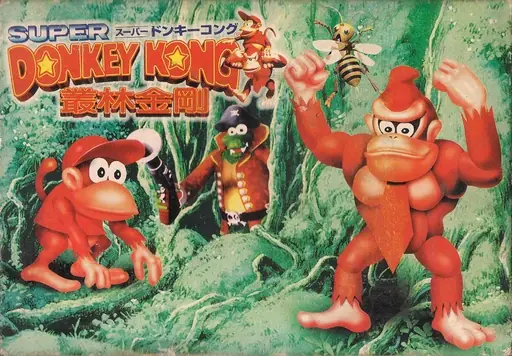
The articlegameplay, story, development, reception
Gameplay
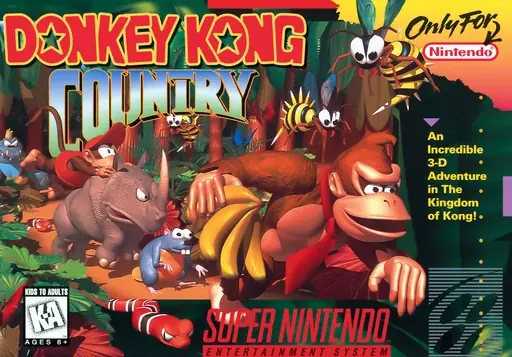
Donkey Kong Country is a side-scrolling platform game. A reboot of the Donkey Kong franchise, its story begins when the crocodile King K. Rool and his army, the Kremlings, steal the Kongs' banana hoard, which the gorilla Donkey Kong and his nephew Diddy Kong must reclaim. Donkey and Diddy, the player characters of the single-player game, run alongside each other and the player can swap between them at will.
Donkey is stronger and can defeat enemies more easily; Diddy is faster and more agile. Both can walk, run, jump, pick up and throw objects, and roll; Donkey can slap the terrain to defeat enemies or find items.
The player begins in a world map that tracks their progress and provides access to 40 levels. The player attempts to complete each level while traversing the environment, jumping between platforms, and avoiding enemy and inanimate obstacles. Level themes include jungles, underwater reefs, caves, mines, mountains, and factories. Some feature unique game mechanics, such as rideable minecarts, blasting out of cannons resembling barrels, and swinging ropes.
Each area ends with a boss fight with a large enemy. Donkey and Diddy can defeat enemies by jumping on, rolling into, or throwing barrels at them. If hit by an obstacle, one of the Kongs runs off and the player automatically assumes control of the other. They will only be able to control that Kong unless they free the other Kong from a barrel.
In certain levels, the Kongs can free an animal that grants them special abilities, similar to Yoshi from the Super Mario series. Buddies include Rambi, a rhino that can charge into enemies and find hidden entrances; Enguarde, a swordfish that can defeat enemies with its bill; Squawks, a parrot that carries a lantern; Expresso, an ostrich that flies; and Winky, a frog that can jump high. Each level contains collectible bananas, letters that spell out K–O–N–G, balloons, and animal tokens. These items can be found within the main level or by discovering hidden bonus stages, where they are earned via solving puzzles.
The player starts with six lives. Collecting 100 bananas, all the K–O–N–G letters, a balloon, or three of the same animal token grants an extra life.
The player can visit other members of the Kong family from the world map. Funky Kong operates a flight service allowing the player to travel across different areas of Donkey Kong Island; Cranky Kong, the aged incarnation of Donkey Kong from the original Donkey Kong (1981), provides tips and fourth wall-breaking humour; and Candy Kong operates a save point service. The player can increase their completion percentage by finding bonus stages. Reaching the maximum 101 per cent unlocks a different ending.
Donkey Kong Country includes two multiplayer modes. In the competitive "Contest", players take turns playing each level as quickly as possible. In the cooperative "Team", they play as a tag team.
Development
In 1985, the British game developers Tim and Chris Stamper established Rare Ltd. The brothers previously founded the British computer game studio Ultimate Play the Game and founded Rare to focus on the burgeoning Japanese console market. After Nintendo rejected their efforts to form a partnership in 1983, Chris Stamper studied the Nintendo Entertainment System (NES) hardware for six months. Rare demonstrated it was possible to reverse-engineer the NES and showed several tech demos to the Nintendo of America president Minoru Arakawa; impressed, Arakawa granted Rare a Nintendo developer licence. Rare developed more than 60 NES games, including the Battletoads series.
When Nintendo released their next console, the Super Nintendo Entertainment System (SNES), in 1991, Rare decided to limit their output. Around 1992, Rare invested their NES profit in Silicon Graphics, Inc. (SGI) Challenge workstations with Alias rendering software to render 3D models. It was a significant risk, as each workstation cost £80,000 (equivalent to £177,000 in 2025).
The move made Rare the most technologically advanced UK developer and situated them high in the international market. In 1993, Nintendo formed a partnership with SGI to develop the SNES's successor, the Nintendo 64.
Though they had purchased the workstations to produce games for the Nintendo 64, Rare discovered it was possible to use them with the 16-bit SNES. Rare tested the SGI technology with Battletoads Arcade (1994) and began developing a boxing game, Brute Force, using Alias PowerAnimator. Around this time, Nintendo was embroiled in a console war with Sega, whose Mega Drive competed with the SNES. Nintendo wanted a game to compete with Sega's Aladdin (1993), which featured graphics by Disney animators, when Nintendo of America's chairman Howard Lincoln learned of Rare's SGI experiments during a trip to Europe.
Nintendo sent several representatives, including the chief technology officer Genyo Takeda; they asked the Stampers if they could demonstrate Brute Force on the SNES hardware. Within two days, the Stampers developed a working build, impressing Nintendo.
Tim Stamper—inspired by Mortal Kombat's (1992) use of digitised footage in place of hand-drawn art—suggested developing a platform game that used pre-rendered graphics. Nintendo granted the Stampers permission to use the Donkey Kong intellectual property. The franchise had been largely dormant since the unsuccessful Donkey Kong 3 (1983), so Nintendo figured that licensing it posed minimal risk. Some sources indicate that the Stampers obtained the licence after Nintendo offered them their catalogue of characters and they chose Donkey Kong.
Conversely, the lead designer Gregg Mayles and his brother Steve recalled that it was Nintendo that requested a Donkey Kong game. Donkey Kong's creator, Shigeru Miyamoto, said that Rare approached Nintendo and offered to handle Donkey Kong since other developers were preoccupied with franchises such as Mario and The Legend of Zelda.
Rare assembled a team of 12, the largest in their history at that point, and development began in mid-1993. Nintendo codenamed the project "Country" (based on Rare's location in Twycross), leading to the title Donkey Kong Country. Other titles considered included Rumble in the Jungle, Monkey Mayhem, and Donkey Kong and the Golden Bananas. Nintendo is usually highly protective of their intellectual properties, but was relatively uninvolved with Donkey Kong Country, leaving most of the work to Rare.
The programmer Brendan Gunn noted that the Stampers worked to shield the team from outside influence. Donkey Kong Country was the first Donkey Kong game that was neither directed nor produced by Miyamoto, who was working on Super Mario World 2: Yoshi's Island (1995). Miyamoto was still involved with the project and Rare said he provided crucial input.
Rare spent 18 months developing Donkey Kong Country from an initial concept to a finished game, and according to the product manager Dan Owsen, 20 people worked on it in total. It cost an estimated US$1 million to produce, and Rare said that it had the most man hours ever invested in a video game at the time, 22 years. The team worked 12–16 hours every day of the week. Gunn said they were under significant pressure from the Stampers and to finish in time for Thanksgiving due to Nintendo's competition with Sega. They developed it simultaneously with Killer Instinct (1994) in a former farmhouse; the Killer Instinct team worked in the stables, while the Donkey Kong Country team worked upstairs.
Donkey Kong Country was one of the first games for a mainstream home video game console to use pre-rendered 3D graphics, a technique used in the Amiga game Stardust (1993). Rare developed a compression technique, Advanced Computer Modelling (ACM), to incorporate more detail and animation for each sprite for a given memory footprint, which better preserved the pre-rendered graphics. Nintendo was sceptical of Rare's approach, concerned it would hamper playability. Early in development, Mayles and other developers presented a demo to the original Donkey Kong team in Japan.
Mayles recalled they were largely uncomplimentary, with one member, Gunpei Yokoi, saying it "looked too 3D". Conversely, Miyamoto thought it looked "awesome" and gave Rare his approval to continue development. Miyamoto said he felt "blessed" to have Rare developing Donkey Kong Country because they had their technology prepared in advance.
The artists began by modelling the characters in NURBS using PowerAnimator and adding textures. They then created the animations and rendered them frame by frame before compressing them. The ACM process was handled by a designated computer that had a proprietary utility similar to Deluxe Paint. Adapting to the cutting-edge SGI workstations was difficult; Steve Mayles said they had a steep learning curve.
To help, Nintendo provided Rare with research material regarding apes, barrels, and caves. The pre
Reception
Donkey Kong Country received critical acclaim and was lauded as a paradigm shift that set new standards for video games. It received perfect scores from several outlets. Diehard GameFan and Total! said it changed expectations for 16-bit and platform games, and Entertainment Weekly wrote it "is to most 16-bit games what most 16-bit games are to their Atari forebears.
Once you've played it, everything else before it seems like a peewee". Electronic Gaming Monthly (EGM) called Donkey Kong Country "one of the few games that is actually as good as the hype", and Total! declared it the best game of 1994. GameFan said that Donkey Kong Country set a new quality standard that many developers would attempt to imitate.
The visuals were considered the best aspect. Reviewers considered them a major technological achievement, their detail unprecedented for a 16-bit game. EGM said that the graphical quality prompted questions about the purpose of 32- and 64-bit hardware. Total!
said the character animations surpassed those of a Disney film and applauded the parallax scrolling. Several critics said the graphics were the best on available hardware, with Entertainment Weekly writing that they were comparable to matte paintings. The soundtrack and audio were also lauded. Total!
said the music built atmosphere, Top Secret wrote the "captivating" soundtrack asserted itself as a masterpiece in its own right, and EGM and Entertainment Weekly said the audio quality was unprecedented for the SNES and on par with a CD's.
Reviewers praised the gameplay for its variety and depth; Entertainment Weekly appreciated that it did not build upon the original arcade game's design. Total! described Donkey Kong Country as addictive, accessible and exciting, with humour, imagination, puzzles and secrets, and proved there was still potential in the platform game genre. EGM and GameFan wrote that it was lengthy and offered plenty of technique, and GamePro commended the replay value that searching for bonus stages provided.
EGM and GamePro found searching for bonus stages was challenging, though GamePro said it was easy to "breeze through the game" without them and criticised the boss fights as simplistic. The four reviewers in Famitsu complimented the gameplay, though one, Hirokazu Hamamura, found it too difficult.
Critics frequently compared Donkey Kong Country to the Super Mario series, particularly Super Mario World (1990). Some considered Donkey Kong Country an improvement upon the Mario formula. GameFan said it would be a worthy successor to Super Mario World even without the graphics and Total! wrote that it took Mario's best elements, increased the speed, and presented them better.
Next Generation felt the gameplay, though good, did not meet the standards of previous SNES games such as the Mario and Legend of Zelda series and prevented it from being a "typical Nintendo blockbuster". CVG wrote that Donkey Kong Country was the only SNES game that matched Super Mario World, but that it would be a conventional platformer without its graphics. It said that experienced players may find the game, designed for the mass market, unoriginal.
Donkey Kong Country received many Game of the Year awards. For EGM's Best and Worst of 1994, it won Game of the Year, Best SNES Game, and Best Animation; Donkey Kong and Diddy Kong won Best Game Duo. It also received Video Games: The Ultimate Gaming Magazine's awards for Game of the Year, Best SNES Game, Best Action Game, and Best Graphics. Donkey Kong Country was the only video game included in Time's Best Products of 1994 list, coming in second behind the Chrysler Neon, and it became the first game to win the Favourite Video Game Kids' Choice Award at the 1995 Kids' Choice Awards.
Legacy
Donkey Kong Country's visual appeal helped the SNES remain popular in a period of uncertainty for cartridge-based games. Consumers were unfamiliar with 3D graphics at the time. According to Official Nintendo Magazine, by bringing next-generation graphics to the SNES just 12 days before the PlayStation's Japanese launch, Donkey Kong Country persuaded consumers that an immediate upgrade was unnecessary. IGN wrote that it "saved the SNES" and revitalised sales by bringing back lapsed fans.
Donkey Kong Country also helped Nintendo pull ahead of Sega and win the console wars of the 1990s. Whereas Nintendo continued to release AAA games such as Donkey Kong Country, Sega had alienated audiences with add-ons such as the Mega-CD and 32X, and its subsequent console, the Saturn, failed.
The Donkey Kong Country series re-established Donkey Kong as one of Nintendo's most popular and profitable franchises. Donkey Kong Country heralded Donkey Kong's transition from villain to hero; Rare's redesign became his standard appearance, and its gameplay format was followed by sequels. Donkey Kong Country inspired an animated series that ran for 40 episodes from 1997 to 2000, and Diddy Kong starred in a Nintendo 64 racing game spin-off, Diddy Kong Racing (1997). , the Country series went on a hiatus until Donkey Kong Country Returns, developed by Retro Studios, was released for the Wii on Donkey Kong Country's 16th anniversary in 2010.
A sequel, Donkey Kong Country: Tropical Freeze, was released for the Wii U in 2014. Wise, who left Rare in 2009, returned to compose Tropical Freeze's score.
Reviewing the Virtual Console rerelease, Nintendo Life felt the visuals were still among the SNES's best, and Jeuxvideo.com said they had provided unprecedented realism. IGN and AllGame said the visuals remained impressive for the SNES (though IGN thought they were no longer as significant a draw), while GameSpot thought the graphics rivalled 32-bit consoles. Conversely, USGamer said that, though technically impressive, they did not age well, with "cringe-inducing", "paper-thin backgrounds". Hardcore Gaming 101 agreed, writing that the visuals looked plastic-like, did not hold up well once the novelty of pre-rendering had worn off, and were clearly experimental, even if their detail was admirable. Critics praised the GBC version for attempting to preserve the visuals in spite of hardware limitations, but criticised the GBA version's downgrades, which IGN considered detrimental to the experience.
Donkey Kong Country became divisive in the years following its release. Eurogamer wrote that it became popular to dislike it in the early 2000s, and it was often described as one of the most overrated video games. For example, Vice wrote that it did not deserve to be considered a classic and, alongside GameSpy, called its gameplay unremarkable and lacking depth. According to IGN, critics accused Donkey Kong Country of "sacrificing gameplay for the sake of a short-run attention grab and quick impulse sales", which USGamer attributed to the "flimflammery of its visuals and the relative mundanity of its actual game design".
USGamer wrote that it was often criticised as an example of style over substance, with gameplay that was arguably inferior to SNES launch games such as Super Mario World and Super Castlevania IV (1991). GameSpy complained that Donkey Kong Country overshadowed games such as Yoshi's Island, which it considered superior.
However, Donkey Kong Country has also been listed among the greatest video games. USGamer wrote that the criticism was unfair because it "exudes craftsmanship ... Rare went to great pains to create a consistent, seamless world that managed to convey trompe-l'oeil immersion", something few developers could replicate. Though retrospective reviewers criticised the boss fights, they praised the rhythm, variety, and replay value.
Polygon said that although some aspects had not aged well, Donkey Kong Country remained among the best Donkey Kong games and deserved praise for resurrecting the franchise. Journalists have called its soundtrack one of the best in games, with praise for its atmosphere and diversity. Hardcore Gaming 101 said it was the one element that had unquestionably aged well and contained some of the 16-bit era's most memorable music.
In the years following its release, rumours spread that Miyamoto disliked Donkey Kong Country and found it amateurish, and had created the hand-drawn art style of Yoshi's Island in retaliation for its pre-rendered visuals. Miyamoto spoke highly of Donkey Kong Country in a 2000 interview; he said that Rare "breathed new life into" Donkey Kong, had demonstrated excellent research into what made a Nintendo game work, and proved they could be trusted with the Donkey Kong franchise. However, the author Steven L. Kent wrote that Miyamoto said "Donkey Kong Country proves gamers will put up with mediocre gameplay if the art is good" during a joint interview with Tim Stamper in Electronic Games in 1995.
Kent said that Nintendo's marketing department had rejected Yoshi's Island for lacking Donkey Kong Country's pre-rendered graphics, and that this had possibly motivated Miyamoto's remark. Miyamoto denied this in 2010, noting he "was very involved" in Donkey Kong Country and had corresponded with Stamper throughout development. In 2014, USGamer described Kent's claims as "seemingly apocryphal", and in 2019, the video game historian Frank Cifaldi found that the Electronic Games interview did not contain the alleged quote from Miyamoto.
Donkey Kong Country exerted "revolutionary influence", according to GameSpot. Kotaku said its unprecedented graphics represented the future of games and Nintendo World Report wrote that it set standards for how platform games could look and play. Sega commissioned BlueSky Software to develop the Mega Drive game Vectorman (1995) in response to Donkey Kong Country's popularity. Many developers imitated the