
The articlegameplay, story, development, reception
Gameplay
Earth 2150 consists of a mostly linear series of missions with occasional choices over their order or branching after a win or loss, with mission goals such as such as gathering resources, destroying all enemy forces, or defending a fortified position. A conventional campaign structure for the genre, except the campaign isn't won by completing the missions, but at any point the player has expended 1,000,000 credits (half that for the Lunar Coalition) on building the means to evacuate from their doomed world. Complicating this, credits, representing materials, are also required to construct units, buildings and weapons, and for research.
The hunger for resources is present from the first mission on. Missions have finite ore deposits to mine for credits, and the player must decide whether to retain the funds for use in the mission, or commit them to a transport building that gradually ferries them to the spaceport for evacuation. Regardless of mission objectives all credits, in the ground and on hand, will be gradually delivered to the spaceport if the player destroys all enemy forces and ends the mission with the means in place.
The spaceport lies in the main base, a parallel map that persists through the campaign, can be switched to and from at will, can be used to build structures and units and conduct research, and has a vast air transport that can bring sizable amounts of units and credits to and from the mission. The main base has its own credit tally and the player can shuffle credits to and from the spaceport, but any time the spaceport contains 10,000 it launches them into space, where they're considered spent on the evacuation and cannot be retrieved. Units brought to the main base are retained between missions, although they'll count toward a population limit where the construction of new military units is disabled past a specific total credit cost, increasing from mission to mission, of all those owned. The player may opt to save money by building units at the main base instead of erecting factories at the mission site only to abandon them at the mission's end, but this is risky: the delays in transporting them may see the enemy gather more resources, or even throw the player out entirely.
The game has a global time limit, although a very generous one. Separately, the terrain is scripted to change at the beginning of some missions: a frigid worldwide winter thaws and plants grow, only to die out as deserts overtake the Earth and bodies of water evaporate. Finally lava flows glow in a landscape of ash and entire oceans are gone from the globe that's the mission selection screen. As the temperature rises the effectiveness of heat-based weapons changes, navies are retired for lack of water to put them in, and the actions available for the Lunar Coalition's weather controller superweapon change. Occasionally the player receives news clips about the construction of the evacuation program or thanks, admonishments, or threats regarding meeting its quotas, but these are cosmetic.
The stand-alone expansion packs The Moon Project and Lost Souls returned to a conventional structure about winning a series of missions.
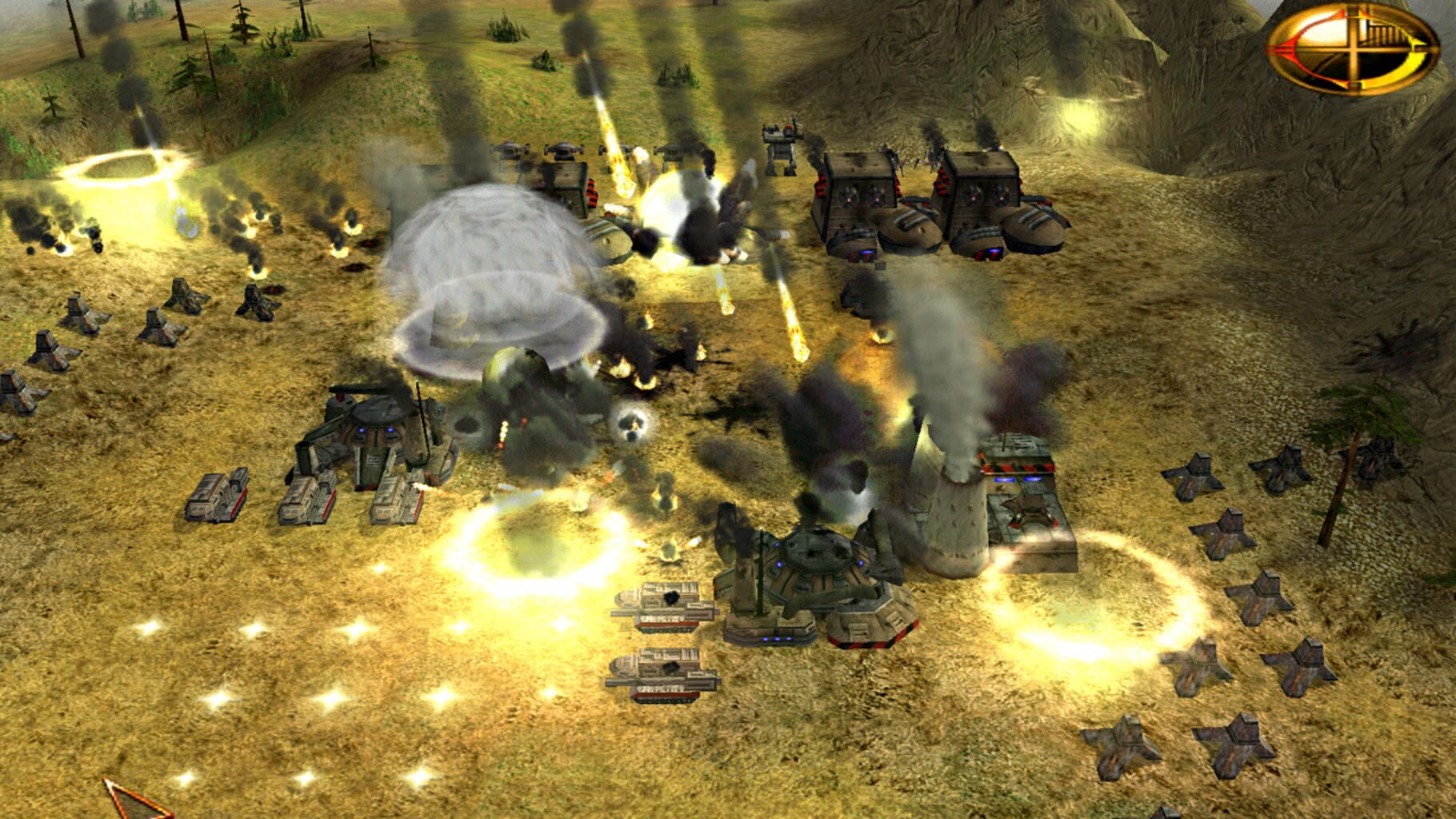
As real-time strategy, Earth 2150 belongs to a genre of wargames marked by ease of use and prompt action, and not by realism or intricate simulation; for example, units are built in seconds in factories on the front lines, paid for by gathering materials in the field. Generally the player builds a base, harvests resources, manufactures units, and seeks to destroy the enemy by issuing units commands such as where to move, what to target, or to halt. Some campaign missions liven this up with objectives such as defending the ambassadors at a summit, and scripted events, such as a hacker capturing robotic UCS units or an alliance falling apart, that can change mission objectives. Another change to the formula in most missions is the landing pad structure, the transport link with the main base, which can supply units for rushes and allow for leaner bases with less need to operate independently - and less ability to rebuild this lifeline should it be cut. Alternately, the player may opt for a single battle ("skirmish") where the goal is always to eliminate the opposition, or for online multiplayer.
The game has ground vehicles, ships, and aircraft, leaving out the infantry from Earth 2140. Units can gain levels, and the game offers a small degree of unit customization where the player builds unit types by choosing the chassis, the weapon or weapons or other equipment, and the name. Unusually, the commands a unit type can receive can be set to only the three above, the RTS standards such as "escort" and "hold position", or an extended set such as "hold area" (ie. pursue enemy units a limited distance) with standing orders such as "retreat at 50% HP." However, this is not available for all unit types and can be changed for units after they are built.
Conventional weapons restock ammo via a flying supply carrier from a depot (for ground or naval units) or a stop at the depot (for air units). g. a weak machine gun with extensive stores requires different support than a powerful, long-ranged grenade launcher that's exhausted in a single engagement, and since carriers and other air units will fly in a straight line unless manually commanded and directly into the teeth of enemy air defenses should the player attack from the wrong direction. Energy weapons regenerate ammo, bypass the damage reduction armored chassis have, and tend to be unusual, "gimmick" weapons.
For example, while the plasma cannon is merely extremely powerful, the laser does no damage to HP and instead heats enemy units until their ammunition detonates and they explode, making short work of most targets but wearing off if interrupted. They are countered by shields, a second, regenerating health bar that is bypassed by conventional fire but completely
Reception
The PC version received "generally favorable reviews" according to the review aggregation website Metacritic. Brian Wright of GamePro was positive to its gameplay, graphics, soundtrack, and sound effects, but concluded that its complexity makes the game more suitable for hardcore players rather than the casual ones.
In the German market, the game debuted in 22nd place on Media Control's computer game sales rankings for November 1999. It took 25th and 23rd in the first and second halves of December, respectively, before dropping to 27th in January 2000 and 44th in February. The game's sales in the German region had surpassed 60,000 units by May, a performance that publisher Topware Interactive considered acceptable, according to PC Player's Udo Hoffman. He, however, noted that the game had been overshadowed by competitors Command & Conquer: Tiberian Sun and Age of Empires II: The Age of Kings, and remarked that "in retrospect, the date of publication was poorly chosen". David Fioretti of the German retailer PC Fun cited the game's numerous bugs and Topware's reputation as a "cheap brand" as further reasons for its failure to achieve hit status.
The game was a commercial failure in the U.S. CNET Gamecenter's Mark Asher reported in early September 2000 that the game had sold 23,163 units and earned revenues of $873,855 in the country. He felt that this performance "can't be classified as a hit", and with journalist Tom Chick explaining that it "didn't even hit PC Data's charts".
The game won the award for Best Multiplayer Game at the CNET Gamecenter Computer Game Awards for 2000.


