Ludography
82/100
Players97 ratings
90/100
Critics1 review

Where to get it

Eternal Darkness 2 cover

2002 · Silicon Knights · Action-adventure · Adventure

Eternal Darkness 2

Nintendo exclusive

Eternal Darkness: Sanity's Requiem is a psychological horror action adventure, released in 2002 by Nintendo for the Gamecube. It tells the stories of twelve characters that span across the world and two millennia who have to deal with ancient forces of evil which have been trying to manifest themselves in our world. Chapters take place in Ancient Rome, Persia, the Middle East, and modern-day Rhode Island. Throughout the game, the protagonists will have access to several weapons appropriate for their era, from bastard sword & gladius to flintlock pistol and shotgun.

Also known as
Eternal Darkness: Sanity's Requiem · Eternal Darkness · ED
Released
24 June 2002
Platforms
GameCube
Genres
Action-adventureAdventurePsychological horrorPuzzle
Developers
Silicon Knights
Publishers
Nintendo
Modes
Single-player
Perspective
Third person
Themes
ActionHorrorSurvival
Country
Canada
Age ratings
CLASS_IND 18ESRB M
Languages
EnglishEnglish (UK)FrenchGermanItalianJapaneseSpanish (Spain)
Time to beat
11hmain story15hwith extras
Directors
Denis Dyack
Composers
Silicon Knights

About

Eternal Darkness: Sanity's Requiem is a 2002 horror game developed by Silicon Knights and published by Nintendo for the GameCube. It was produced and directed by Denis Dyack. The game follows the story of several characters across a period of two millennia and four different locations on Earth, as they contend with an ancient evil who seeks to enslave humanity. The gameplay distinguishes itself with unique "sanity effects", visual and audial effects that confuse the player and often break the fourth wall.

Development on Eternal Darkness began after Nintendo, impressed with Silicon Knights' Blood Omen: Legacy of Kain (1996), contacted the company to propose a collaboration on an original mature title. Silicon Knights based their concept around Lovecraftian horror and the Eternal Champion concept, and decidedly avoided making a survival horror game. It was originally planned for the Nintendo 64, and was mostly completed before development was moved to Nintendo's forthcoming home console, the GameCube. It was the first game published by Nintendo to receive an M (Mature) rating from the Entertainment Software Rating Board (ESRB).

›Story

The story of Eternal Darkness takes place over four principal locations which the game skips back and forth between. They include an underground temple complex called the Forbidden City, in Persia; a Khmer temple in Angkor Thom, Cambodia; Oublié Cathedral in Amiens, France (not to be confused with Amiens Cathedral); and the Roivas Family Estate in Rhode Island, which also leads to an ancient underground city named Ehn'gha beneath the mansion. Each time a location is visited, it is done so in a different time period. Spanning from 26 BC to 2000 AD.

Almost half of which take place in the 20th century. Each different era and character offers a different periodic and personal perspective on the location.

The chapters found in the game are not discovered in chronological order. Instead, to make the narrative more dramatic, each chapter jumps around the timeline of the plot. However, despite the overall story skipping back and forth through time, the chapters do follow chronological order within their respective locations. This is because each setting also has its own contained story.

In 2000 AD, Alexandra Roivas finds herself returning to her family's estate in Rhode Island after her grandfather, Edward Roivas, her only living relative, is found brutally murdered. Two weeks after returning, with the local police having gotten nowhere with the investigation, Alex decides to investigate the mansion for clues, and stumbles upon a secret room containing a book bound with human skin called the Tome of Eternal Darkness. Deciding to read it, she finds it contains accounts of various people in the past, beginning with the story of Pious Augustus.

Keywords

  • psychological horror
  • female protagonist
  • action-adventure
  • lovecraftian
  • fake game over screen
  • retroachievements
  • nintendo gateway system

Media

The articlegameplay, story, development, reception

Gameplay

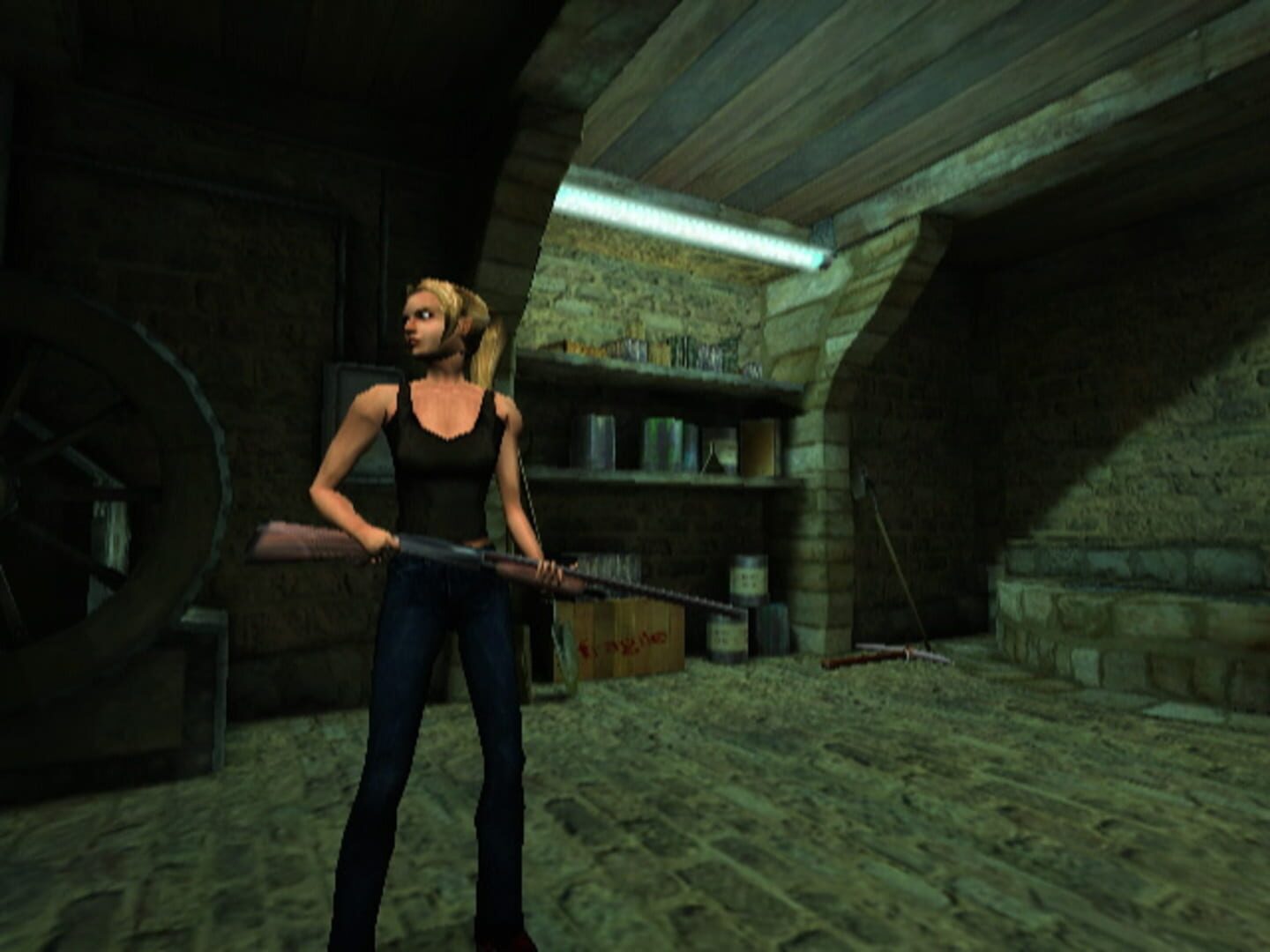
The game is conducted from a third-person perspective. It has an in-game map which tracks the player's bearings. The inventory system stores weapons and items that can be used to solve puzzles, some of which can be combined with other objects, even enchanted with magick, for different effects.

Combat focuses on a simple targeting system. Players may attack in a general direction, or lock-on to an enemy to focus on individual parts of its anatomy. Decapitating most enemies effectively blinds them. There are many classes of enemies the player must either defeat or avoid.

Story

The story of Eternal Darkness takes place over four fictional locations which the game moves between. They include the "Forbidden City" underground temple complex in Persia; a Khmer temple in Angkor Thom, Cambodia; Oublié Cathedral in Amiens, France; and the Roivas Family Estate in Rhode Island, which leads to an ancient underground city named Ehn'gha beneath the mansion. The story moves between these locations, with each chapter occurring during a different time period (between 26 B.C. and 2000 A.D.), and from the perspective of a different character. The chapters in the game are not in chronological order.

In 2000 AD, Alexandra Roivas returns to her family's estate in Rhode Island after her grandfather, Edward Roivas, her only living relative, is found brutally murdered. Two weeks later, the local police have gotten nowhere with the investigation. Alex decides to investigate the mansion for clues, and stumbles upon a secret room containing a book bound with human skin called the Tome of Eternal Darkness. Deciding to read it, she finds it contains accounts of various people in the past, beginning with the story of Pious Augustus in 26 BC.

Development

Eternal Darkness was developed by Canadian development studio Silicon Knights and published by Japanese game company Nintendo. It was directed and produced by Denis Dyack of Silicon Knights. The project's origins can be traced back to the mid-1990s when Nintendo staff saw Silicon Knights' game Blood Omen: Legacy of Kain (1996) at an E3 gaming convention. Nintendo contacted Silicon Knights, as they had been contemplating adding more mature games to their line-up, and the two companies began collaborating to produce Eternal Darkness.

Silicon Knights's concept for the game was to create a horror game that did not fall under the survival horror genre. Dyack claims they went with "a deeper, more classical approach" to horror, calling it a "psychological thriller" as opposed to the "B-movie horror plots" of the Resident Evil series. They also wanted to make a game in response to contemporary video game controversies. Dyack explains: "Video games were under fire for messing with people's heads, and being accused of being murder simulators and stuff.

Reception

Eternal Darkness: Sanity's Requiem received critical acclaim upon its release, with aggregated review scores of over 9/10 at both GameRankings and Metacritic. Upon review, IGN gave Eternal Darkness one of its Editor's Choice Awards and, in its review of the game, stated: "Simply put, an amazing achievement that shouldn't be overlooked. Games do not come any better than this".

The game was reviewed for the Japanese magazine Famitsu Cube + Advance . The four reviewers all complimented the story as engaging, with one reviewer specifically found it engaging how the stories and characters gardually weave themselves together. One reviewer said the combat scenes were somewhat repetitive while another said that running in the game was awkward. While all reviewers said the game was strictly for adults, one said that this would limit the game's audience.

Legacy

Alex Roivas makes a cameo appearance in the 2018 fighting game Super Smash Bros. Ultimate as one of the many "Spirits" that players can collect. The battle associated with Alex's Spirit sees the player needing to defeat Zero Suit Samus from the Metroid series while the screen is mirrored at random intervals. The patent for the sanity system expired in 2021.

In 2006, Dyack said "absolutely yes" in response to the question of a possible sequel. He stated that Silicon Knights had intended for Eternal Darkness to be a stand-alone game, but they wanted to make more games set in the same universe involving the Ancients. At Microsoft's Spring 2008 Showcase, Dyack said there was a "strong chance" they would return to the Eternal Darkness brand. In 2011, Silicon Knights said they were refocusing on one of their most requested titles for the next generation of consoles.

Releases by platformdates and regions as published

Releases by platform
PlatformReleasedRegions
GameCube23 June 2002North America · Brazil 23 August 2002 · Japan 25 October 2002 · Europe 1 November 2002

Decompilations and portscommunity projects that rebuild or port the game

Games like this

Collections1 collection

Development status

Description adapted from its source, CC BY-SA 4.0.