Ludography
73/100
Players18 ratings
80/100
Critics1 review
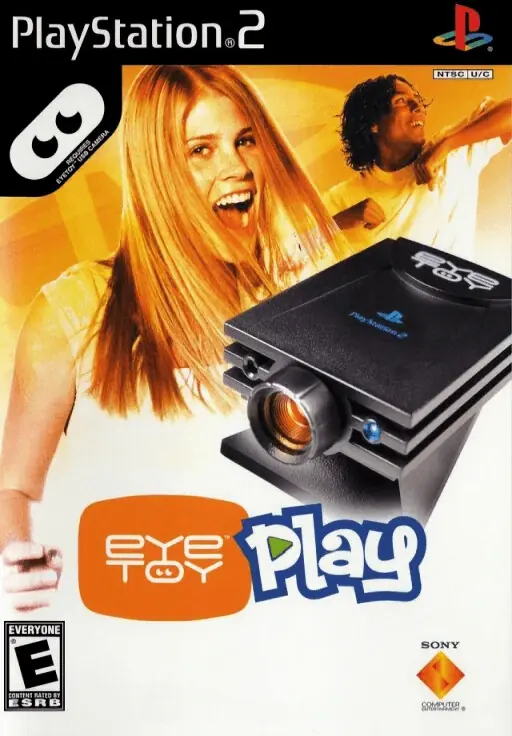
EyeToy: Play cover

2003 · London Studio · Arcade · Party

EyeToy: Play

PlayStation exclusive

EyeToy: Play is a video game for the PlayStation 2, released in 2003. It was the first game to make use of the PlayStation 2's video camera accessory, EyeToy. The game was initially packaged with the EyeToy when the accessory was first released. It features twelve mini-games to choose from.

Released
4 February 2003
Platforms
PlayStation 2
Genres
ArcadePartySimulationSports
Developers
London Studio
Publishers
Sony Interactive Entertainment
Series
EyeToy
Modes
MultiplayerSingle-player
Perspective
First person
Themes
ActionParty
Country
United Kingdom
Age ratings
ESRB EPEGI 3USK 0
Languages
EnglishFrenchGermanSpanishItalianDutchPortugueseSwedishNorwegianDanishFinnishJapaneseand 2 more
Entry
#1 in EyeToy

About

EyeToy: Play is a minigame compilation video game developed by London Studio and published by Sony Computer Entertainment for the PlayStation 2. It was the first game to make use of the PlayStation 2's video camera accessory, EyeToy. The game was initially packaged with the EyeToy when the accessory was first released.

›Story

A cool new gaming idea needs some cool games to play on it. So have a look at EyeToy: Play, the first game made exclusively for EyeToy, a motion sensitive camera that sits on top of your TV and plugs into your PlayStation 2. EyeToy: Play is a collection of 12 addictive games. With Kung Foo, puzzles, dancing, juggling, football, boxing, fireworks, and loads more, there are enough games here to keep you all laughing at each other for hours.

Keywords

  • martial arts
  • minigames
  • augmented reality
  • game critics awards
  • polygonal 3d
  • eyetoy support
  • peripherals
  • bundled with peripherals
  • gesture-based controls
  • fireworks
  • greatest hits
  • played without touching a controller

Media

The articlegameplay, story, development, reception

Gameplay

EyeToy: Play features twelve mini-games to choose from. This game, and all other EyeToy titles, are played by moving one's body. The motion is detected by the USB camera. The software recognizes pixel changes in the video image and compares the proximity of the change to other game objects to play the game. Users who get a high score get to take a photo to tease other players.

Beat Freak: A rhythm action game where the player must touch moving discs as they cross speakers.

Development

EyeToy: Play was developed by Sony Computer Entertainment's London Studio under the direction of Jamie MacDonald, with Ron Festejo acting as producer. Craig Kerrison and Pete Marshall were the game's respective lead designer and programmer, while Masami Kochi and Andrea Falcone served as the lead artists. The voices for the game's characters were provided by Burt Kwouk, Ben Fairman, Cornell John, and Amy Shindler.

Reception

Eye Toy: Play received a "Double Platinum" sales award from the Entertainment and Leisure Software Publishers Association (ELSPA), indicating sales of at least 600,000 copies in the United Kingdom. In October 2003, Sony Computer Entertainment Europe announced one million copies of EyeToy: Play had been sold in Europe. By December 2003, Sony reported that number had increased to two million copies in the same region. In 2004, Sony reported that worldwide sales of EyeToy: Play were over four million units, making it overall the 18th best-selling PlayStation 2 game.

The game received "generally favorable" reviews according to the review aggregation website Metacritic. In Japan, Famitsu gave it a score of one nine, one six, one seven, and one six, for a total of 28 out of 40. Tim Tracy of GameSpot described it as a "solid choice" for those "who have little or no interest in video games". Douglass Perry of IGN described all the minigames as "simple, instantly graspable, and fun for a single player", although highlighted that "none of [them] are deep in any way." Kristan Reed for Eurogamer felt EyeToy: Play was "tremendous fun for a quick mess around if you've got a few mates around" but playing alone "feels a bit pointless."
Awards

Releases by platformdates and regions as published

Releases by platform
PlatformReleasedRegions
PlayStation 24 April 2003Japan · Europe 4 July 2003 · North America 4 November 2003

Title IDsone per regional release, with its latest update

Title ids and disc serials by release
PlatformTitle IDRegionLatest update
PlayStation 2SCCS-40017China—
SCED-51779Europe—
SCES-51513Europe—
SLES-51513Europe—
SCES-51513-ANZEurope / Australia—
SCES-51513-ANZ/PEurope / Australia—
SCES-51513/ANZEurope / Australia—
SCES-51513/GEREurope / Australia—
SCES-51513/PEurope / Australia—
PCPX-96638Japan—
SCPS-15061Japan—
SCPS-15070Japan—
SCPS-19315Japan—
SCKA-20017Korea—
SCUS-97319North America—
SCAJ-20065——

Box artone per regional release we hold art for

In the same series

Games like this

Collections2 collections

Platform libraries

Description adapted from its source, CC BY-SA 4.0.