Ludography
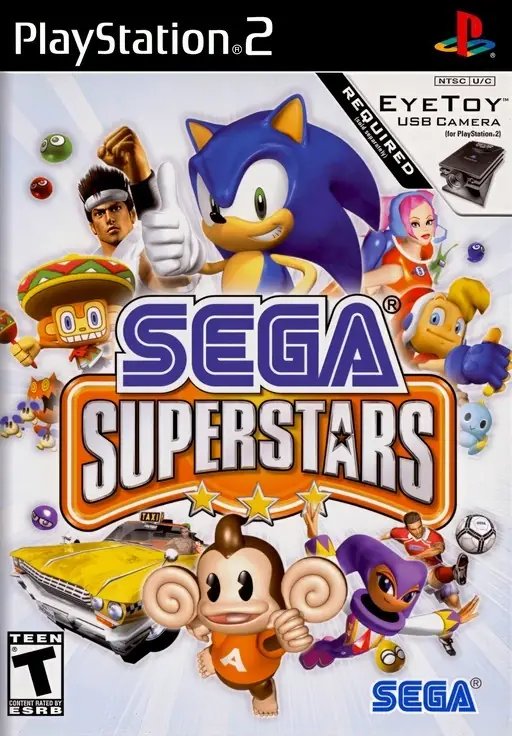
Sega Superstars cover

2004 · Sonic Team · Arcade · Crossover

Sega Superstars

PlayStation exclusive

There are a total of 12 different full games to play in the main mode of Sega Superstars:

Sonic the Hedgehog – As Sonic runs down a round tunnel, he follows the position of the player's hand. Using this method, the aim of the game is to gather rings and Chaos Emeralds in order to obtain the highest score at the end of the game. It is much like the Special Stage on Sonic the Hedgehog 2, Sonic Heroes, and especially Sonic Rush.

Samba de Amigo – Players choose a song, and then must hit 6 different targets around the screen as the 'beat balls' reach them in time with the music. Posing with hands over 2 of the targets, or holding one position until a trail of beat balls is complete, may also be required from the player.

ChuChu Rocket! – Movement over a certain target on the screen will cause a bridge to raise, which the chu-chus then follow to the goal. The bridge also must be dropped at certain moments to prevent KapuKapus from destroying the score.

Puyo Pop Fever – Differently colored puyos will fall from the top of the screen, and the player's body must be positioned to guide them into the corresponding pots and allow bombs to topple off the bottom of the screen.

Crazy Taxi – Large movements and loud sounds must be undertaken to stop the Crazy Taxi and complete the level.

Super Monkey Ball – The player must move their arms into different positions in order to guide the monkey ball around obstacles and towards the goal, picking up as many bananas as possible along the way.

NiGHTS Into Dreams – NiGHTS must be controlled and navigated through rings, collecting chips along the way, by raising your arms into a 'flying' position and adjusting them along the way.

House of the Dead – A multitude of different zombies must be attacked and defeated by hitting them. Innocent people who occasionally appear must also be avoided.

Virtua Striker – As footballs drop from the top of the screen, the aim is to head them into differently colored and scored balloons on the opposite side of the screen in order to obtain the highest score.

Virtua Fighter – Standing to one side, players kick and punch the corresponding attack prompts on the screen in order to defeat the opponent. Block and counter prompts also appear, and must be reacted to accordingly.

Space Channel 5 – Different dance move combination must be remembered when shown by the Morolians, and then repeated in time to the music by hitting six different buttons on the screen.

Billy Hatcher and the Giant Egg – By waving their hands over two different targets, players must move Billy and the egg around, and crush enemies and collect fruits along the way to the goal.

Also known as
Sega Superstars (Doukonban) · Sega Superstars (With Eyetoy) · Sega Superstars Eyetoy Bundle · EyeToy: Sega Superstars
Released
22 October 2004
Platforms
PlayStation 2
Genres
ArcadeCrossoverPartySports
Developers
Sonic Team
Publishers
—
Series
Sega Superstars
Modes
MultiplayerSingle-player
Perspective
First personThird person
Themes
ActionParty
Country
Japan
Age ratings
ESRB TPEGI 3
Languages
EnglishFrenchSpanishItalianGermanJapanese

About

Sega Superstars is a party video game developed by Sonic Team for the PlayStation 2. It was published by Sega and released in Europe on October 22, 2004; in North America on November 2, 2004; and in Japan on November 11, 2004. The game features several minigames based on various Sega titles that are controlled using the EyeToy peripheral. Upon release, the game received "average" review scores from critics.

Keywords

  • minigames
  • crossover
  • high score
  • motion control
  • eyetoy support
  • peripherals
  • spiky-haired protagonist
  • gesture-based controls

Media

Sega Superstars screenshot 1

The articlegameplay, story, development, reception

Gameplay

Gameplay is similar to that of EyeToy: Play, in which players use their body to play a variety of minigames. However, while that game only picked up player's movement, Sega Superstars uses a more advanced system. Before the start of each game, a setup screen with an orange area is shown. In order to start the game, players have to stand in a position where the orange area won't pick up any movement and select the continue button. This method determines what area is the background, allowing EyeToy to pick up the player's position, as opposed to just what areas are moving.

Sega Superstars features 12 minigames, each based on different Sega franchises. Rings earned in each game can be used in a Chao Garden mode, in which players raise Chao from the Sonic the Hedgehog series.

Sonic the Hedgehog — Using their hands, players must guide Sonic through a tube, collecting rings and Chaos Emeralds while avoiding bombs.

Super Monkey Ball — Players use their arms to control AiAi as he rolls in a ball through a maze, aiming to reach a goal without falling off the stage.

Samba de Amigo — Players move their hands over one of the six circles in time to the music.

Space Channel 5 — Players must copy dance moves given by the Morolian opponents by hitting monitors with their arms.

NiGHTS into Dreams — Using their arms as if they were flying, players guide NiGHTS through a series of rings and collectables.

The House of the Dead — Players use their body to attack zombies that appear on-screen, being careful not to hit any hostages.

Virtua Fighter — Players fight against various fighters, following command prompts to attack them while also defending against their attacks.

Billy Hatcher — Players must use rolling motions to help Billy Hatcher roll a giant egg around and clear each level.

Puyo Pop Fever — Players use their entire body to funnel colored Puyos into their respective departments, being careful not to accidentally roll in a bomb.

ChuChu Rocket! — Players use their hands to activate mechanisms and guide ChuChus to a rocket while protecting them from a hungry cat.

Virtua Striker — Players must knock falling soccer balls into floating balloons to score points.

Crazy Taxi — Players attempt to make as much movement and noise as possible to attract the attention of a taxi.

Development

Before Sega Superstars, few games had made use of the EyeToy. As such, the game was developed as a product that would combine the novelty of this accessory with the familiarity of Sega's first-party franchises to extend the long-term viability of the PlayStation 2 console. It was announced in April 2004, and exhibited at the Electronic Entertainment Expo (E3) and Tokyo Game Show events of that same year.

Reception

The game received "average" reviews, according to the review aggregation website Metacritic. In Japan, Famitsu gave it a score of two nines and two sevens for a total of 32 out of 40.
Releases by platformdates and regions as published

Releases by platform
PlatformReleasedRegions
PlayStation 222 October 2004Europe · North America 2 November 2004 · Japan 11 November 2004

Title IDsone per regional release, with its latest update

Title ids and disc serials by release
PlatformTitle IDRegionLatest update
PlayStation 2SCES-52834Europe—
SCES-52885Europe—
SLED-52875Europe—
SLES-52834Europe—
SLES-52885Europe—
SLPM-62554Japan—
SLPM-62559Japan—
SLUS-20999North America—

Box artone per regional release we hold art for

In the same series

Games like this

Collections4 collections

Platform libraries

Publishers

Description adapted from its source, CC BY-SA 4.0.