Ludography
85/100
Players5 ratings
82/100
Critics2 reviews

Where to get it

Final Fight: Double Impact cover

2010 · Bundle / compilation · Proper Games · Fighting · Beat 'em up

Final Fight: Double Impact

Bundle / compilation

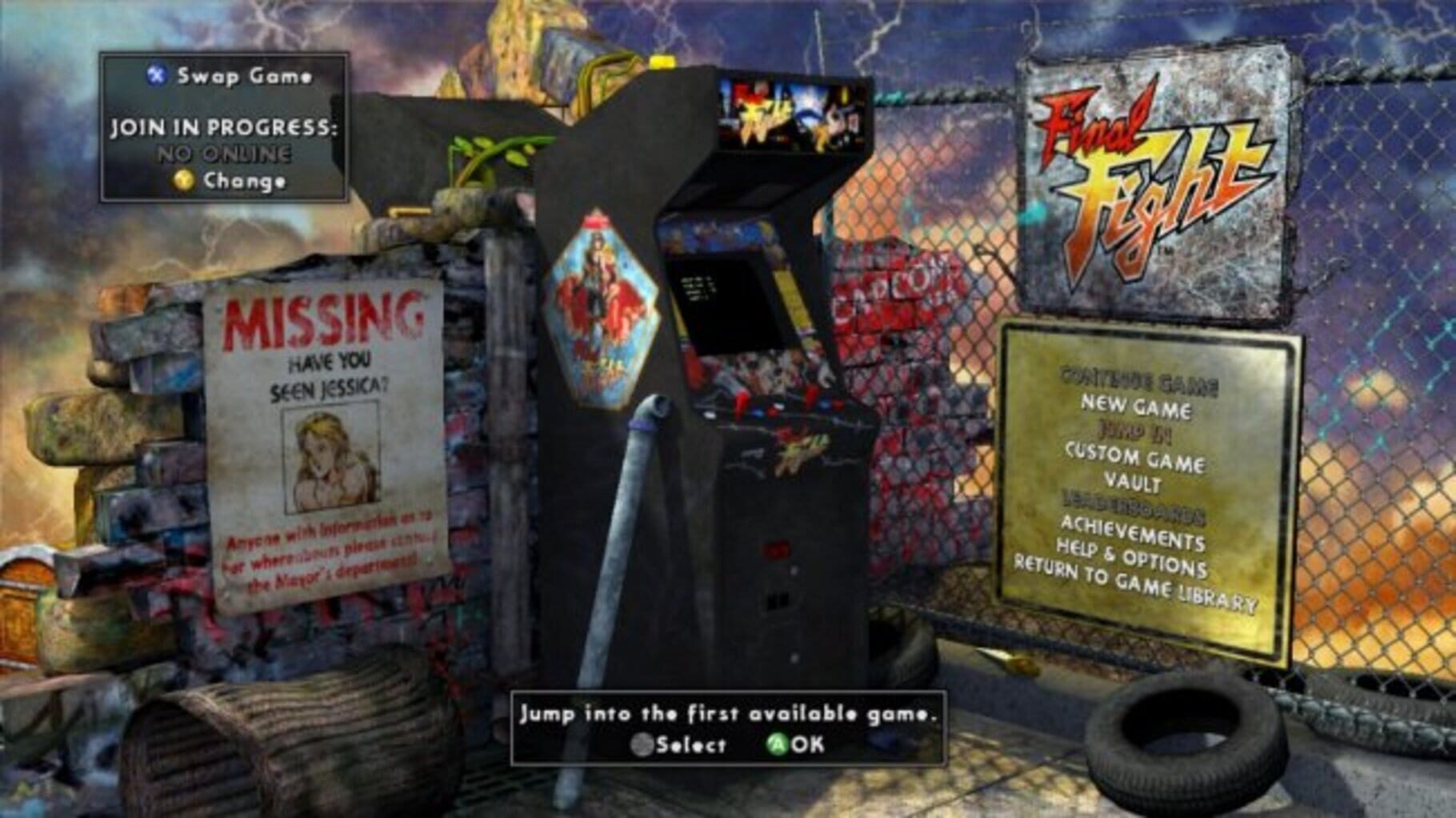
The arcade version of Final Fight was released in a two-in-one bundle titled Final Fight: Double Impact, alongside the arcade game Magic Sword, released digitally for Xbox 360 and PlayStation 3. Added features include various graphic filters, including an arcade cabinet view, online drop-in multiplayer, an arranged soundtrack composed by Simon Viklund (who worked on Bionic Commando Rearmed), and extra content such as concept art, Street Fighter comic pages featuring Final Fight characters, and the "Final Fight" episode of the Street Fighter animated series, which are unlocked by completing certain in-game challenges.

Also known as
Magic Sword · Final Fight/Magic Sword Bundle · Fainaru Faito - Majikku Soudo · Final Fight - Magic Sword: Heroic Fantasy
Released
15 April 2010
Platforms
PlayStation 3Xbox 360
Genres
FightingBeat 'em up
Developers
Proper Games
Publishers
Capcom
Modes
Co-opMultiplayerSingle-player
Perspective
Side view
Themes
Action
Engine
CP System II (CPS-2)
Age ratings
PEGI 16GRAC 12+CLASS_IND 12ESRB T

About

Final Fight is a 1989 beat 'em up game developed and published by Capcom for arcades. It is the seventh title released for the CP System hardware. Set in the fictional Metro City, the player controls one of three street fighters: former pro wrestler and city mayor Mike Haggar, expert brawler Cody Travers, and modern-day ninja Guy. The trio set out to rescue Jessica (Haggar's daughter and Cody's girlfriend) when she is kidnapped by the Mad Gear Gang.

The game began development as a sequel to the original Street Fighter released in 1987, under the working title Street Fighter '89. However, its genre was switched from a fighting game to a beat 'em up, and the title was changed to Final Fight following the success of Technōs Japan's Double Dragon. Final Fight was ported to various home computers and consoles, including the ZX Spectrum, Super NES and Sega CD.

›Story

Final Fight:

The story of Final Fight takes place from within the fictional city of Metro City, in which both crime and violence has ruled the streets for many years and that the citizens themselves live in a complete state of constant fear and danger at the hands of the local street gangs, which has given Metro City an infamous reputation in being a well-known crime capital of the world. A former professional wrestler and street fighter turned newly-elected mayor, named Mike Haggar had made a personal vow to the public from within his past campaign in that he would help clean up the streets of both crime and violence so that the citizens of Metro City could finally gain the peace and happiness that they had sought and wanted for so long.

The Mad Gear Gang: the most powerful and dominant criminal organization of Metro City's criminal underworld, sees Haggar as a potential threat to their own violent rule of the city, which causes the gang to create and initiate an immediate plan of action so that they could make sure and see to it that Haggar himself doesn't get in the way of their own criminal activities. While in his office one day, Haggar receives an unexpected phone call from a suspicious sounding man who tells him that his young daughter, Jessica has been kidnapped by Mad Gear and he also warns Haggar that unless he doesn't want anything bad happening to her, he'll let the gang do as they please like the last mayor did before him. Upon knowing and realizing the dire threat at hand, Haggar wastes no time in meeting up and informing both his daughter's boyfriend Cody and his sparring partner Guy about the entire situation, which causes Cody and Guy to know and realize the fact that they can't allow Mad Gear to get away with this and that the two of them personally vow to aid and help Haggar out in saving Jessica and defeating Mad Gear.

From there, the trio of Haggar, Cody, and Guy head into the streets of Metro City to bust Mad Gear's skulls, fighting their way through the hordes of goons littering the city and also battling against the top ringleaders of Mad Gear, which includes the Caribbean thug Damnd, the American Japanophile Sodom, the corrupt cop Edi. E, former Red Beret and militia leader Rolento, and the ill-tempered Abigail. After fighting and battling against all of Mad Gear from within their rescue mission, Haggar, Cody, and Guy soon confronts the Mad Gear's boss and leader, the crooked businessman Belger from upon the top floor of a large building which serves as Belger's penthouse apartment. After a tough and intense final fight, Cody knocks Belger out of the window with a strong uppercut punch, sending him falling to his death below while Jessica is rescued and saved from the current danger, culminating with Cody and Jessica sharing a passionate kiss with each other as the young couple are emotionally happy to be reunited with one another after the entire ordeal.

The original Japanese version of the Final Fight intro states that the game takes place in 1989, and provides the corresponding ages and birthdates for each of the main characters. The English language version changes the setting to "Sometime in the 1990s..." and only provides the birthdates for the characters. The English translation featured in Final Fight One reverts back to the original 1989 date.

Magic Sword:

A long time ago, a powerful sorcerer known as Lord Drokmar was seduced by the dark powers of the Black Orb, who promises eternal life to its wielder, and attempted to cover the world in darkness to create a lightless hell on Earth. A brave warrior of light, however, stopped his plans and confined the demon inside the 50-floor tall Dragon's Tower. For unknown reasons, however, the brave warrior was unable to fully destroy the Black Orb at the time.

Now, suddenly the Black Orb has returned to its master, and Lord Drokmar has ressurected from within the tower alongside an army of ghouls and demons from Hell. The influence of his magic spreads across the lands as Drokmar resumes his plans to capture all light within the Black Orb and rule over a darkened world. The hopes of the inhabitants once again rests on a brave warrior determined to fight against the armies of Hell throughout the 50 floors of the Dragon's Tower, defeat Drokmar and shatter the Black Orb once and for all. However, is he the right person? can he resist the temptation presented by the Black Orb?

Keywords

  • death
  • hand-to-hand combat
  • brawler
  • side-scrolling
  • multiple protagonists
  • bromance
  • achievements
  • crime
  • high score
  • boss fight
  • digital distribution
  • bonus stage

Media

The articlegameplay, story, development, reception

Gameplay

Final Fight can be played by up to two players simultaneously. Before the game begins, the player chooses between the three main characters: Haggar, Cody and Guy. Each has his own fighting style and attributes. Health gauges are displayed for both player and enemy characters.

The controls for Final Fight consist of an eight-way joystick and two buttons, one each for attacking and jumping. By entering different combinations of joystick moves and button presses, the player can perform a variety of attacks:

Story

The game is set in a fictional city on the Atlantic coast in the United States named Metro City, analogous with New York City. According to the game's intro, in the 1990s, or 1989 in the Japanese version, the city's crime rate reached alarming levels, but since the election of pro wrestler turned politician Mike Haggar as the new Mayor, Metro City was changed and cleaned up drastically. Under his term, Haggar managed to suppress the crime rate of the city to its lowest points.

While the citizens of Metro City were thankful for Haggar's hard work in curbing crime, the Mad Gear Gang, who had served as the dominant criminal organization of Metro City, would not go down so easily. Under the leadership of the crooked businessman Belger, the group attempted to bribe Haggar with a large payoff to keep him from going after them, to which Haggar refused. Still determined to bring Haggar under their rule like the last mayor before him, Mad Gear proceeded to kidnap his daughter Jessica and create further unrest among the citizens.

Development

The game was designed by Akira Nishitani, and produced by Yoshiki Okamoto. When coming up with the game's concept, Okamoto cited the arcade game Double Dragon II: The Revenge (1988) as his basis for Final Fight. The game was originally shown at trade shows under the title of Street Fighter '89. According to Okamoto, the sales division of Capcom originally requested a Street Fighter sequel, so his team decided to promote Final Fight as a Street Fighter sequel at trade shows (going as far to refer to one of the main characters as a "former Street Fighter"). The title was changed to Final Fight before its official release after feedback from operators stating that the game was nothing like Street Fighter.

According to the developers, they were originally planning to have Ryu and Ken Masters from the original Street Fighter as the playable protagonists, but that idea was scrapped for a new plot and new settings, involving the kidnapping of an attractive young woman by a city gang. Capcom's president wanted the team to develop the game as if it was a film, so he made the team watch a number of films. Nishitani's team then approached the "planning and design as if it were a movie."

Reception

In Japan, Game Machine listed Final Fight on their January 15, 1990 issue as being the second-most-successful table arcade cabinet of the month. It went on to be the highest-grossing arcade game of 1990 in Japan (according to the annual Gamest charts), as well as Japan's second-highest-grossing arcade game of 1991 (just below Street Fighter II).

Overseas, the game had a successful launch in North America and Europe. In the United States, it was a blockbuster hit, becoming the top-grossing new video game on the RePlay arcade charts in February 1990, and then the top-grossing software conversion kit for eight months in 1990, from March to April, then from June to October, and then December. During November and December, weekly coin drop earnings averaged $183.50 per kit. It ended the year as America's highest-grossing arcade conversion kit of 1990. Final Fight sold a total of 30,000 arcade units worldwide.

Legacy

Final Fight was followed by a few sequels. The total sales of the Final Fight series have totaled 3.2 million units for home systems.

The Super Famicom version of the game is a key element in the plot of the manga Hi Score Girl and its Netflix anime adaptation.

Releases by platformdates and regions as published

Releases by platform
PlatformReleasedRegions
Xbox 36015 April 2010North America · Europe 15 April 2010
PlayStation 315 April 2010Europe · North America 15 April 2010

Title IDsone per regional release, with its latest update

Title ids and disc serials by release
PlatformTitle IDRegionLatest update
PlayStation 3NPHB00157Asia—
NPEB00168Europe—
NPUB30087North America—

Editions and related releases

Included in
Capcom Digital Collection
Includes
Final FightMagic Sword

Games like this

Collections4 collections

Description adapted from its source, CC BY-SA 4.0.