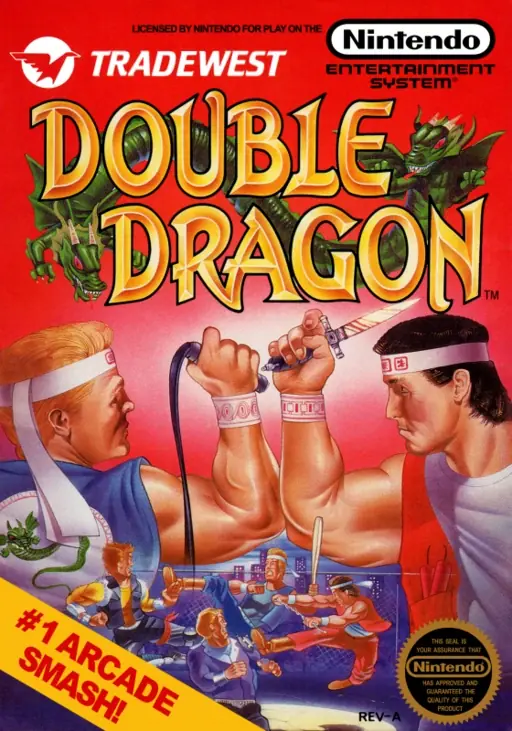
The articlegameplay, story, development, reception
Gameplay
The game is displayed in a belt scroll format, like Kunio-kun. In contrast to the arena-like levels in Kunio-kun, Double Dragon takes place in a continuously side-scrolling world.
The player takes control of martial artist Billy Lee, or his twin brother Jimmy (also known as Hammer and Spike in the supplementary materials for the American arcade release), as they fight their way into the turf of the Black Warriors gang in order to rescue Billy's girlfriend, Marian. The player character has a repertoire of martial arts techniques which they can perform by using the joystick and three action buttons (kick, jump, and punch) individually or in combination. Techniques range from basic punches and kicks to more elaborate attacks such as throws and elbow strikes. When playing with another player, one can grab an opponent from behind, allowing the other to attack unimpeded; some enemies are able to do the same thing to the players.
The player begins the game with a certain number of extra lives and a life gauge which depletes as the player takes hits, and must complete each stage within a time limit. One life is lost if either the life gauge or timer reaches zero, or if the player character falls off the bottom of the screen or into a hole, river, or bed of spikes.
Certain enemies carry melee weapons, which can be knocked out of their hands and picked up to use against them. Available weapons include baseball bats, whips, throwing knives, and dynamite; in addition, rocks, oil drums, and boxes can be found in certain places.
The game is divided into four different stages or "missions", which consist of a city slum, a factory, a forest, and the gang's hideout. The first three levels takes place in a single long map, with the change in background music indicating the presence of a boss character. When a boss is defeated, the remaining underlings will retreat and the player character will enter an automatic transition sequence where he will walk into the next stage. There's also another transition sequence near the end of the third stage just as the player reaches the entrance of the gang's hideout.
The fourth and final stage is set inside the hideout on a separate map as the players fight their way through numerous traps until reaching the main hall where Willy awaits. The Double Dragon title theme plays during this period. The game normally ends if Willy is defeated by a single player, but if both Lee brothers manage to complete the game together, they will be forced to fight each other in order to determine who will win Marian's affections. Both life gauges are refilled, any extra lives are taken away, and the timer is reset for this fight.
Development
The game's development was led by Yoshihisa Kishimoto, who had previously created the 1986 arcade beat 'em up Nekketsu Kōha Kunio-kun, which was a semi-autobiographical game based on his own high school years and was localized as Renegade in the West. Following its release, he was asked by his seniors at Technōs Japan to create a follow-up, which they suggested should be two-player as that could earn more money in video arcades. He originally envisioned what would become Double Dragon as a Kunio-kun game, a direct sequel to Nekketsu Kōha Kunio-kun, before his seniors asked him to design an art style that would appeal to international audiences. This led to Kishimoto changing it to a spiritual successor with a new cast and setting, rather than a direct sequel.
He came up with a new title, Double Dragon, with the "Double" referencing the two-player gameplay and the "Dragon" a homage to Bruce Lee's martial arts film Enter the Dragon (1973), which was a major inspiration behind Kunio-kun and Double Dragon. For the game's setting and art style, he replaced the high-school-themed setting of Kunio-kun with a disaster-ridden city inspired by the Mad Max films and the manga and anime series Fist of the North Star. Kishimoto also expanded the game world to make it a continuously side-scrolling world, adding a sense of progression to the game. This, along with the use of cut scenes, also gave it a cinematic look and feel.
The original arcade version displayed 384 colors on the screen, out of a 4096 (12-bit) color palette. The hardware used several 8-bit microprocessors running in parallel. Along with the multiple Hitachi HD6309 based processors, multiple processors were dedicated to sound, such as the Yamaha YM2151 FM synthesis sound chip.
Reception
The arcade game was a blockbuster hit. In Japan, Game Machine listed Double Dragon as the most successful table arcade cabinet of June 1987. It went on to be the third highest-grossing table arcade game of 1987 in Japan. In Europe, it was the top-grossing arcade game on the UK's Deith Leisure arcade charts in July and August 1987.
In the United States, it was the biggest arcade hit since Pac-Man, becoming the highest-grossing arcade video game of 1988 and again the highest-grossing dedicated arcade game for a second year in 1989. In 1988, Taito America sold over 10,000 dedicated arcade cabinets in the United States, where the game was purchased by over 80% of arcade operators. The game went on to sell 40,000 arcade units worldwide, including 26,000 arcade units in the United States. However, Taito America's earnings were negatively impacted by pirated printed circuit board (PCB) arcade conversion kits, which led to a lawsuit that it eventually won in 1989.
The NES and Master System ports were also highly successful. Toys "R" Us reported that the NES version of Double Dragon sold out in its first two weeks on sale in the United States, becoming America's top-selling game by July 1988. The NES version sold 100,000 copies within 30 days of release in the US, where it drew controversy concerning video game violence. With demand for 1 million cartridges, it was among the most in-demand games through Christmas 1988, along with Nintendo's Super Mario Bros.
2 and Zelda II: The Adventure of Link. Double Dragon's chart-topping sales on home consoles continued with the Atari 2600 version by Activision going on to sell nearly 500,000 copies, making it one of the most popular games on the console, even as it was approaching the end of its lifespan. In the United Kingdom, Melbourne House's ZX Spectrum and Commodore 64 ports topped the software sales chart in late 1988, while Mastertronic's Amiga port topped the Amiga chart in early 1990, and Mastertronic's budget C64 release was the third top-selling C64 game in June 1991. Mastertronic's home computer ports went on to sell 289,510 units in the UK.
The original arcade version was well-received upon release. In the August 1987 issue of Commodore User, Ferdy Hamilton gave it ratings of 9 for graphics, 7 for sound, 9 for toughness, 10 for endurance, and 9 for value, with an overall score of 9 out of 10. He noted the game's popularity, stating that it took him "about half an hour to get near it in my local arcade" and "a brief glance around West End arcades confirmed" that "Double Dragon is set to be a massive coin-op hit". He said that it "isn't an easy game to play initially" and requires "both brain and brawn", described the graphics as "superb, the handling likewise", and stated "the variety of actions, locations and enemies make this a true state of the art Beat 'Em Up, centuries beyond those old Kung Fu games which still litter the arcades".
He concluded it to be "a strong contender for hottest beat 'em up yet". In the July 1987 issue of Computer and Video Games, Clare Edgeley described the "sordid street fights" as "great fun when you've got the guts" and "if you manage to get hang of the controls". She concluded that "all the ingredients are there for a really addictive, martial arts style kick 'em to bits".
In the October 1987 issue of Crash, the reviewer Tony described it as "the best game of its kind around" and "thoroughly addictive". In the November 1987 issue of Your Sinclair, reviewer Peter Shaw stated that if "you liked Taito's Renegade, you'll jest lurve Double Dragon", describing it as "a streetfighting beat 'em up, but much nastier", with sprites "much bigger than the ones in Renegade, which adds to the realism", and "gruesome sound effects", concluding that it is "great stuff, and really good value, even for 30p a throw".
The critical reception of the home versions varied depending on the version's quality. The Master System port was well received, with positive reviews from Computer and Video Games, The Games Machine, and Mean Machines Sega. The NES version was also well received, including a positive review from Computer and Video Games.
The home computer versions received mixed reviews. Computer Gaming World noted the limitations of a joystick caused the IBM and C64 ports to use fewer moves than the arcade, the C64 port, in particular, being "a pale shadow of the original". Compute! wrote that the Commodore 64 version added a two-player mode, but lacked some arcade features such as moving objects, climbing most ladders, and detailed animation. The Mega Drive/Genesis version also received mixed reviews; Mega placed the game at number ten on its list of the "10 Worst Mega Drive Games of All Time".
Electronic Gaming Monthly awarded it Game of the Year for 1988.
Double Dragon has been listed among the best video games of all time, by publications such as Electronic Gaming Monthly, Empire, and Game Informer, as well as sites such as G4, GameSpot, GamingBolt, Killer List of Videogames, NowGamer, and Yahoo! Spanner of Retro Gamer magazine named it his favorite game of all time.
Legacy
Double Dragon ushered in a "Golden Age" for the beat 'em up genre that took it to new heights with its detailed set of martial arts attacks and its two-player cooperative gameplay. Double Dragon's success resulted in a flood of beat 'em ups in the late 1980s. Subsequent beat 'em ups during the late 1980s to 1990s followed the conventions set by Double Dragon.
Double Dragon was followed by two arcade sequels: Double Dragon II: The Revenge in 1988 and Double Dragon 3: The Rosetta Stone in 1990. Both games were also followed by various home versions. Technōs produced the fourth game in the series titled Super Double Dragon, released for the Super Nintendo Entertainment System in 1992. In 1993, a crossover, titled Battletoads & Double Dragon and featuring characters from both franchises, was released for various platforms.
Also in 1993, a Game Gear game by Virgin Games was released titled Double Dragon: The Revenge of Billy Lee. Billy and Jimmy also appeared in the 1990 NES game Super Spike V'Ball. The characters of Randy and Andy in the 1989 NES game River City Ransom are based on Billy and Jimmy; in Japan, they are known as Ryūichi and Ryūji and they appear in later Kunio-kun games as well.
Another game developed by WayForward Technologies, Double Dragon Neon, was released in 2012 for Xbox Live Arcade and PlayStation Network.
Double Dragon also spawned a series of related media in the United States, which includes a six-issue comic published by Marvel in 1991, an animated TV series which ran for two seasons from 1993 to 1995, which influenced a live-action film in 1994. In turn, the animated series and movie inspired their respective video game spin-offs as well, both which were fighting games. The cartoon inspired the Tradewest-developed Double Dragon V: The Shadow Falls, released in 1994 for the SNES and Genesis (also ported to the Atari Jaguar), while characters and plot elements from the film were adapted into the 1995 Technōs-developed the Neo-Geo version of Double Dragon.
Double Dragon is one of the video games featured in the manga titled Rock'n Game Boy, by Shigeto Ikehara and Published by Comic BomBom October 1989 to December 1991.
Not specific to any format/system, the original game was used as a clue in the 2015 episode of Jeopardy! in the category "The Marian Kind" in the first round on February 17.
The boss Abobo is the star of an unlicensed parody game developed to homage the series, Abobo's Big Adventure.