
The articlegameplay, story, development, reception
Gameplay
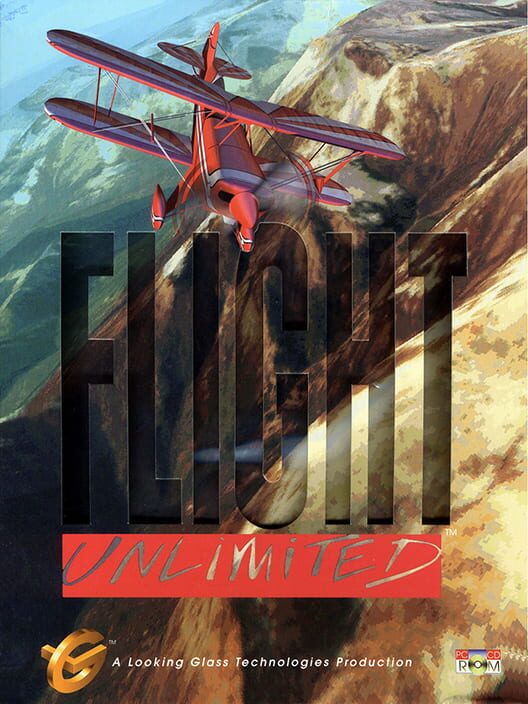
Flight Unlimited is a three-dimensional (3D) flight simulator video game: its gameplay is a simulation of piloting real-world airplanes. Players may control the Bellanca Decathlon, Extra 300S, Pitts Special S-2B, Sukhoi Su-31 and Grob G103a Twin II sailplane. The game begins at the fixed-base operator (FBO) interface—a traversable 3D room whose contents represent menu options. For example, the player interacts with a row of scale airplane models to select an aircraft, and with a world globe to change airfield locations. Six settings are available, including Sedona, Arizona and Springfield, Vermont.
The player may choose to begin flight on a runway or taxiway, or in the air. Aircraft are controlled via keyboard, joystick, head-mounted display or specialized input devices such as pedals. During flight, several third- and first-person camera angles may be selected. For example, the third-person Flyby View places the camera in front of the plane as it flies past, while the first-person Three-Way View displays more information about the plane's position and speed than other angles.
Certain camera angles, including the Three-Way View and 3-D Cockpit view, provide the player with simulated flight instruments such as an altimeter, airspeed indicator, accelerometer, variometer and tachometer. The game is designed to allow players to perform aerobatic maneuvers such as the Immelmann turn, tailslide, Lomcevak and Cuban Eight. Performances may be recorded and played back, with controls that allow the player to pause, rewind and fast forward. At any time, the player may stop a recording and resume flight from that point.
The game contains lessons that cover basic and advanced flight techniques, ranging from rudder turns to challenging aerobatic maneuvers. A simulated flight instructor offers real-time advice based on the player's performance. Certificates are earned by performing well during lessons. In Hoops courses, the player undertakes a time trial through rings that float in the sky, with the option to enable a "ghost plane" of the highest score.
Four types of Hoops courses are available: Basic, Challenge, Distance and Trick. The last is intended as a highly demanding test of the player's aerobatic ability. The game's sole non-powered aircraft, the Grob G103a Twin II sailplane, features its own game mode focused on energy management. The player attempts to use the direction of the wind, thermals—which realistically occur above areas that absorb more heat, such as plains and parking lots—and the orographic lift caused by slopes to stay airborne for as long as possible.
Development
The concept of Flight Unlimited originated from Looking Glass Technologies' discontent with contemporary flight simulators. Company co-founders Paul Neurath and Ned Lerner wanted to develop an exceptional game in the genre, and Neurath considered the idea during the production of Ultima Underworld: The Stygian Abyss and Ultima Underworld II: Labyrinth of Worlds. In 1992, Seamus Blackley, who had been undertaking graduate studies in particle physics at the Fermilab research facility, was hired through a want advertisement that Lerner had placed on a bulletin board. At the company, Blackley programmed the physics modeling system for a racing game and designed a large number of standalone physics demonstrations.
He became fascinated by physics programming. An amateur pilot and flight devotee, Blackley asked Lerner extensive questions about his earlier game Chuck Yeager's Advanced Flight Trainer, which Blackley held in high regard. In reaction to Blackley's enthusiasm, Neurath suggested that the company develop a "traditional Cessna sim".
However, Blackley instead proposed an aerobatics training simulation, which he had conceived while reading an aerobatics magazine on a Lexington, Massachusetts bus. Collaborating with Ultima Underworld II programmer Greg Travis, he created a thirty page concept document that outlined the game. His core idea was to recreate the "yummy, visceral, fluid feeling that you get when flying a real airplane". He wanted the project to bear more resemblance to a playground than to a video game, and he sought to give it simple controls and realistic terrain to decrease the learning curve for beginners.
Blackley assumed the role of project leader and then engaged the team in "flaming sessions" to generate ideas. According to programmer Doug Church, Blackley's concept of the game was not fully developed, but he clearly expressed his thoughts and motivated the team. The first months of the project produced disparate prototypes that demonstrated prospective features. The company committed to full development of the game in early 1993, and production commenced in March.
Blackley's first objective was to code the game's simulated physics. He began by deciding on a programming method—in particular, he sought one that would allow aircraft to perform the "knife-edge spin" maneuver that he had witnessed at air shows. In 1995, he said that he had never played a flight simulator with an accurate sense of flight. He later described his belief that the genre had stagnated, and that flight games were evaluated "by [their] implementation of the standard feature set", rather than by their enjoyability.
Blackley researched physics programming in contemporary flight simulators, and he discovered that many used large databases of wind tunnel and plane sensory equipment information to dictate how aircraft would operate in prerecorded scenarios. Higher-end simulators used a "Newtonian" system, in which algebra-based measurements of force vectors determine a plane's position in real-time. However, Blackley believed that neither system correctly simulated the experience of flight.
In reaction, he used his knowledge of particle physics to create a real-time computational fluid dynamics (CFDs) model for Flight Unlimited. The result is a simulated atmosphere: air acts as a fluid that automatically reacts to the shape of any object placed within it. Blackley gave the example that a lawn chair, if placed within the game's real-time CFDs model, would fall merely because of its shape. The game's planes fly because the interaction of their architecture with the atmosphere creates lift, as with real-world aircraft.
Changes in the plane's direction are caused by the interaction of their flight control surfaces (ailerons, elevators and rudders) with the simulated atmosphere. Because it simulates the dynamics of flight in real-time, the system allows for aerobatic maneuvers that were impossible in previous flight simulators. In 1994, Blackley said that it was possibly the first flight code designed for aerobatics. In constructing the CFDs model, Blackley and the team built from the Navier–Stokes equations of fluid motion, which Blackley described as "horrible, complicated partial differential equations".
According to Computer Gaming World, Blackley did not seek to represent the equations with perfect accuracy, and he was satisfied when the results were consistent and the sensation that they generated was correct.
After programming a basic version of the CFDs model, Blackley used several programs to examine the simulated currents of air that flowed across a model of a flat plate. He adjusted the code until the plate fell realistically, and then constructed test models for a plane wing and fuselage. He eventually built a complete but dysfunctional plane by using data from "pinhead books". By reading aircraft design manuals, he discovered that the problems were caused by his plane's incorrect tail and center of gravity.
Following this, he created an exact three-dimensional model of the Extra 300S over roughly three days. As he had not yet simulated the physical attributes of its propeller, Blackley programmed the plane to be propelled from the rear. However, the accurate model performed properly in the simulated atmosphere.
Artists Mike Marsicano and Kurt Bickenbach played critical roles in the creation of the game's aircraft models, which were built in 3D Studio. As reference material, the team photographed real planes at several airfields, and they received blueprints and datasheets from aircraft manufacturers. The game's Grob G103a Twin II sailplane was based directly on the one that Blackley owned at the time. The sophistication of the real-time CFDs complicated the 3D modeling process, as the planes required accurate geometry to fly properly. While attempting to meet this goal, however, Bickenbach said that the models he created were overly detailed, which caused the team to struggle with performance
Reception
Flight Unlimited was a commercial success. 1 took first place. The game went on to sell more than 300,000 copies by 1997, and more than 780,000 by 2002. According to Constantine von Hoffman of the Boston Herald, Flight Unlimited successfully competed with Microsoft Flight Simulator.
PC Gamer's Lee Buchanan wrote that it "soars above the pack of flight simulations", and he considered it to be "the most fun [he had] had in a computerized cockpit". Frank Vizard of Popular Mechanics hailed it as "the new top gun of flight simulators", and Doug Bailey of The Boston Globe considered it to be the "first real serious challenge to Microsoft's dominance of the genre". The Record's David Noack believed that the game's physics and stereoscopic terrain set "a new standard in flight simulation". Writing for Computer Gaming World, Bob and John Nolan stated, "If anything, you should at least take a look at this product, because you'll be looking at the future of simulations."
The game was a finalist in the 12th Annual Awards for Technical Excellence held by PC Magazine, whose staff called it "the simulator by which all others will be judged." It was named the best simulation of 1995 by Computer Games Strategy Plus (tied with Apache), and the best of 1996 by Macworld, whose editor Steven Levy wrote that it "puts you in touch with what makes flying special." Inside Mac Games and PC Gamer both nominated Flight Unlimited as the simulation of the year, although it lost these awards to A-10 Cuba! and Apache, respectively.
Vizard stated that Flight Unlimited's "very advanced computational fluid dynamics make [each] plane react according to spec". Buchanan lauded the fluid model for creating a "sensation of actual flight [that] is nothing short of magnificent", while PC Magazine's staff commented that it makes "planes behave more like real aircraft than any simulator we have seen". Bob and John Nolan called the game's physics programming "groundbreaking", and Chris Ware of the Lexington Herald-Leader found the game to be the most accurate simulation of flight beyond "those multimillion-dollar flight simulators [used by] fighter pilots and astronauts". Noack agreed: he wrote that the game "is about as close to flying within going to the airport".
In 1996, Computer Gaming World presented Flight Unlimited with a Special Artistic Achievement Award For Physical Model. The magazine's staff praised Blackley's programming for pushing the genre "higher into the realm of simulation", and listed the game's sophisticated physics model as #5 on its list of "the 15 best ways to die in computer gaming".
Ware found Flight Unlimited approachable and noted its "simplicity of use and depth of instruction". Buchanan hailed the lesson mode as "a dream come true for any budding pilot". A writer for The Washington Post called the game "[the] world's first truly easy-to-use flight simulator" and "a good entry product", in which "rank amateurs can just launch the program and start cruising immediately". The Washington Post's John Gaudiosi wrote that, while many games in the genre are overly complex, Flight Unlimited lets "those who aren't rocket scientists ...
experience the thrills of stunt flying." He found its control scheme simple to understand. By contrast, Bailey found the game difficult and initially "frustrating": he complained that he had to play the lesson mode before even taking off. Denny Atkin of Computer Gaming World characterized the game's learning curve as steep, thanks to the accuracy of the physics programming, but he noted the scalable difficulty options.
Bailey later recommended the game in a holiday shopping guide. He wrote that "it can be difficult to master. But once you're up, it's worth the trouble."
A writer for The Washington Post commented that "serious flight freaks will like the racing and advanced maneuvers". According to Gaudiosi, dedicated players will learn "all about aerodynamics and stunt flying"; he considered the latter to be "hard stuff, even with green hoops guiding you". Similarly, Buchanan characterized the Hoops courses as "incredibly demanding", and Atkin cited that mode's Trick difficulty level as "amazingly tough". Bob and John Nolan wrote that people who "love to loop around the skies of Flight Simulator 5 will go bananas for" the aerobatics; but the pair commented that combat flight simulator players "might get a little edgy once the wow-power wears off."
However, Atkin believed that only those "never happy without something to shoot at" could be disappointed by the lack of combat: other players will "be too busy choreographing aerial ballets, pulling off death-defying aerobatic stunts, or just enjoying a quiet soar down the ridge line to miss that stuff". Likewise, Ware called the non-violent gameplay "refreshing", and Buchanan wrote, "If [you are] a battle-weary veteran of air combat sims, Flight Unlimited might be just the sort of [rest and relaxation] you need."
Atkin found the cockpit and terrain graphics to look "almost real". He commented, "Every few years a sim comes along that lets reviewers use the 'sets new standards for graphics' cliché, and Flight Unlimited is the 1995 entry in this club." Bob and John Nolan called Flight Unlimited "the ultimate show off piece for your new Pentium", thanks to "unbelievable" graphics superior to those of any other computer game. Gaudiosi concurred: he characterized the visuals as "photo-sharp" and "better than any I have seen".
PC Magazine's staff found the graphics "impressive" and "even more stunning than those in Microsoft Flight Simulator". Ware noted the "stunning 3-D photo-realistic scenery", while Bailey stated that the "graphics are brilliantly rendered and whiz by smoothly". Buchanan called Flight Unlimited's terrain "just superb" and Vizard described it as "amazingly real". Buchanan believed that "what you hear in Flig


