The articlegameplay, story, development, reception
Gameplay
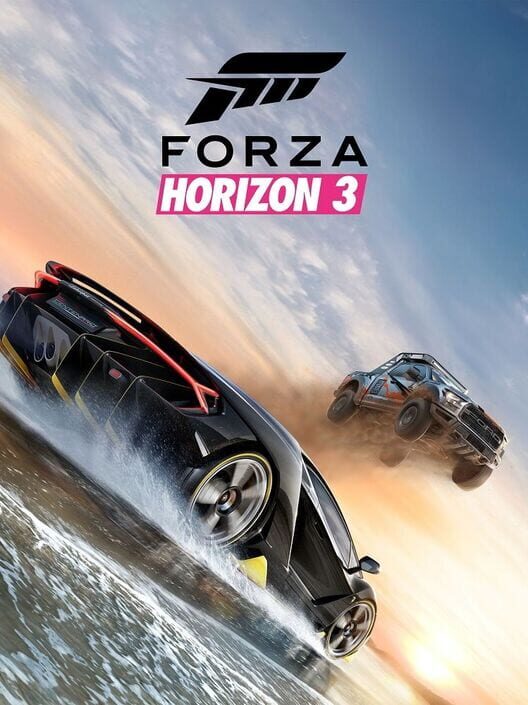
Forza Horizon 3 is a racing game set in an open world environment based in a fictional representation of Australia. The gameplay world is about twice the size of Forza Horizon 2, and the game contains locales and regions based upon their real-life Australian counterparts. While previous Forza Horizon games have depicted the player as being one of the racers of the Horizon Festival, the player is now the director of the festival, and their role is to expand it throughout Australia by completing races, challenges, and stunts to earn fans. If enough fans are earned at a certain threshold, the player can set up new festival locations and unlock more events.
Three types of racing modes are available in the game: Exhibition, Championship, and Rivals. Exhibition is a single race at one location, whereas Championship contains multiple races dispersed throughout the gameplay world. Rivals is a versus race against the player and an AI opponent, where the player has to compete in a time trial to beat the time set by the opponent. Added in Forza Horizon 2, the player can also participate in Bucket List Challenges, where they are given a task to complete with a specific vehicle. The newly introduced Horizon Blueprint feature lets the player customise races and Bucket List Challenges.
Apart from races and Bucket List Challenges, the player can engage in several other activities. Breakable boards called "bonus boards" can be discovered around the gameplay world, and when driven over, they award the player with experience points or a discount on fast travelling. As the player progresses through the game, they can receive rumours of barn finds to uncover and restore. When performing stunts with a vehicle, the player is awarded "skill points".
If enough skill points are acquired, they can be used to purchase perks that may award cars, experience points, in-game currency, and driving advantages, among other benefits. The player may participate in Forzathon competitions, which provide weekly challenges and give awards once completed.
Returning from previous Forza games, Forza Horizon 3 features a vehicle AI called Drivatars, which learns and mimics the driving abilities of Forza players. Drivatars are found throughout the gameplay world, and they appear in races as opponents, where they can be adjusted by game difficulty via the player. Apart from standard races, Drivatars can be challenged to a head-to-head race. If the player wins the race, they will be able to recruit that Drivatar onto their racing team, which allows the player to earn additional experience points, fans, and in-game currency.
The player can also recruit Drivatars in a car convoy. When in a car convoy, Drivatars will follow the player, and they can be upgraded by skill points to perform certain tasks throughout the game.
The player can upgrade and tune individual parts of their vehicles, with body kits being available as well. Additionally, the game includes a vehicle customisation option called "Upgrade Heroes", which utilises both tuning and body kits to alter both a vehicle's performance and appearance, although the customisation preset is limited to a certain number of vehicles. The colour of vehicles and their collective parts can be changed, and the player can also design liveries for vehicles. These liveries can be sold through the in-game shop, which further includes an auction system to bid on cars from other players. A total of 350 vehicles were available at the game's launch.
Forza Horizon 3 offers open world multiplayer modes including an online cooperative mode for up to four players and a competitive mode for up to twelve, where players can compete in races and minigames with their vehicles. As from previous Forza games, the player can join clubs, where they have the ability to compete against players of other clubs in races and minigames.
Due to the licensing issues, vehicles manufactured by Volkswagen are absent from the game.
Development
Forza Horizon 3 was developed by UK-based Playground Games, the creators behind previous Forza Horizon titles. Additional work was provided by Turn 10 Studios, who made the Forza Motorsport series. The game was designed using the ForzaTech game engine, which is used for most other Forza games. The development team started conceptualizing the creation of Forza Horizon 3 in 2014 initially after Forza Horizon 2 was released.
The team desired to give players more freedom in Forza Horizon 3 compared to its predecessor. They also aimed for the game to be of better quality, therefore they sought to optimise more gameplay and graphical aspects over the previous title. One of these changes was minimizing the amount of loading screen time, as it could damage the game's impression of being persistently high quality. Creative director Ralph Fulton felt that Forza Horizon 3 was a "generational leap" over its predecessor because of the work the development team put in to better improve the game.
Playground Games started with a broad range of locations for Forza Horizon 3, narrowing the list of locations with more research. Because of Australia's largely diverse environment, the development team ultimately made the decision to have the game set there, as they also considered the country to be a possible setting for future Forza Horizon games. Mike Brown, a game designer at Playground Games, thought that the team made the correct decision to select Australia as the setting, describing the country's diverse scenery as "perfect".
To help create a convincing gameplay world, a team was sent to Australia to take reference photos to aid in the game design. These photos consisted of plants, rocks, and road details, among others. A significant amount of work was put into simulating landmarks of the country, such as the Twelve Apostles. Minor details were also implemented into the game, like the colours of Australian phone boxes and garbage bins, as well as including native wildlife.
Playground Games stated that they explored and represented every ecologically distinct part of the country in Forza Horizon 3; the gameplay world consists of six distinct regions. However, the world is somewhat geographically inaccurate, with locations in real life existing in different geographic areas in the game. According to Brown, the explanation for this inconsistency was to create a better gameplay experience for the player.
Ralph Fulton explained that Playground Games desired to help celebrate Australian car culture and familiarise the culture to people in other parts of the world, thus multiple Australian car models were incorporated into the game. He added, "[Australia's] culture of Ford vs Holden, and V8s and Utes isn't immediately familiar to everybody north of the equator, but we did feel it was really interesting and colourful and would add to the game."
The Australian locations include the desert town of Coober Pedy, in South Australia; the Great Ocean Road in Victoria; Byron Bay, in New South Wales; Ormiston Gorge in the Northern Territory; and Surfers Paradise in Queensland.
High-dynamic-range (HDR) played a key role in the visuals of Forza Horizon 3. Originally, there was not any thought of incorporating HDR into the game during development, but due to the development team discovering the HDR output of the Xbox One S, it was decided to start programming the feature. ForzaTech was found to be a good match for HDR, as the light rendering of the game engine was adequately set up the incorporate the brightness gamut of HDR. Multiple televisions were then bought for investigation of the feature. The development team later discovered that the televisions displayed HDR variously, which added more difficulty to the process of adding the feature to the game.
Over the course of development, the team talked about and tested new technology prototypes for several months to help enhance the visuals for the game. Among these prototypes was an HDR sky system. As an idea, the team thought of pointing a high-resolution camera at the sky for hours as a time-lapse. A test was then conducted in Leamington Spa, England.
Lighting artist Jamie Wood admitted that during the test, there was more variety in shooting a camera at a sky than the sky design system that was used in Forza Horizon 2. Three teams of two were then sent to Braidwood, New South Wales to capture Australia's more distinguishing skies, clouds, and weather patterns. For a few months, the teams performed the shooting process using HDR cameras. The cameras took thousands of photos with frame interpolation over 24 hour periods, alongside the lenses and light sensors needing to be cleaned regularly.
Videos of the sky were also taken, with the footage being about 30 days long overall. The shooting process took place through various weather conditions and times of day to resemble a "dynamic weather system" in the game. This further meant that camera exposures and filters had to be changed frequently to adjust to each time of day. The footage of the sky was then imported into the game.
Because of the sky footage, days were longer in Forza Horizon 3 than its predecessor, and clouds also correlate with weather systems in-game.
The lighting effects in Forza Horizon 3 are calculated with real-time computing, which helps simulate a realistic sun in the game. Shadows are generated based on how light is distributed and occluded depending on the locations of surrounding objects and substances. Real-time computing is also used in the game's voxel-based global illumination system to calculate the bouncing of light. The sky, other sources of light, and occlusion data is used to determine surfaces light bounces onto. This helps light accurately blend into areas that have varying degrees of brightness.
Playground Games wanted the beach to be an important racing area in the game, therefore much effort was put into allowing the sea to realistically interact with the beach to make the location
Reception
Forza Horizon 3 received "universal acclaim" from critics for the Xbox One version, while the Windows version received "generally favorable" reviews, according to review aggregator website Metacritic.
The choice of an Australian setting was well received by critics. Colin Campbell of Polygon admired the realistic portrayal of Australia and enjoyed exploring the various locales, particularly noting the Outback, where he felt was the most enjoyable region. Miguel Concepcion of GameSpot thought that Australia was a good fit for the Forza Horizon series and further remarked that off-road activities were more prominent as a result of the location. IGN's Luke Reilly praised the game for its attention to detail towards specific aspects such as street signs and road markings, and for its variety of landscapes, calling it an improvement from Forza Horizon 2, where he felt the terrain felt largely the same.
Jeff Gerstmann of Giant Bomb agreed and also thought the world was better to drive through than its predecessor. Nicholas Tan of GameRevolution was fond of the details of the landmarks and visuals of the gameplay world, calling it a "sight to behold".
The races received mixed reviews. Concepcion felt that the races were thrilling and stated that they are "never bereft of split-second moments of gratification." USgamer's Jaz Rignall praised the game for its variety of races set across different types of terrain, and concluded that they were a "step up" from its predecessor. Andrew Reiner of Game Informer appreciated the race course layouts and thought that most races felt intense and were "awesome adrenaline rushes," but criticised head-to-head races against Drivatars, stating that they are rarely enjoyable and sometimes have imbalance problems between vehicles.
Towell also criticised head-to-head races for being too easy to win. Towell further remarked that generally, races were tedious, and in contrast to Reiner, felt that track layouts were uninteresting. Gerstmann thought that completing races felt repetitive, and remarked that the Championship game mode was "overly redundant", Phil Savage of PC Gamer liked the Drivatar opponents in the game, calling the AI system "broadly effective." He also enjoyed that players that he knows sometimes appear in races, as Drivatars are usually people on a player's friend list or game club.
Concepcion agreed, and considered them a good alternative to "traditional catch-up or rubber-band AI". The Horizon Blueprint feature, a new race customisation feature, was better received. Rignall appreciated the feature, and liked how the feature allowed him to race any type of vehicle against similar types, letting him choose the vehicles he wants to race with. Reilly praised the feature for the amount of creativity it provides for players, stating that races can be recreated in "dozens and dozens of different ways".
Reiner liked the feature for letting play events in the way they want and called the Horizon Blueprint a "smart move" to be added by Playground Games.
Critics praised the game for its variety of content and freedom of choice for the player. Concepcion acclaimed Forza Horizon 3 for the amount of content available in the game's campaign, comparing it to Burnout Paradise. Campbell appreciated the variety of activities that he could partake in, and felt that exploring the world and participating in other activities were more enjoyable than completing races. Both Tan and Brett Makedonski of Destructoid liked the fact that they had the choice to engage in various activities or drive around the gameplay world without repercussions.
However, Tan criticised the game for having little incentive to explore the gameplay world. Rignall was impressed by the large array of different types of vehicles the player was able to use, further stating that they offer "an exceptionally broad spectrum of driving experiences". Reilly applauded the game for having a large range of car customisation options.
The game's graphics were positively received by critics. Towell praised the game for its realistic day and night cycles and rainy weather. Rignall was impressed by the graphics of cars and landscapes, stating that Forza Horizon 3 is one of the "best-looking" games on the Xbox One. Concepcion appreciated that the graphics of the game were able to be customised on the Windows version to a large extent. Reilly praised the game's global illumination system, and acknowledged that the system's lighting made the world feel more unique and realistic.
Ralph Fulton commented that the success of Forza Horizon 3 exceeded the expectations of Playground Games. The game was the seventh best-selling in Australia and the tenth best-selling in the United Kingdom in 2016. In the same year, it was the ninth best-selling on the Xbox One in the United States. More than 2.5 million copies of Forza Horizon 3 were sold in February 2017, effectively bringing the Forza series to amassing $1 billion in sales. In September 2018, the game surpassed 10 million players.