
1978 · Namco · Pinball · Arcade
Gee Bee
Namco's first independently designed video arcade game, Gee Bee combines gameplay elements of pinball and Breakout.
- Released
- 1 October 1978
- Platforms
- Arcade
- Genres
- PinballArcade
- Developers
- Namco
- Publishers
- NamcoGremlin Industries
- Themes
- Action
About
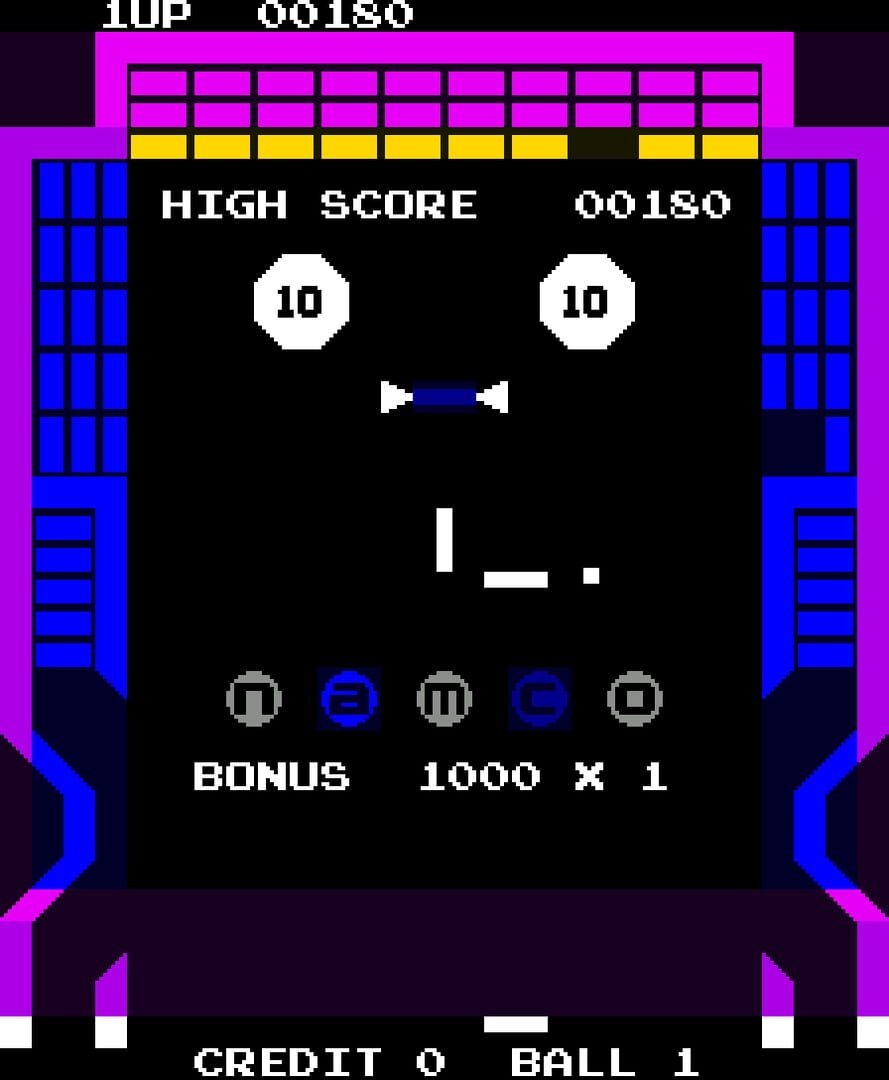
Gee Bee is a 1978 block breaker and pinball video game developed and published by Namco for arcades. The player controls a set of paddles with a rotary knob, where the goal is to score as many points as possible by deflecting a ball against bricks, pop bumpers and other objects in the playfield. It was developed by Toru Iwatani, known as the creator of Pac-Man and Pole Position. Outside Japan, it was published by Gremlin Industries.
Gee Bee was the first video game to be designed in-house by Namco. Prior to this, the company had manufactured arcade electro-mechanical games (such as Periscope and F-1) and published a number of video games by Atari, Inc. (notably Breakout) in Japan. Iwatani originally wanted to produce pinball machines for the company, but higher-ups at Namco disapproved of the idea. As a compromise, Iwatani instead made a video game with pinball-elements, combined with mechanics established in Breakout.
Keywords
- pinball
- platform exclusive
Media
The articlegameplay, story, development, reception
Gameplay
Gee Bee is a block breaker arcade game intermixed with elements of a pinball table. The player uses a rotary dial to control a set of paddles on-screen, the goal being to score as many points as possible by deflecting a ball towards objects placed on the board. These include Breakout-like brick formations, pop bumpers that award ten points each when hit, and spinners that slow down the ball. Making the ball touch the "NAMCO" rollover symbols (replaced by the Gremlin logo in the North American version) causes them to light up and having all of them lit up increases the score multiplier.
Development
Gee Bee was developed by Toru Iwatani and was Namco's first video game produced in-house. The company began their insertion into game development in July 1976, when Shigeichi Ishimura, a Namco electro-mechanical game designer, proposed the idea of creating a video arcade game utilizing a CPU, with information accumulated from his work on electro-mechanical games. Namco approved of the idea and purchased a surplus amount of PDA-08 microcomputers from NEC, employees being assigned to study the system's potential to create video games.
In 1977, Toru Iwatani joined Namco, shortly after graduating college. Before the arrival of Iwatani, Namco was publishing Atari arcade games in Japan, following their acquisition of Atari Japan a few years prior. Iwatani wanted to create pinball machines as opposed to video games, but Namco higher-ups disapproved of his idea. As a compromise, Iwatani was allowed to instead create a video game based on the concept of pinball, akin to Atari's Video Pinball dedicated console, intermixed with the gameplay elements established in Breakout.
Reception
The game is reported to have sold nearly 10,000 units, which was a good sales figure for its time, but Gee Bee was not as successful as Namco hoped it would be, due to coin drop earnings per unit falling below expectations and because of competition from Taito's Space Invaders. Nevertheless, Gee Bee was the eighth highest-earning arcade video game of 1978 in Japan, and helped establish Namco as a prime video game developer in Japan, leading to them producing their own arcade games alongside publishing those from other companies. Cashbox complimented the game's cabinet artwork and later said it had a "good looking cabinet and graphics". In a retrospective, Earn Green of Allgame noted the game's importance for Namco, being Toru Iwatani's first video game for the company. Retro Gamer listed Gee Bee as one of the best Breakout clones for its notability as Namco's first internally designed video game.
Gee Bee would spawn two sequel titles, including Bomb Bee, which was released a year later in 1979. This game includes colorized graphics, new gameplay additions such as a 1,000 point pop bumper, and the ability to earn extra lives. A second sequel, Cutie Q, was released in 1979. This one was not developed by Iwatani, but rather Shigeru Yokoyama, who would later create Galaga, although Iwatani designed a number of the sprites.
Releases by platformdates and regions as published
Editions and related releases
- Ported as
- Arcade Archives 2: Gee BeeArcade Archives: Gee Bee
Games like this
 Atari exclusive47
David's Midnight Magic
1981 · Apple II, Atari 2600 +9
Pinball · Arcade

Rollaround
1987 · Amstrad CPC, Commodore C64/128/MAX +1
Pinball · Arcade
 Sega exclusive52
Virtual Pinball
1993 · Sega Genesis
Pinball · Arcade
 Nintendo exclusive
Microsoft Pinball Arcade
1998 · Game Boy Color, Windows
Pinball · Arcade

Obsession
1994 · Amiga, Atari ST +1
Pinball · Pinball
 80
Pinball Fantasies
1992 · Amiga, Amiga 1200 +11
Pinball · Arcade
 Nintendo exclusive
Pinball Action
1985 · Arcade, Nintendo Switch 2
Pinball · Arcade
 Nintendo exclusive50
Rollerball
1984 · MSX, NES +2
Pinball · Pinball
Collections2 collections
Publishers
- Namco gamesArcade-based games › Namco proprietary arcade systems
Reception and records
- Arcade gameHighest-grossing
Description adapted from its source, CC BY-SA 4.0.