The articlegameplay, story, development, reception
Story
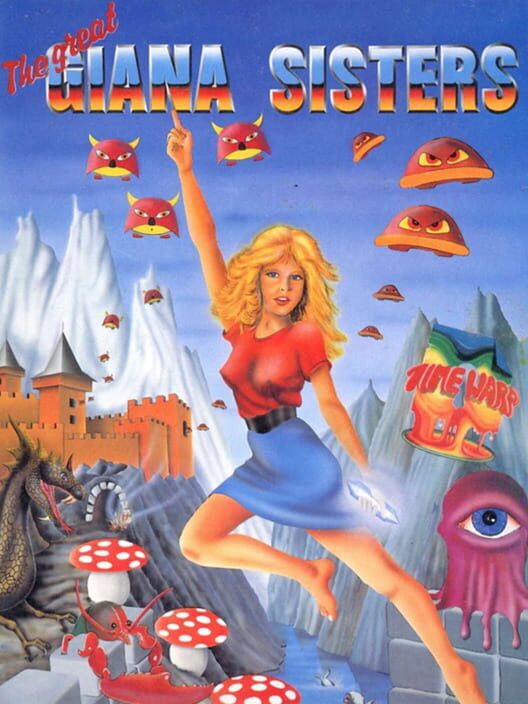
The Great Giana Sisters is set in the dream of a girl, Giana. She dreams about a world of deserted castles filled with monsters and can only wake up when she finds a large diamond. It is a platform game, where the player can either control Giana in single-player mode, or switch between Giana and her sister Maria in two-player mode. The player controls either sister via a joystick, where they can walk and jump through 33 levels of horizontally scrolling platforms, while avoiding holes and other dangerous objects such as nails and fire.
Each player starts with five lives. Each level has a 100-second time limit. If time runs out, the player loses a life.
Most enemies can be defeated by having Giana jump on top of them. Power-ups granting enhancements can be collected. These include projectiles such as lightning and strawberry power-ups, clocks which cause all enemies onscreen to fall asleep, magic bombs that vanish all enemies on screen, and lollies which give the player an extra life.
Reception
Darran Jones of Retro Gamer wrote in his overview of the game that The Great Giana Sisters received a "fair amount of critical acclaim" on its release for the Commodore 64. Reviews compared the game to contemporary platformer games. "GBH" of Your Commodore compared the game to earlier attempts at platforming games on home computers, writing that players no longer need "to make pixel perfect leaps or time every move down to the last split second". "Dunc" of Your Sinclair found the game similar to Wonder Boy, stating that The Great Giana Sisters was superior to the game for its addictive gameplay.
64 reviewer went as far as to say it was "the best game of its kind since Bubble Bobble, and there can't be many higher recommendations than that". 64 and Computer and Video Games all compared the game to Super Mario Bros. Matt Bielby of Computer and Video Games went as far as to call it "as straight a rip-off as they come". 64 and Power Play generally found it not as strong as Nintendo's game.
Other reviews commented on the variety in the gameplay of The Great Giana Sisters, such as "GBH" and the Zzap!64 reviewers who praised the game for its large number of secrets and power-ups. Both of the previous reviews found the game addictive, while Rod Lawton of ACE questioned whether players would feel compelled to complete the game. For the game's music, Lawton wrote that it was "appropriately jaunty", while the reviewers of Zzap!64 found it a "a bit twee", but ultimately excellent.
Jones of Retro Gamer described the version for the Amstrad CPC as a "god-awful conversion" with low-quality graphics and no sound. Crash reviewed the unreleased ZX Spectrum release, praising the variety of the game. It echoed comparisons to Super Mario Bros. stating that The Great Giana Sisters could not compare in terms of graphics to Nintendo's game, but that "in terms of gameplay (which is the most important thing after all), those Super Mario Bros have certainly met their match".
The reviewers generally praised the game but found that the ZX Spectrum port lacked colour and ran slower than the Commodore 64 original. Tony Dillion of Sinclair User wrote positively about the game's theme and graphics, but that the game performed far too slowly to be playable on the ZX Spectrum.
From retrospective reviews, Kristan Reed of Eurogamer stated that the game felt like a "footnote in gaming history", saying "to most teenage C64 owners of the late '80s, it was an essential release at the point when the best developers had already started to migrate to the 16-bit systems". In a 2021 overview, Stefano Castelli of IGN called it the best scrolling platform games on the Commodore 64, while still being a pale imitation to Super Mario Bros. He wrote that The Great Giana Sisters was lacking inspired level design in terms of variety, the control lacked the subtleties of Nintendo's game, and that Huelsbeck's music was less inspired than Koji Kondo's Super Mario Bros. score.
Legacy
The Great Giana Sisters received a sequel in 1989, Hard'n'Heavy, for the Commodore 64, Atari ST, and Amiga. The characters in the game wore space suits and had an outer-space themed setting, a theme less connected to Super Mario Bros. By 2008, the rights to the Great Giana Sisters were held by Gessert's Spellbound Entertainment. The company released an adaptation of the C64 version of the game for mobile phones in 2005. Further follow-ups to the game followed in the 21st century, such as Giana Sisters DS (2009), Giana Sisters: Twisted Dreams (2012), and Giana Sisters: Dream Runners (2015).
Andreas Lange and Michael Liebe wrote in Video Games Around the World (2015) that along with Trenz's other Rainbow Arts game Turrican (1989), The Great Giana Sisters was the most popular action game from Germany, with both games receiving international acclaim. Despite being removed from the market, the game grew in popularity via piracy and emulation. Gessert later reflected that "I think it's a great game, but it never reached the detail and class of Super Mario Bros".
Huelsbeck would go on to compose music for games in Star Wars: Rogue Squadron and the R-Type series. His music has been adapted to symphony orchestra music, such as at the concert Symphonic Shades, in tribute to Huelsbeck. Giana Sisters: Twisted Dreams also features Huelsbeck's music, which features new arrangements and extensions from the original music.