The articlegameplay, story, development, reception
Gameplay
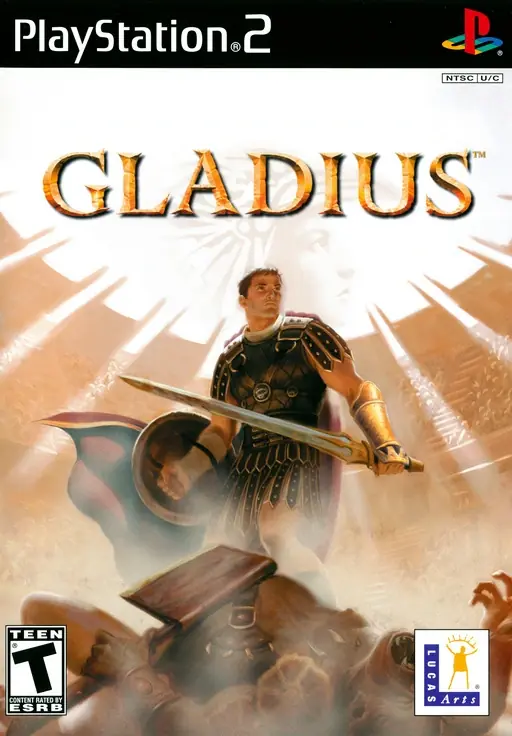
Gladius is a turn-based tactical role-playing game. There are two main gameplay components — combat and a world map. The primary game mechanic tasks the player with building a school of gladiators and taking them into battle against opposing schools, winning regional tournaments so as to earn the right to compete in more prestigious tournaments. Upon beginning the game, the player must choose their player character from two options; Valens runs a school in the Roman-like Imperia, whilst Ursula is a member of a school run by her brother in the Nordic-like Nordagh. The storyline plays out differently depending on which character is used, but the overarching gameplay is the same across both characters.
Combat in Gladius uses an interleaved turn-based system. The player issues an order to a gladiator (such as "move", "strike", or "defend") and the gladiator carries out that order. The player then either issues an order to another gladiator, or a computer controlled gladiator will perform an action, and so on. Each gladiator is free to move around the grid-pattern of the arena, but they can only move a certain distance per turn, determined by their character class, type of equipment, and status effects.
Story
Gladius features two separate storylines, one each for the two available player characters; Valens and Ursula. Unlike in many games with multiple player characters, the two campaigns in Gladius do not present different perspectives on the same story. Although some of the plot points are the same in each storyline, they are, in fact, two entirely independent plots, the details of which do not coalesce.
The game takes place in the fictional lands of Gladius where, decades earlier, only the barbarians of Nordagh stood against the marauding Empire of Imperia. The ensuing conflict, known as the Great War, was vicious and bitter, and although it quickly reached a military stalemate, the slaughter senselessly continued. So pronounced was the violence that it led to the rebirth of the Dark God, Mortuus, a dragon-like entity who began to lay waste to both armies. In response, the benevolent Affinity Gods lent their strength to Galltyr, Queen of the Valkyrie, and with her Warriors of Light, she attacked Mortuus. Although the Valkyrie were all but wiped out, they succeeded in defeating him.
Development
Gladius was first announced in May 2002, slated for a Spring 2003 release. At this point, the game had already been in development for 18 months. The press release emphasised the two storylines, the mixture of single-player and multiplayer modes, and the core game mechanic of building up and managing a gladiatorial school. LucasArts estimated that it would take around 72 hours to complete both storylines, emphasising the size of the game's four distinct regions.
They also cited the game's 16 character classes, 100+ character types, 200+ skills, and 400+ pieces of equipment. According to Sam Saliba, product marketing manager for LucasArts;
Reception
Gladius received "generally favorable reviews" across all three platforms; the PlayStation 2 version holds an aggregate score of 78 out of 100 on Metacritic, based on 27 reviews; the Xbox version holds a score of 79 out of 100 from 31 reviews; and the GameCube version holds a score of 82 out of 100 from 13 reviews.
Game Informer's Matthew Kato scored the GameCube version 9 out of 10 and was especially impressed with the depth of the combat mechanics, particularly lauding the implementation of the hit meters. He concluded, "Gladius is the convergence of a lot of successful elements working in tandem." Also writing for Game Informer, Andrew Reiner scored the PlayStation 2 version 9 out of 10, calling it "a compelling and ingenious romp." He especially praised the use of hit meters and the depth of character customisation, concluding, "it has all of the makings of a bona fide classic." Jeremy Zoss scored the Xbox version 9.3 out of 10, also praising the range of customisation, the depth of the combat mechanics, and, especially, the hit meters.