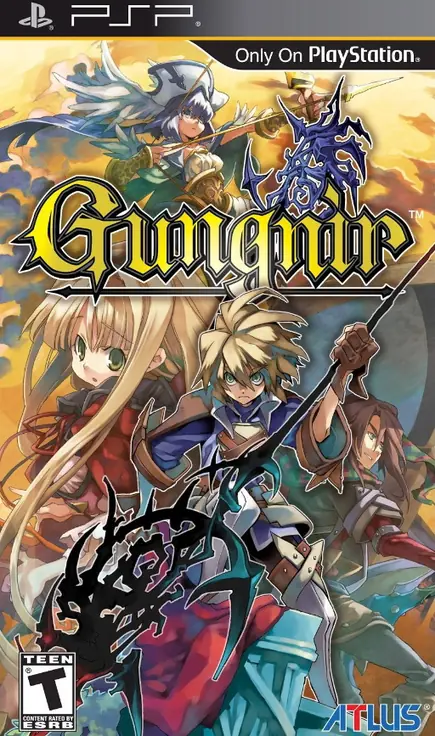
The articlegameplay, story, development, reception
Gameplay
Gungnir is divided between event scenes, battles, and breaks between each stage in which the player may buy new equipment and change the equipment of party characters. The game display is isometric, with hand-drawn character sprites and environments rendered in 3D. The game uses a time system with a mechanic known as the "Tactics Gauge."
Gungnir features an optional support mode for players struggling with the system and difficulty level. Both multiple routes and Easy Mode were later confirmed.
Story
Gungnir begins in the year 983 and takes place in the empire of Gargandia, a country populated by two races: the upper-class Daltania and the peasant Leonica. The Leonica race is regarded as "cursed" for yet unknown reasons, and is subjected to harsh class discrimination.
Because of this and incidents such as the "Espada Massacre" that occurred over fifteen years ago, a group of Leonicans aided by Daltania sympathizers has formed a resistance army called Esperanza. Their resistance is, however, badly outmatched and struggling.
Development
Details about Gungnir and its development first emerged in JaJa's blog as early as May 2009, where it was referred to by the code name "9th". However, while 34 entries were posted over the course of May and June of that year featuring development talk and occasional postings of concept artwork, JaJa's blog went silent after that time. While Sting initially projected that the game would be released in late 2010, no more was said about it during the development of Yggdra Unison's DS remake, Hexyz Force, the PSP version of Knights in the Nightmare, and Blaze Union, which were developed and released from late 2009 to mid-2010.
The project resurfaced in February 2011 with an announcement in Famitsu magazine, followed by the appearance of a teaser site maintained by Sting and hosted on Atlus' domain. On February 24, JaJa uploaded his first post in two years, confirming Gungnir as Dept. Heaven Episode IX. According to JaJa, part of the reason he had not updated his blog during this time was because Sting received a great deal of help on Gungnir from people outside the company itself, and he was worried about causing trouble if he mentioned things that weren't supposed to be revealed yet. Attached to the post in question is a sketch by Satoko Kiyuduki featuring the four main characters of the game backstage at the Famitsu announcement, complaining about their two-year wait.
Reception
Gungnir has received mixed reviews. Tech-Gaming found the game's battle system to offer a nice variation on strategy role-playing formula and lauded the game's charming graphical style which consistently offers a plethora of information but bemoaned the game's plodding introduction.