The articlegameplay, story, development, reception
Gameplay
As the game is a port of the PlayStation Portable games, the gameplay is relatively the same as the original. The signature PlayStation shaped buttons, circle, cross, square and triangle are now the 4 large buttons on the machine's panel, and players push those buttons to play the games. Unlike the handheld versions of the game, players can hold a button or buttons for an unlimited time when the game indicates to hold a certain note. This will allow players to receive a bonus which continually increases the score until the player releases one of the held button or a "Max Hold Bonus" is granted.
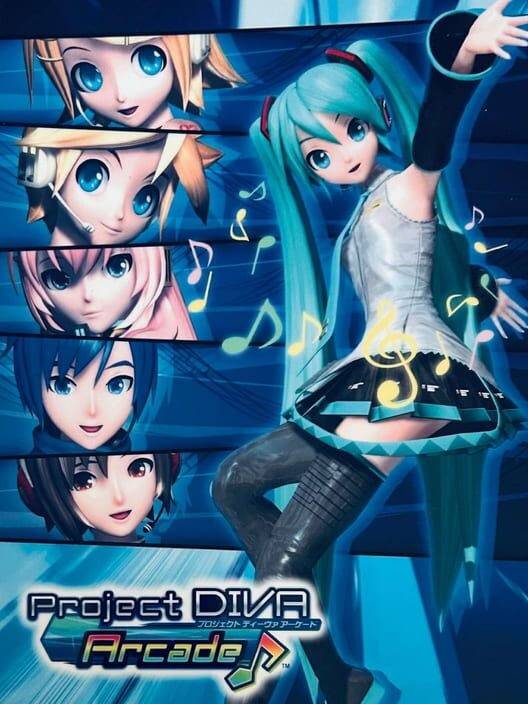
Another difference is that multiple buttons can be hit at the same time up to all four buttons. The arcade version features songs from both Hatsune Miku: Project DIVA series and Hatsune Miku and Future Stars: Project Mirai, along with a variety of original songs not included in either of the handheld versions. The Promotional Videos (PVs) for the game, which are the videos playing in the background during a song have been updated and re-rendered for the game bearing a similar resemblance to the Dreamy Theater versions of the PVs. Players have the ability to choose from a reel of songs and select their difficulty before playing a song, similar to a Dance Dance Revolution arcade game.
The four difficulties are Easy, Normal, Hard, and Extreme, as seen in Project DIVA 2nd. The PlayStation 4 version added arrow icons, using the signature PlayStation shaped button colors, in which can be combined to the signature PlayStation button icons (labeled as "Arcade"). Furthermore, MegaMix / Mega39's featured a newly re-tooled toon shader effect to match the anime visuals, along with new letter icons with a different color set to fit the four letter buttons on the Nintendo Switch (red A, orange B, green Y and blue X), with the option to combine it with a new color set to the arrows, using the Switch button colors, Mix Mode, which allows the Joy-Con controllers, using the L/SL and R/SR buttons to the beat, and Touch Play, which uses the Nintendo Switch's touch screen instead of the controllers. In MegaMix+ / Mega39's+ allows the ability to switch between the two visual styles, as well as a new color set to letter button icons to match the signature Xbox letter buttons (red B, green A, blue X and yellow Y), in which can be combined with a new color set to the arrows, matching the signature Xbox button icons.
Lyric subtitles in the English version, as well as the Western languages in MegaMix / Mega39's & MegaMix+ / Mega39's+ shows Japanese Romaji lyric subtitles, whereas the Japanese and Chinese versions, as well as the Asian languages in MegaMix / Mega39's & MegaMix+ / Mega39's+, shows Japanese Kanji lyric subtitles.
Development
Project DIVA Arcade began development on the Virtua Fighter 5 engine, with a Hatsune Miku model being created in the engine with Dural as a base and then with the attributes changed to look like Miku instead. At the Summer 2009 Miku Festival, a prototype of Project DIVA Arcade was made using the Virtua Fighter 5 engine running on the Sega Lindbergh arcade board. Subsequently, the game became a full-fledged project at Sega. Development branched off from Virtua Fighter 5 and was transferred to the newer RingEdge arcade boards that then debuted as a prototype at a Spring 2010 Miku Fan event. Most changes made were with regards to the game's graphics and animation effects such as particles and motion blur.
Sega announced that Hatsune Miku: Project DIVA would be coming to arcades on October 5, 2009 and along with it a plea to fans to submit their own music for the game's track list. This was done between October 15 and October 31 where fans would upload their video to the Project DIVA Nico Nico Channel. These songs needed to be original songs and not remixes or variations of existing songs that were between 2 and a half minutes to 3 and a half minutes. The winners would then have their songs chosen by the game's development staff and then used in the release of the game.
In addition, the website Piapro even held an event/contest for artists to submit their own created Vocaloid songs as well as illustrations for the game. Tripshots designed the machine which will include four buttons which has the same gameplay as its predecessor on the PSP.
Reception
Project DIVA Future Tone won the award for "Best Rhythm/Music Game" at Game Informer's Best of 2017 Awards, while it came in third place for the same category in their Reader's Choice Best of 2017 Awards. In addition, it was nominated for "Game, Music or Performance Based" at the National Academy of Video Game Trade Reviewers Awards.