
The articlegameplay, story, development, reception
Gameplay
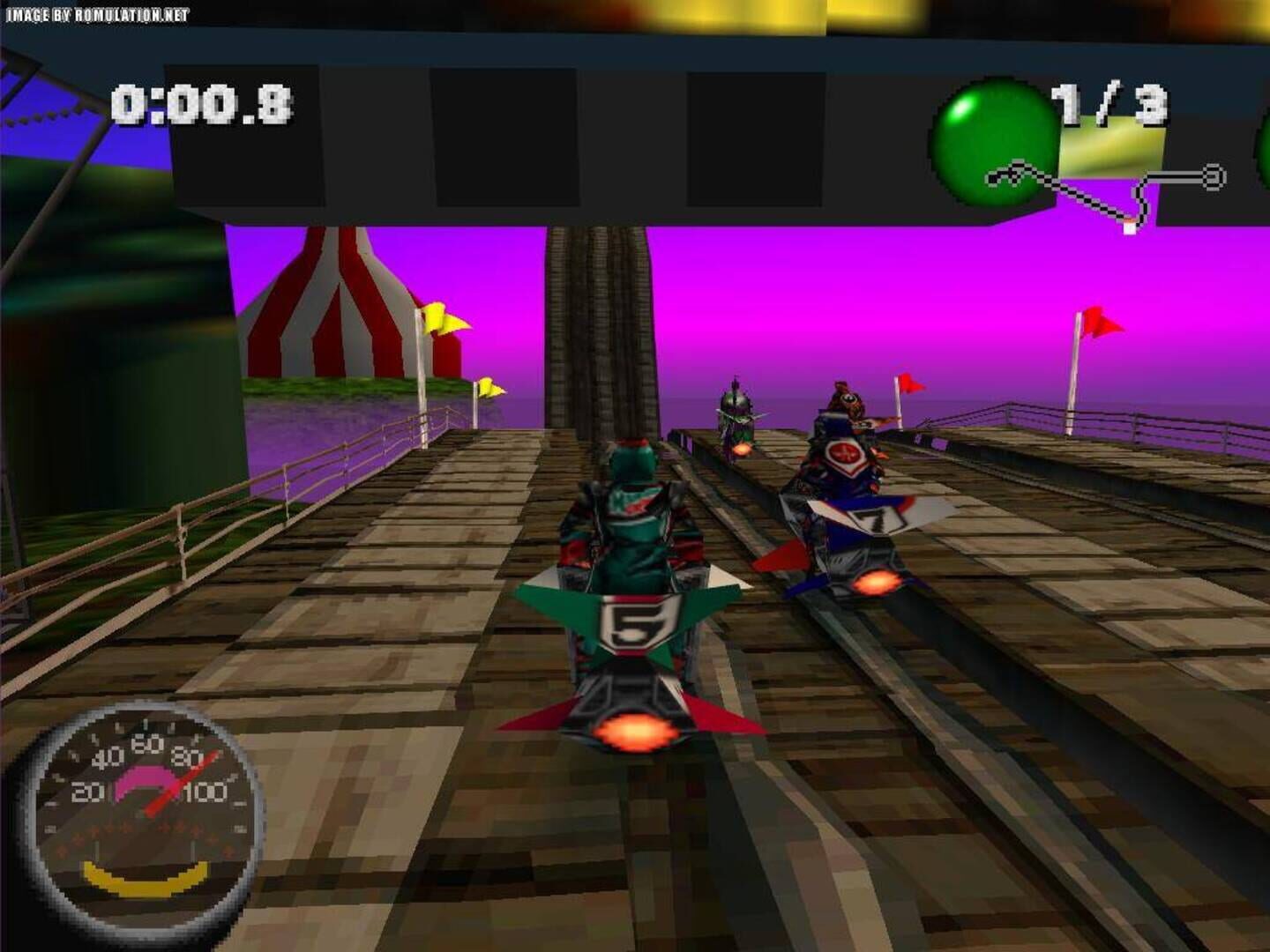
Jet Moto 2 retains all of the basic gameplay from its predecessor. Players control hoverbikes which sit close to the ground and can be ridden over land and water. The courses in the game are designed to take advantage of this ability. Characters are split into teams, and bikes are adorned with logos of products such as Mountain Dew and Jet Ski, similar to real-life sponsored racing. The riders received an overhaul, with only a total of ten selectable characters being available, and subsequently only ten racers on the track at any given time.
The number of tracks available greatly increased, with ten new tracks added plus the ability to unlock all of the tracks from the original game. Track designs are more varied in Jet Moto 2, with each level containing a unique theme rather than the shared themes of the original. The courses range from earthquake-damaged cities to desert canyons, ice-covered mountains, a roller coaster, and several other themes.
Development
Jet Moto 2's original cut from 20 competitors to 10 was "to open the game up to a broader market, one that wasn't driven by hardcore." Chef Boyardee was one of the new sponsors in the game, however the game's producer, Brian Wiklem fought to ensure the sponsor would not be a rider's sponsor. As a result, Chef Boyardee's logo was added to track advertisements throughout the tracks. Of the ten new tracks created for the game, five concepts were designed by SingleTrac, and five by Wiklem and his assistant.
Dual Analog Controllers and the accompanying vibration functions were supported for the first time, but DualShock Controllers were not. As with the first Jet Moto, Axiom Design created the user interface shell for the game. Pinnacle Music Group composed the music for the game.
Reception
Jet Moto 2 received mixed reviews from critics. It held a 70.08% at GameRankings, a video game aggregator, based on 12 reviews. Like Jet Moto, the game's popularity would earn it a spot in the PlayStation Greatest Hits. Between the original version and the Greatest Hits Championship Edition, Jet Moto 2 sold over 800,000 copies.
Reviewers disagreed on many points about the game. While many praised the new variety of tracks offered, all four reviewers for Electronic Gaming Monthly complained that the tracks are frustratingly confusing and unfair, and Next Generation opined that the track design "is not nearly as impressive as the first, if only because it's more of the same." On the positive side, GameSpot stated that the variety of courses "take the Jet Moto series yet another step away from the traditional racer." Likewise, while IGN called the physics system "even more over-the-top" and was pleased that "The bike flies about everywhere," GameSpot considered the unexpected results of maneuvers and collisions to be a problem.
Legacy
Jet Moto 2 was the last game developed by SingleTrac for publisher Sony Computer Entertainment, as they would later be acquired by GT Interactive. Pacific Coast Power & Light developed Jet Moto 3, with 989 Studios publishing the third title. Jet Moto 3 was released August 31, 1999 exclusively in North America. To date it is the last title in the series to be released.
Two other titles were cancelled during their development. Pacific Coast Power & Light was also developing Jet Moto 2124 for the PlayStation, set over a century after the first three games, however the game was cancelled when Jet Moto 3 showed poor sales. Jet Moto: SOLAR, developed by RedZone Interactive, was also cancelled. SOLAR would have been the first title in the series to appear on the PlayStation 2.


