Ludography
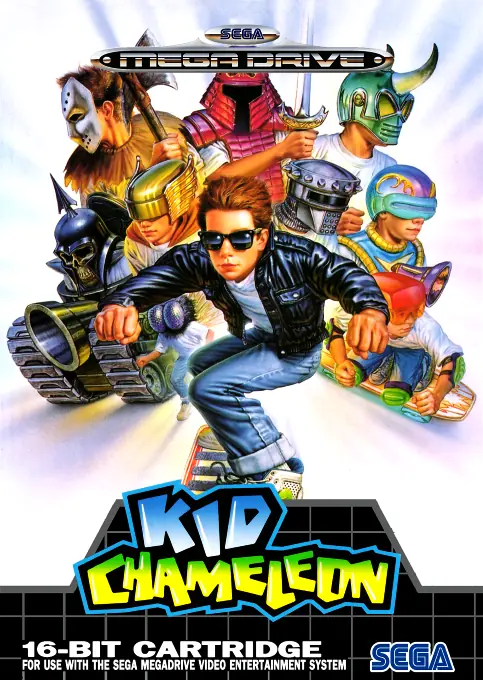
Kid Chameleon cover

1992 · Sonic Team · Platformer

Kid Chameleon

Timed Sega exclusive

Kid Chameleon is a 1992 platform game released for the Sega Genesis/Mega Drive. The premise of the game is that the main character, Casey, can use masks to change into different characters in order to use different abilities. It was later released in Japan as Chameleon Kid.

The game is also a part of the Sega Genesis Collection for the PlayStation 2 and PlayStation Portable. It was released for the Virtual Console in Japan on May 22, 2007; North America on May 28, 2007; and Europe on June 1, 2007. It was also released in addition to a series of other Sega games, including Shining Force and Comix Zone, in Sega Smash Pack 2. The game has also appeared in Sonic's Ultimate Genesis Collection for Xbox 360 and PlayStation 3.

Also known as
Chameleon Kid · Kid Chameleon Classic · Arcade Legends Sega Mega Drive · Kid Chameleon (USA, Europe)
Released
28 May 1992
Platforms
Sega GenesisWiiLinuxmacOSWindowsAndroidiOS
Genres
Platformer
Developers
Sonic Team
Publishers
—
Modes
MultiplayerSingle-player
Perspective
Side view
Themes
ActionFantasyScience fiction
Country
United States
Age ratings
ESRB EPEGI 7
Languages
English

About

Kid Chameleon is a 1992 platform game developed and published by Sega for the Sega Genesis. The player controls the "Kid Chameleon" and attempts to save his peers from a virtual reality video game's rogue artificial intelligence. The gameplay involves the player going through a series of levels, in which the goal is to reach a flag at the end. The central mechanic revolves around different forms, obtained from masks, which are used to progress through levels.

The game has been ported to several platforms via game compilations and digital distribution services.

Keywords

  • action-adventure
  • steam
  • blocks
  • pixel art
  • tank
  • teleportation
  • digital distribution
  • xbox controller support for pc
  • throwing weapons
  • virtual console
  • secret area
  • video game characters that play video games

Media

The articlegameplay, story, development, reception

Gameplay

The player controls Kid Chameleon as he progresses through a series of over 100 levels, featuring an array of enemies and obstacles. Most levels contain a flag, which is the primary goal and method of progressing to the next level. However, a number of teleporters throughout the game can warp the player not only to different places within the same level, but also to other levels, and sometimes to an entirely alternate path. There is no password system or other method of saving.

As Kid Chameleon moves through the levels, he discovers masks which alter him into different characters. Each character has unique special abilities and varying numbers of hit points. In addition to the offensive abilities of each form, the Kid can also defeat enemies by jumping on them, although he may still take damage from some enemies. Each form can also make use of Diamond Powers that require diamonds to use.

Reception

Mega placed the game at #35 in their Top Mega Drive Games of All Time. MegaTech magazine said it was let down by the lack of challenge. ” Console XS gave Kid Chameleon an overall score of 89/100. They praised the game for having constant variety because of the main character's ability to change forms.

The four reviewers of Mega Play gave positive reviews praising the gameplay, calling it "very concise" and commended the levels, the power-ups, graphics and music. They felt that Kid Chameleon was similar to other action games and one reviewer said it "gets to be monotonous after a while." Manci Games praised the graphics, controls and the gameplay and commended the power to swap abilities, saying that specific feature separates the game from what it is inspired by. The reviewer found Kid Chameleon to be similar to Super Mario Bros and the only criticism the reviewer had is the game does not have a save or password system.

Legacy

In 1993, a Kid Chameleon comic strip ran from issues 7–12 in the Fleetway publication Sonic the Comic. A sequel storyline, "Back to UnReality!", ran in 1995 from Issues 54-59. Both stories were written by Michael Cook, with art by Brian Williamson and Steve White.

Releases by platformdates and regions as published

Releases by platform
PlatformReleasedRegions
Sega Genesis28 May 1992North America · Japan 29 May 1992 · Europe 31 December 1992 · Brazil 31 December 1992
Wii22 May 2007Japan · North America 28 May 2007 · Europe 1 June 2007
Linux13 September 2010Worldwide
Windows13 September 2010Worldwide
macOS13 September 2010Worldwide
iOS21 June 2017Worldwide
Android21 June 2017Worldwide

Title IDsone per regional release, with its latest update

Title ids and disc serials by release
PlatformTitle IDRegionLatest update
Sega GenesisG-4070Japan—

Box artone per regional release we hold art for

Decompilations and portscommunity projects that rebuild or port the game

Editions and related releases

Included in
Sonic's Ultimate Genesis CollectionSega Smash Pack 2Sega Genesis CollectionSega Genesis ClassicsArcade PortableSega Mega Drive and Genesis ClassicsArcade Legends: Sega GenesisMega Drive Twin PadsZone SegaSega Mega Drive Portable Video Game PlayerArcade UltimateSega Genesis Ultimate Portable Game PlayerArcade Ultimate PortableGenMobileSega Archives from USA Vol. 3ReactorArcade MasterSega Genesis MiniSega Genesis Classics: Series 2Mega Drive 4Mega Drive 3Mega Drive 3: 81 Super JogosSega Genesis Classic Game ConsoleSuper Mega Drive 3: 71 Super JogosSuper Mega Drive 3: 43 Super JogosSuper Mega Drive 3: 60 Super JogosMega Drive
Includes
Altered BeastGolden AxeFlickySonic the HedgehogDr. Robotnik's Mean Bean Machine

Games like this

Collections6 collections

Platform libraries

Years

Licensing

Publishers

Description adapted from its source, CC BY-SA 4.0.