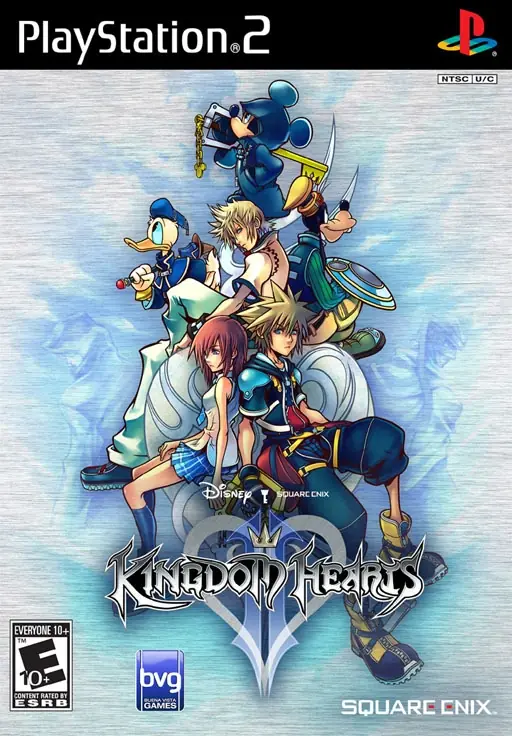
The articlegameplay, story, development, reception
Gameplay
The gameplay of Kingdom Hearts II is similar to the action RPG and hack and slash gameplay of the first Kingdom Hearts game, though developers made an effort to address some of the complaints of no map and camera bugs with the previous game. The player directly controls Sora from a third-person camera angle, though it is possible to switch to a first-person perspective by pressing the Select button. Most of the gameplay occurs on interconnected field maps where battles take place. The game is driven by a linear progression from one story event to the next, usually told via cutscenes, though there are numerous side-quests available that provide bonuses to characters.
Like many traditional role-playing video games, Kingdom Hearts II features an experience point system which determines character development. As enemies are defeated, the player and allies gain experience to "level up", allowing them to grow stronger and gain access to new abilities.
Combat in Kingdom Hearts II takes place in real-time and involves hack and slash elements with button presses which initiate attacks by the on-screen character. A role-playing game menu on the screen's bottom left, similar to those found in Final Fantasy games, provides other combat options, such as using magic or items, summoning beings to assist in battle, or executing combination attacks with other party members. A new feature is the "Reaction Command", special enemy-specific attacks that are triggered when the player presses the triangle button at the correct time during battle. Reaction Commands can be used to defeat regular enemies or avoid damage, and are sometimes necessary to complete a boss battle.
In addition to the main character, two party members are usually present who also participate in combat. Although these characters are computer-controlled, the player is allowed to customize their behavior to a certain extent through the menu screen, such as attacking the same enemy Sora targets.
In response to criticism, the "Gummi Ship" feature of the first game was re-imagined to be "more enjoyable". Although retaining its basic purpose of travel, the system was completely redone to resemble a combination of rail shooter and "Disney theme park ride". In the world map, the player now controls the Gummi Ship from a top-down view to fly to the world they wish to enter. Worlds are no longer open from the beginning—the player must unlock the routes to them by entering a new level, controlling the ship from a third-person point of view, and battling enemy ships.
After the route is opened, travel to the world is unimpeded, unless it is blocked again due to a plot-related event. The player may also gain new Gummi Ships from completing routes, which is also a new feature.
One of the new features is a meter known as the "Drive Gauge". which has two functions: to transform Sora into a "Drive Form" or to summon a special character. While in a Drive Form, Sora bonds with party members to become more powerful and acquire different attributes; all but two Forms also allow the use of two Keyblades. When a Drive is executed, Sora's combat statistics are heightened.
Drive Forms also give Sora new abilities that can be used in normal form, called "Growth Abilities". Sora's first two Drive Forms only combine power with one party member; later-obtained Drive Forms require him to bond with both party members. When allies are used in a Drive, they are temporarily removed from battle for its duration. Unlike the HP and MP gauges, the Drive Gauge is not refilled at save points.
Like in the first game, Sora can summon a Disney character to aid him in battle. Summons will replace the two computer-controlled characters and fight alongside Sora for as long as the Drive Gauge allows, or until Sora's HP runs out. Instead of being limited to only one action, Summons now have a menu of their own and are capable of performing solo or cooperative actions with Sora, which are performed by pressing the triangle button. The Summon ability and each Drive Form are leveled up separately and by different criteria; obtaining higher levels allows for extended use and in the case of Drive Forms, access to new abilities.
Story
Kingdom Hearts II begins one year after the events of Kingdom Hearts and Chain of Memories. The game's setting is a collection of various levels (referred to in-game as "worlds") that the player progresses through. As in the first game, the player can travel to various Disney-based locales, along with original worlds specifically created for the series. While Disney-based worlds were primarily derived from the Disney animated features canon in the first game, Kingdom Hearts II introduces worlds that are based on live-action franchises: Pirates of the Caribbean and Tron.
Each world varies in appearance and setting, depending on the Disney film on which it is based. The graphics of the world and characters are meant to resemble the artwork and style of the environments and characters from their respective Disney films. Each world is disconnected from the others and exists separately; with few exceptions, players travel from one world to another via a Gummi Ship.
Some worlds featured in the previous games reappear, but with new and expanded areas. New worlds are also introduced, with the Land of Dragons being based on Mulan, Beast's Castle on Beauty and the Beast, Timeless River on Steamboat Willie among other shorts from the Mickey Mouse film series, Port Royal on Pirates of the Caribbean: The Curse of the Black Pearl, Pride Lands on The Lion King, and Space Paranoids on Tron. Twilight Town, an original world first seen in Chain of Memories, has a greater role as the introductory world. The World That Never Was is a new world that serves as the headquarters of Organization XIII.
The three protagonists are Sora, a 15-year-old boy chosen as a wielder of the Keyblade—a mystical key-shaped weapon that can combat darkness; Donald Duck, the court magician of Disney Castle; and Goofy, the captain of the Disney Castle guards. Both Donald and Goofy are under orders from their missing king, Mickey Mouse, to accompany Sora and his Keyblade. Other original characters include Riku, who is briefly playable at the game's climax, and Kairi, who are Sora's friends from his home world of Destiny Islands; Roxas, a boy who can also wield the Keyblade and is playable in the game's beginning sequence; Naminé, a girl with the power to manipulate memories; and DiZ, a man clad in red robes with a vendetta against Organization XIII, and is later revealed to be Ansem the Wise, Xehanort's mentor.
As in the previous games, characters from both Disney and Square Enix works appear. While some return from Kingdom Hearts, additional Disney characters are introduced, such as Scrooge McDuck and several characters from Disney films in their home worlds. Pete appears as a persistent enemy who works with the resurrected Maleficent. Nearly twenty characters from Final Fantasy games appear, notably Auron from Final Fantasy X, Squall Leonhart from Final Fantasy VIII, and Cloud Strife, Sephiroth, and Tifa Lockhart from Final Fantasy VII. Other new characters to the series are Vivi Ornitier from Final Fantasy IX, Seifer Almasy from Final Fantasy VIII, and Setzer Gabbiani from Final Fantasy VI.
The worlds that Sora explores often have an optional party character from the film which the world is based on. These party members include Fa Mulan, a woman who passes as a man to take her ailing father's place in the army; Jack Sparrow, a pirate who seeks to reclaim his ship, the Black Pearl; Simba, a self-exiled lion and the rightful king of the Pride Lands; and Tron, a security program in Hollow Bastion's computer network who seeks to end the dictatorship of the Master Control Program.
Organization XIII, a group of powerful Nobodies—the "empty shells" left over when a strong-hearted person becomes a Heartless—introduced in Chain of Memories, is established as the primary group of antagonists early on. Xemnas, the leader of Organization XIII, serves as the main antagonist and final boss of the game. Villains unique to the worlds are prevalent and are often presented as challenges that Sora's group must overcome.
Sora, Donald, and Goofy have spent the past year in suspended animation to restore their lost memories. Meanwhile, Roxas, Sora's Nobody, is unknowingly trapped in a virtual simulation of Twilight Town created by DiZ to protect him from Organization XIII until Sora awakens. DiZ's plan is threatened when Nobodies led by Axel, Roxas's former friend in Organization XIII, infiltrate the virtual town to retrieve him. Roxas repels the Nobodies before merging with Sora.
After awakening, Sora, Donald, and Goofy meet King Mickey and Yen Sid, who send them on a new journey to find Riku and uncover Organization XIII's plans. Meanwhile, Maleficent is resurrected and reunites with Pete to continue her quest for power.
Sora travels to both familiar and unfamiliar worlds, resolving conflicts caused by Organization XIII, the Heartless, and various local villains. During a visit to Hollow Bastion, the group reunites with Mickey, who reveals that the "Ansem" they previously defeated was an impostor who was actually the Heartless of a man named Xehanort, and that Xehanort's Nobody, Xemnas, leads Organization XIII. The Organization reveals that it seeks to create its own Kingdom Hearts from the hearts Sora releases from defeated Heartless, believing its power will restore the members' lost hearts. They also abduct Kairi to use as leverage against Sora. As Sora revisits the worlds to resolve lingering problems while searching for a route to Organization XIII's stronghold in the World That Never Was, he is secretly aided by a hooded figure he believes to be Riku.
Following a lead, Sora, Donald, and Goofy travel through Twilight Town to reach the World That Never Was, where Axel sacrifices himself to help them proceed. Sora reunites with Kairi and Riku, learning that Riku assumed the appearance of Xehanort's Heartless after unleashing his power to subdue Roxas. Mickey encounters DiZ, who reveals himself to be the real Ansem, Xehanort's mentor. Ansem use
Development
As a joint project, Square Enix and Disney had different roles during development; the former oversaw the creative design and production, whereas the latter had approval over which content was included. Producer Shinji Hashimoto noted that they had earned Disney's trust, which allowed the team to put more into the sequel. While the Square Enix team was familiar with Disney's preferences when designing the game, Disney did veto a few elements. Square Enix's Product Development Division 1 handled development, with most of the first game's original staff returning. Tetsuya Nomura had plans for a sequel when working on the first Kingdom Hearts and returned as director.
Planning for Kingdom Hearts II began around the completion of Kingdom Hearts Final Mix, but specific details were undecided until July 2003. Before development could begin, the team requested to showcase Mickey Mouse more, which required Disney's approval. Based on feedback from the first game, Nomura wanted a larger role for the character. During initial talks with Disney, Kingdom Hearts: Chain of Memories was also conceived. Developed for the Game Boy Advance, it bridges the stories of the first game and Kingdom Hearts II.
The team aimed to provide a balanced story that would appeal to all audiences; the game has mystery and playful elements that can engage older and younger demographics, respectively. Scenario writer Kazushige Nojima considered reworking the previous games' established elements into something new the challenging part of writing the sequel's story. Similar to the previous game, Nomura provided Nojima plot points in order to write the scenario. He allowed Nojima creative freedom outside those plot points.
When writing the story, Nojima integrated themes of light and dark, the heart, and the friendship between Sora and Riku into the scenario. As a guide, the team kept a list of the unresolved issues established in the first game. When writing dialogue, Nojima spoke the lines out loud and discarded anything he felt was too difficult to vocalize. Additionally, he minimized wordplay in the script to ensure localization outside Japan went smoothly.
In designing the Kingdom Hearts II universe, the team wanted to bring back previous worlds and introduce new ones. To accomplish this, they rebuilt the game's engine without reusing data from the first game. The developers also recreated assets and textures. The new game engine allowed the team to expand the returning worlds.
Masaru Oka, the planning director for events, implemented a two-part scenario design for the worlds. In the first game, there was little to do in each world after defeating the boss. For the sequel, Oka wanted to provide players a second full scenario after the worlds' first boss was defeated.
The developers reworked previous worlds for the sequel. Nomura selected Twilight Town as the game's starting world as an reference to Chain of Memories' ending, which focused on a midpoint between light and dark. The team designed Twilight Town's story and activities to provide fans and new players with equal footing. They also added several minigames to make it more engaging.
The developers altered Hollow Bastion as a response to the events of the first game: the castle is being repaired and the surrounding waters were drained to reveal a town. The developers decided to incorporate musical elements into Kingdom Hearts II—something they had conceived during the first game's development—and believed Atlantica was a good fit. Nomura noted that the The Little Mermaid's songs are recognizable even to those unfamiliar with the film. Committing wholeheartedly to the concept, they incorporated musical gameplay into the world's entire scenario.
New worlds were selected for a variety of reasons. 0, which inspired him to include the Space Paranoids world. He believed the retro aesthetic would be interesting and refreshing. Nomura considered Beast an important character in the first game and wanted him to return in the sequel.
He added Beast's Castle from Beauty and the Beast to facilitate this. The Pride Lands world was intended for the first game but was omitted due to technical limitations of the game's engine. Nomura considered the inclusion of The Nightmare Before Christmas in the first game as an unexpected world and wanted a bigger surprise in the sequel for fans. While contemplating this, Pirates of the Caribbean: The Curse of the Black Pearl released and Nomura pitched it to his team, who were enthusiastic.
Despite the source material being live-action, he likened mixing it with the Kingdom Hearts aesthetics to Who Framed Roger Rabbit. Additionally, he believed the development team could successfully create the Pirates of the Caribbean's visuals because most of the staff had previously worked on the Final Fantasy series, including Final Fantasy X, which feature character models that are more humanlike than Kingdom Hearts. Nomura noted that despite having numerous "strictly defined" Disney worlds and characters, they combined in the game well because the individual properties had already integrated their own realistic and fantastical elements.
The development team aimed to retain the original's concepts but update the system of the game. Many gameplay aspects were reworked for the sequel. Some changes were made due to player feedback while others were meant to be included in previous games but were omitted due to time or technological constraints. The camera system and Gummi Ship portions were reworked based on negative feedback in the first game.
The camera controls were switched from the Dualshock controller's shoulder buttons to the right analog stick in order to make them more user friendly. Despite receiving a negative reception, Nomura retained the Gummi Ship because he liked the concept. He assigned a small team to focus on reworking it for the sequel.
Reception
Within a week of its Japanese release, Kingdom Hearts II shipped one million copies, selling almost 730,000 copies. The NPD Group reported that Kingdom Hearts II was the highest-selling console game in North America during March 2006 with 614,000 copies. Within four weeks, sales exceeded one million copies in North America. GameStop listed the game as their best-selling title for the first quarter of 2006.
The game was also on IGN's "Top 10 Sellers in 2006". 7 million in North America. By March 31, 2007, Square Enix had shipped over 4 million units worldwide. com figures, Final Mix+ was the best-selling PlayStation 2 game during the week of its release in Japan.
Anticipation was high for Kingdom Hearts II prior to release. Electronic Gaming Monthly readers voted it number eight and ten during the months of June 2004 and December 2004, respectively. Similarly, the readers of PlayStation Magazine voted it the second "most wanted game" in September 2004. After release, the game was met with "generally positive" reviews according to the review aggregator website Metacritic.
Like its predecessors, the gameplay received mixed reviews. The refined combat system was praised, with the drive forms, limit breaks, and combos being said to add depth, variety, and excitement. Andrew Reiner of Game Informer called the combo potential "divine", claiming that it surpassed God of War's intensity. Carrie Gouskos of GameSpot and Luke Albiges of Eurogamer highlighted the game's accessibility, with Gouskos saying that the ease of customization allowed for both deep and shallow gameplay experiences, and Reiner noted the dynamic controls, which he said instilled confidence and comfort.
Gouskos and IGN's Jeff Haynes criticized the combat's decreased difficulty, with Haynes remarking that the effectiveness of basic attacks sidelined offensive magic, and observed that the large amount of health orbs released by enemies during battle rendered healing items redundant. However, Gouskos regarded the approach to be an improvement upon the original game, which she felt derived difficulty from "backtracking, tediousness, and confusion". Louis Bedigian of GameZone also concluded that the game would not be challenging to players experienced with action RPGs from the SNES and PlayStation eras. Patrick Gann of RPGFan deemed the partner artificial intelligence to be superior to the first game, whereas Haynes denounced it as "absolutely terrible", attributing this to the omitted ability to issue AI commands.
The quick time events were a generally welcomed addition, with Albiges regarding their quality and impact to be on par with the knife fight scene in Resident Evil 4. Bedigian declared the game to be the first instance of quick time events being successfully implemented, and admired the resulting actions as "some of the most beautiful polygon sequences seen on PlayStation 2". While Russ Fischer of GameRevolution deemed their lenient mechanics compared to God of War to be a saving grace, he and Gann acknowledged that the lack of skill required for their execution may be a drawback for hardcore gamers. Bryan Intihar and Shane Bettenhausen of Electronic Gaming Monthly (EGM) spoke positively of the boss fights, with Bettenhausen saying that the quick time events enhanced their dynamic feeling.
Eric Bratcher of GamesRadar+ was also excited by most of the boss battles, though considered a few of them "straight-up lame". Gouskos described the bosses as interesting and well conceived, but observed that the strategies for defeating them hardly differed from that of regular enemies.
Reviewers complimented the camera's increased responsiveness, which Haynes attributed to the altered control method from the shoulder buttons to the right thumbstick. Contrariwise, Gerald Villoria of GameSpy and Gann did not see any improvement, with Villoria occasionally struggling with forced and awkward camera positions. James Mielke (writing for EGM) and Gann dismissed the first-person mode as unhelpful, with Mielke warning that the inability to see Sora's Keyblade was disorienting.
The RPG elements were described as light, with Haynes calling them a "casualty" of the increased emphasis on combat; he remarked that items were "practically useless" due to a lack of need to use them in certain places as in the first game. Although Albiges considered the quality of the locales to be consistently high (singling out Port Royal for praise), others lamented the decreased size and increased linearity of the worlds, with Haynes particularly describing Halloween Town and Atlantica as "shadows of their former selves". While the assortment of minigames in the Hundred Acre Wood was said to be improved from the first game, the transition of Atlantica from an action set-piece to a series of rhythm minigames was derided. Bratcher and Gann were relieved by the absence of the scavenger hunt-type quests from the first game.
The Gummi Ship segments were widely agreed to be an improvement over those of the first game. Comparisons were drawn to Star Fox, Panzer Dragoon, Gradius, R-Type, Einhänder, and the recent works of Cave. Although Gouskos and PALGN's Phil Larsen acknowledged the improved execution, they were still overall unimpressed, though Larsen singled out the battle against a giant pirate ship as a highlight. Villoria considered the shipbuilding interface to have been greatly improved, whereas Fischer and Gann still found it obtuse and confusing.
The visuals were lauded, with Mielke and Albiges considering them among the PlayStation 2's best, and Villoria putting them on par with Square's best productions. The environmental renderings were praised, with special mention going to the Space Paranoids, Timeless River, and Port Royal worlds. The character models and animations were complimented; Villoria and