The articlegameplay, story, development, reception
Gameplay
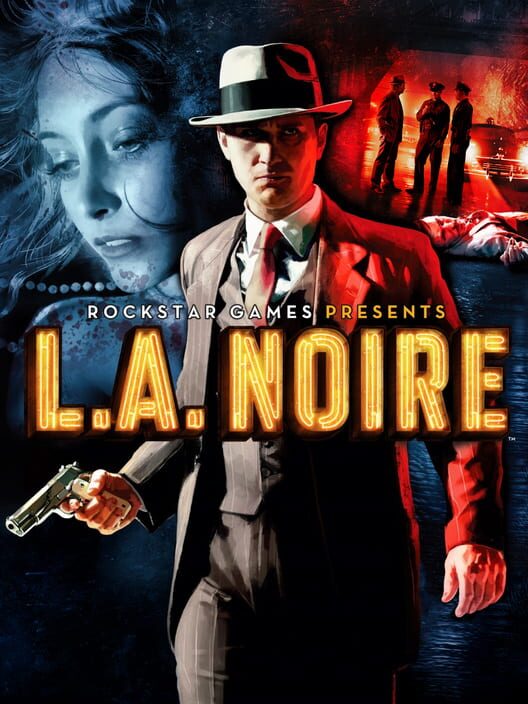
A. Noire is an action-adventure game with neo-noir and crime genre elements. Played from a third-person perspective, the game is set in an open-world environment featuring Los Angeles in 1947. The player completes cases to progress through the story, fulfilling objectives in a generally linear order; as they roam the open world, the player can also complete optional street crimes—short, linear scenarios with set objectives—and collect items such as golden film reels, vehicles, novels, and golden records.
The player can also discover multiple landmarks based on real monuments from Los Angeles in the 1940s. For most of the game, the player controls Cole Phelps, a Los Angeles Police Department (LAPD) patrolman who advances through the police department bureaus (desks) of Traffic, Homicide, Vice, and Arson; in some cases during the final desk, the player controls investigator Jack Kelso. The player has the option to play the game in black and white to imitate film noir.
While solving cases, the player discovers evidence, including information from non-player characters or physical clues found in or around crime scenes, locations of interest, or dead bodies; several pieces of physical evidence can be manipulated or further investigated to discover more information. When all key clues are discovered at a crime scene, the investigation music concludes. The player can also use telephones or gamewells to contact the police radio and access additional information. During cases, the player interrogates suspects and witnesses to discover information.
When the interviewee responds, the player is given the option to either believe them, doubt them, or accuse them of lying. If the player accuses them of lying, they must submit evidence to prove it. The player's in-game notebook is used to list evidence, locations, and people involved in the case, as well as to select questions during interrogations.
When interrogating two suspects at the police station, the player may decide whom to charge with the crime; charging the wrong suspect affects the case's end rating—a five-star scale determined based on the player's performance in investigations, interrogations, and behaviour while driving. The player can use Intuition points during investigations to locate remaining clues, or during interrogation by removing an answer or discovering the most popular answer among players via the Rockstar Games Social Club. Progressing through the game will increase the player's Rank, which unlocks outfits and hidden vehicles, and earns an additional Intuition point; the maximum rank is 20. In some cases, while searching for clues, the player can discover newspapers, which provide access to a short cinematic covering a part of the game's overarching plot.
The game's world is primarily traversed on foot or in a vehicle. The player can climb over fences and up pipes and ladders to access different areas. While driving, the player can turn on the vehicle's siren, allowing them clearer passage through streets. The game also allows the player to skip travel sequences: as Phelps, they can nominate their partner as the driver and select the destination; as Kelso, who lacks a partner, they select the destination and arrive after a loading screen.
As Phelps, the player can also ask their partner for directions. The game features fast-paced action sequences, including chases, combat, and gunfights. The player uses melee attacks and firearms to fight enemies; weapons can be swapped by opening the boot of the player's police vehicle. In combat, auto-aim and a cover system can be used as assistance against enemies.
Should the player take damage, the screen colour will begin to fade to black and white; when free from damage, the character's health will gradually regenerate. Weapons can only be used in appropriate circumstances, such as during firefights; in some chase sequences, the player has the option to fire a warning shot against fleeing suspects. The player's partner will sometimes shoot at suspect vehicles during driving chase sequences. The player is presented with the option to skip action sequences and continue through the narrative upon failing three times.
Story
For most of the game, the player takes on the role of Cole Phelps (Aaron Staton), a decorated United States Marine Corps veteran from the Sixth Marines. The game begins with Phelps as an LAPD patrol officer alongside his partner Ralph Dunn (Rodney Scott), another new recruit. When Phelps is promoted to the Traffic desk, led by Captain Gordon Leary (Ned Vaughn), he is partnered with Stefan Bekowsky (Sean McGowan), a Polish American whom Phelps eventually befriends. Upon his promotion to Homicide, led by Captain James Donnelly (Andrew Connolly), Phelps is partnered with Rusty Galloway (Michael McGrady), a weary and cynical detective who often challenges Phelps's theories and opinions.
In the Vice bureau, led by Lieutenant Archie Colmyer (Steve Rankin), Phelps becomes partners with Roy Earle (Adam J. Harrington), a sardonic and corrupt detective with whom Phelps repeatedly clashes over morality, behaviour, and technique. During his time in Vice, Phelps begins an extramarital affair with Elsa Lichtmann (Erika Heynatz), a German jazz singer. As a detective, Phelps frequently works with coroner Dr.
Malcolm Carruthers (Andy Umberger) and technical crime scene investigator Ray Pinker (JD Cullum).
Following his demotion to the Arson desk, led by Captain Lachlan McKelty (Randy Oglesby), Phelps is partnered with Herschel Biggs (Keith Szarabajka), a former Marine and proficient detective who is reclusive and opposed to partners but eventually grows to respect Phelps. For some Arson cases, the player controls Jack Kelso (Gil McKinney), a former Marine with whom Phelps developed an intense rivalry. Kelso, initially a claims investigator at California Fire and Life and later a District Attorney Investigator, helps Phelps and Elsa discover the truth behind the Suburban Redevelopment Fund (SRF)—a program founded under the pretense of providing affordable housing for returning veterans. Members of the SRF include real estate magnate Leland Monroe (John Noble), California Fire and Life vice-president Curtis Benson (Jim Abele), and psychiatrist Harlan Fontaine (Peter Blomquist).
Fontaine's mentee is medical student Courtney Sheldon (Chad Todhunter)—a former Marine stationed with Phelps and Kelso—who becomes involved in the city's drug trade through a partnership with gangster Mickey Cohen (Patrick Fischler). One of Fontaine's patients is Ira Hogeboom (J. Marvin Campbell), a former flamethrower operator from the Sixth Marines who became severely traumatised after unintentionally burning out a cave of civilians on Phelps's orders.
In 1947, after successfully solving a major murder case as a patrol officer, Phelps is promoted to detective. His tenure at the Traffic desk results in solving multiple cases of murder and fraud. Six months later, after a stint on the Burglary desk, Phelps is promoted to the Homicide desk. He and Galloway investigate various cases containing similarities to the Black Dahlia murder, arresting numerous suspects.
However, Phelps is doubtful they are apprehending the actual murderers; his theories are ultimately proven correct. They eventually track down and kill the real murderer but are unable to publicly disclose his identity due to his relation to a powerful government official. The wrongfully arrested suspects are due to be released via mistrial.
Upon being promoted to the Vice division, Phelps investigates the distribution of military surplus morphine, stolen from the ship that had brought home his former Marine unit from the war. He learns that several members had stolen and distributed the morphine, only to be assassinated on the orders of Cohen. During this time, Phelps begins his affair with Elsa. Earle helps several prominent figures in the city draw attention away from a major prostitution scandal by exposing Phelps's adultery before he is able to draw a confession from Sheldon over his involvement with the stolen morphine.
In exchange, Earle is given a place in the SRF. Phelps's marriage ends, he becomes disgraced in the LAPD, and he is demoted to the Arson desk, where he is tasked with investigating several suspicious house fires. Despite noting a solid connection between them and a housing development the SRF operates, Phelps is warned off by Earle from pursuing the syndicate and its founder Monroe. Seeking help, Phelps prompts Kelso to look into the matter.
Kelso discovers the development uses unsuitable building materials, and his boss Benson is knowingly insuring them. Following a shootout at Monroe's mansion, Kelso learns the syndicate used one of Fontaine's patients to burn down the homes of those who would not agree to sell their property to the fund while the occupants were on vacation; eventually, the patient accidentally killed four people in one such fire and became irreversibly traumatised. The patient confronts and murders Fontaine at his clinic and kidnaps Elsa. Investigating the clinic, Phelps discovers the syndicate was a front to defraud the Federal Government: knowing the government would later purchase the plots through eminent domain for a planned highway, Monroe would acquire land with money invested by the syndicate and build surreptitiously cheap houses to increase their value. Phelps also discovers that Sheldon, overcome with guilt, had provided Fontaine with the stolen morphine under the pretense that Fontaine would legally provide the morphine to medical facilities, with the profits being reinvested into the SRF; Fontaine later murdered Sheldon after gaining knowledge of Kelso's investigation into the SRF.
Kelso realises Fontaine's patient was Hogeboom and joins Phelps in pursuing him and Elsa into the Los Angeles River tunnels. The pair rescue Elsa, and Kelso shoots Hogeboom to end his suffering. As the water rises within the tunnels following intense rainfall, Elsa and Kelso manage to escape, but Phelps is washed away by a violent current and dies. At Phelps's funeral, Earle delivers a eulogy, claiming Phelps was falsely accused of wrongdoings
Development
After the release of The Getaway (2002), writer and director Brendan McNamara left developer Team Soho and moved from London to his native Sydney. In mid-2003, he founded the six-person development studio Team Bondi alongside former Team Soho developers. A. Noire began shortly thereafter, in 2004.
The studio had signed an exclusive deal with Sony Computer Entertainment to develop a game for the PlayStation 3, though the publishing rights were handed to Rockstar Games by September 2006. The development team visited Rockstar's headquarters in New York every few months to exhibit progress. Development was assisted by multiple studios owned by Rockstar Games worldwide. Analyst estimations place the game's combined development and marketing budget at more than US$50 million, which would make it one of the most expensive video games to develop.
A. Noire uses a proprietary engine from Team Bondi. McNamara led the founding of Depth Analysis, a sister company to Team Bondi that developed the motion capture technology MotionScan, which records actors at 1,000 frames per second with 32 surrounding cameras to capture facial expressions from every angle, resulting in a realistic recreation of a human face. The technology is central to the interrogation mechanic as players are required to use reactions to judge whether the interviewee is lying.
Its precise requirements demanded extensive preparation, including hairstyling for performers. Rockstar was doubtful about the process and the team considered using the same technique as other Rockstar games like Red Dead Redemption (2010) as a fallback. The game uses Havok as its physics engine. Eleven cases across two desks—Bunko and Burglary—were cut as the team suspected they would not fit on one Blu-ray for PlayStation 3; the Xbox 360 version utilised three discs, though it originally used up to six prior to compression.
A version of Grand Theft Auto's wanted system—wherein the player would evade and attack other police officers—was removed as it felt out of character for Phelps.
McNamara had been interested in 1940s Los Angeles for some time—while working on The Getaway, he had a screensaver of the first freeway being built in Los Angeles—and felt the improvement in lighting systems from the PlayStation 2 to PlayStation 3 allowed the possibility to explore the film noir genre. He began with writing a 4–5-page outline before reading stories from the Los Angeles Public Library to use as inspiration. The team spent the first year-and-a-half of development researching Los Angeles by using newspapers and magazines, organising research trips, and capturing photographs; a total of 180,000 photographs were available as resources throughout development, and over 1,000 newspapers were used for research. The open world of 1947 Los Angeles was modelled using aerial photographs taken by photographer Robert Spence, which helped to create traffic patterns and public transport routes, as well as the location and condition of buildings. Jay Leno's collection of vintage vehicles was photographed for reference.
Building interiors were based on real Los Angeles buildings; the team extensively studied the Barclay Hotel for an accurate recreation in-game. While striving for an accurate recreation, the team took some artistic licence, including the appearance of Intolerance's Babylon film set, which was destroyed prior to the 1940s but included to celebrate its history. The team created over 140 production bibles during development, acting as style guides with information about floorplans, dressing, signs, graphics, lighting, and reference material. Several in-game cases were inspired by real-life crimes reported by the city's media at the time; for example, "The Red Lipstick Murder" is based on the unsolved murder of Jeanne French in February 1947. When creating the themes, narrative, visuals, and sounds, McNamara and the team were inspired by several films, albums, television and radio shows, and books.
A. Noire has over twenty hours of voice work, and over 400 actors performed for the game. McNamara felt the technology allows players to connect with the characters in a way games had not achieved; he aimed "to go on a personal journey with characters". The team engaged Michael Uppendahl to direct the actors due to his experience.
Secretive auditions were held for casting by Schiff/Audino, leading to several shared actors with the television show Mad Men, which used the same casting firm. Mad Men star Jon Hamm was considered for the role of Phelps, but Rockstar Vice President of Creativity Dan Houser suggested Staton. Staton joined production after McNamara pitched him the character, world, and technology. He worked on the project for about 18 months; unable to read the entire 2,200-page script, he received a 12-page document outlining the story and Phelps's history.
Regarding the switch in player character from Phelps to Kelso, McNamara explained the player had to "go outside the realm of being a cop to bend the rules". He found the ending akin to A Tale of Two Cities (1859), with the characters coming "full circle" where "[Phelps] could do something for [Kelso] for once"; Phelps's death was partly inspired by the ending of the film Chinatown (1974). A gameplay sequence was originally meant to take place after Phelps's death but was cut as it "never really worked".
Characters' physical movements were recorded using motion capture. McGowan felt Bekowsky, initially jealous of Phelps, eventually warmed up to him and treated him like a younger brother. McGrady felt his own introverted personality helped him connect to Galloway, who he felt convinced to play after reading the script. McNamara and Harrington considered Earle true to the genre, citing his dated attitudes and sense of entitlement. Harrington compared the motion capture performance to live acting, though found th
Reception
L.A. Noire received "generally favorable reviews" from critics, according to review aggregator Metacritic. It was praised for its facial animation, narrative, characters and performances, music, world design, and interrogation gameplay, though responses to the shooting and driving mechanics were mixed. The Guardian's Steve Boxer described it as a "breakthrough for games"; Edge felt most elements are achieved better by other games but "few developers have brought such a diffuse set of genres together so atmospherically, stylishly or cohesively". GameTrailers wrote it "sets a new standard for storytelling in video games", though noted some overall limitations compared to other games.
Reviewers praised the game's facial animation, with several calling it the best in any video game. GameTrailers wrote "it allows a level of emoting that's never been seen in interactive entertainment". Matt Liebl of GameZone felt the interrogation mechanic would have been unrealistic without the use of MotionScan. Joystiq's Justin McElroy considered the technology "nothing short of revolutionary", noting it allowed the player to view "an actor's entire performance"; Edge found it added a "human element" to the interrogations. Some reviewers found the body animations failed to match the faces—sometimes failing to bridge the uncanny valley—but felt the effect added to the realism and subtlety of performances.
A. Noire to be "one of the strongest stories Rockstar's ever published", and Giant Bomb's Brad Shoemaker called it "among the best in the business", citing its cohesiveness and tension near its climax. Liebl of GameZone thought the focus on narrative and performances excelled the game over Rockstar's action-oriented titles. Boxer of The Guardian praised the narrative's pacing and arc; Carolyn Petit of GameSpot found the game's later chapters made the slower pace of the early story more worthy.
GamePro's Will Herring similarly lauded the game's final act, noting the narrative's accuracy in its portrayal of Los Angeles; conversely, some reviewers felt the game became less interesting towards the end and some found it became repetitive. Hilary Goldstein of IGN wrote the cases that strayed from the formula—particularly the Homicide desk—were among the best, though noted the game failed to reach the emotional heights of Heavy Rain.
Petit of GameSpot found Phelps's character development "fascinating", and Herring of GamePro wrote his rapport with his partners made the game more interesting. GamesRadar's Mikel Reparaz considered Phelps more likable as the game progressed. Giant Bomb's Shoemaker felt the characters' dialogue made them feel appropriate to the setting. Polygon's Owen S.
Good found Biggs's moral code and reignited interest in justice a crucial personification of the noir theme. Critics lauded the cast's performances, with particular praise for Aaron Staton, John Noble, Andrew Connolly, and Michael McGrady; Edge felt Connolly "dominated any scene he's in". Some reviewers found the performances made the characters feel more believable and convincing; IGN's Goldstein praised the actors' mannerisms. Ryan McCaffrey of Official Xbox Magazine (OXM) wrote the performances made it "a hell of a great drama to watch unfold"; similarly, McElroy of Joystiq felt they made it one of the "most compelling video game stories ever".
Eurogamer's Oli Welsh wrote Staton "does his best with a dry character".
Many reviewers found Los Angeles to be the "star" of the game, with praise directed at the generally accurate recreation of the city in 1947. Eurogamer's Welsh compared it to Rockstar's Grand Theft Auto: San Andreas (2004) and Midnight Club: Los Angeles (2008), noting "it's the fastidious period detail that really impresses this time". Shoemaker of Giant Bomb wrote the historical elements greatly benefited the overall tone and atmosphere, granting authenticity to the narrative. GamePro's Herring called it "one of the richest and most impressively rendered video game environments".
Matt Helgeson of Game Informer lauded the attention to detail but felt it lacked the feeling of interactivity of Liberty City from Rockstar's Grand Theft Auto IV (2008). Petit of GameSpot said the "outstanding" art direction made the game more memorable but the believability of the open world was marred by the awkward dialogue of the non-playable pedestrians.
Reviewers lauded the game's original score. A. Confidential (1997). GameSpot's Petit concurred it successfully evoked some of the best music of film noir, and Joystiq's McElroy praised its authenticity to the time period.
Helgeson of Game Informer felt the game effectively balances jazz tracks from the 1940s with a "mournful score". Giant Bomb's Shoemaker wrote the "big-orchestra score feels completely appropriate for the setting and subject matter", and appreciated the music notes used during investigations.
A. Noire"; IGN's Goldstein concurred, comparing them to dialogue-heavy scenes from role-playing games. Shoemaker of Giant Bomb favourably compared the interrogations to the dialogue choices of Mass Effect 2, noting they provide new energy to each case. Petit of GameSpot found the interrogations became more interesting once the player received more autonomy.
OXM's McCaffrey appreciated the "vigor" brought to the game by the interrogations but criticised their passive nature of simply listening and pressing a single button. Some reviewers considered the system flawed due to its vague and sometimes illogical choices. Critics were divided on the game's investigation elements: GameSpot's Petit called it "compelling" and praised the rich details, while Eurogamer's Welsh called it "clunky" and "lab