The articlegameplay, story, development, reception
Gameplay
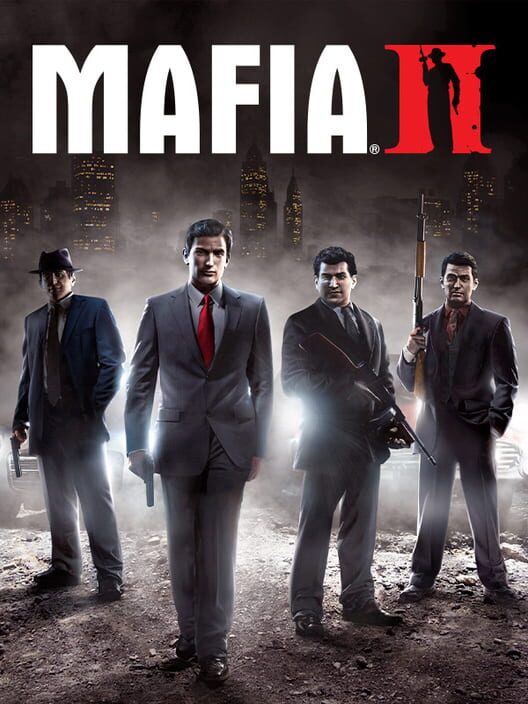
Mafia II is an action-adventure game set in an open world environment and played from a third-person perspective. Most of the game is set in the fictional city of Empire Bay, based on New York City, Chicago, San Francisco, Los Angeles, Boston, and Detroit, during the mid-1940s and early 1950s. The core gameplay revolves around shooting and driving; a limited melee combat system is also included, which combines punching and dodging. There are 50 era-accurate vehicles in the game as well as licensed music.
Depending on the weather during the course of the game, vehicles handle differently. For example, during the early chapters in winter, vehicles are more likely to slip on the road due to the ice. Many firearms from the previous game return, such as the Thompson submachine gun and Colt 1911, as well as a pump-action shotgun. New World War II–era weapons, such as the MG 42 and the Beretta Model 38, also appear in the game.
Interacting with objects in the environment involves two action buttons: a standard action and a "violent" action, used in context-sensitive situations; for example, when stealing a car, the player may choose to either pick its lock or break the window glass. A map is included as in the original Mafia game, but the checkpoint system has been completely overhauled. New controls include a cover system that allows the player to take cover behind objects and shoot enemies, rather than just entering an arbitrary crouch pose behind them as in the first game. This feature provides tactical support against enemies and has become a crucial technique of the genre.
The game's cutscenes are created by the game engine in real-time. For example, if the player is riding in a car and a cutscene starts, the player will be driving the same car with the same condition (damaged or intact) and will be wearing the same clothes. There are exceptions, however, such as the opening sequence and a cutscene in the tenth chapter, which are pre-rendered video clips.
The game features three different in-game radio stations (Empire Central Radio, Empire Classic Radio, and Delta Radio) with licensed music, news, and commercials. The radio stations include music from different genres including rock and roll, big band, rhythm and blues, and doo-wop, with licensed songs by Chuck Berry, The Everly Brothers, Dean Martin, Little Richard, Muddy Waters, Buddy Holly & The Crickets, Bing Crosby, Bill Haley & His Comets, The Chordettes, Ritchie Valens, Bo Diddley, Ricky Nelson, Eddie Cochran, The Champs, The Drifters, The Fleetwoods, Screamin' Jay Hawkins, Nat King Cole, The Chords, and The Andrews Sisters.
Story
Set nearly a decade after the first game, Mafia II takes place between two distinct time periods – 1945 and 1951 – within the fictional U.S. city of Empire Bay; the game's first chapter takes place in the fictional town of San Celeste in Sicily, while the sixth is set within a prison located outside Empire Bay. The city is situated on the United States' eastern coastline and divided by a river, and consists of several districts, including wealthy suburbs, slums, and tenement blocks for the city's different ethnic groups, including Irish, African-American, Chinese, and Italian, and large-scale industrial complexes, with the city supported by a large port, a railroad station, a major prison outside its city limits, several parks, and a collection of shopping malls and supermarkets.
The game's main story sees the city divided between a number of criminal outfits, including three mafia families — the Falcone family, Vinci family, and Clemente family — a Chinese Triad outfit, the Irish Mob, and several street gangs. The city's design, including the architectural styles, cultures, public transportation and landmarks, are influenced by various real-life American cities, including New York, Chicago, Los Angeles, San Francisco, Boston, and Detroit, from within the two respective time periods used in the game.
Two of the game's DLC packs, The Betrayal of Jimmy and Jimmy's Vendetta, also take place in the early 1950s, but in a different canon from the base game, while the third, Joe's Adventures, is set during the events of the main storyline, bridging the gap between the two time periods.
In 1943, Sicilian immigrant Vito Scaletta is arrested during a robbery and opts to join the United States Army to avoid prison time, being enlisted in the 504th Parachute Infantry Regiment. Vito first experiences the power of the Mafia when an operation in Sicily goes awry, and Don Calò arrives to order the Italian soldiers to stand down.
In February 1945, Vito returns home on leave to Empire Bay, reuniting with his childhood friend and accomplice Joe Barbaro, who has joined Don Alberto Clemente's crime family in Vito's absence. Joe supplies Vito with counterfeit discharge papers and introduces him to some of his contacts for work. Learning that his late father left the family in debt to a loan shark, Vito seeks work with his father's former employer, Derek Pappalardo, who has ties with the Mafia. Later, Vito is introduced by Joe to Henry Tomasino, a Clemente made man.
Upon carrying out several jobs with Joe and Henry, Vito secures enough money to pay off his father's debt. However, he is arrested again, this time for the theft and sale of ration stamps, and sentenced to ten years in prison. While serving his time, Vito befriends Leo Galante, the consigliere of Don Frank Vinci. While his sister Francesca visits him, their mother dies and Vito's remaining money was spent on her funeral.
In April 1951, Vito is released early due to his connections with Leo. Reuniting with Joe, Vito meets the Falcone family, led by Don Carlo Falcone and his underboss Eddie Scarpa. Soon, Vito and Joe become made men within Falcone's organization, allowing them to secure a better lifestyle. Learning that Clemente is conducting drug operations against the traditions of the Commission, Carlo orders the pair to assassinate him.
Following the hit, Henry approaches Eddie through Vito in search of new employment and is ordered to kill Leo to prove himself. Although Vito manages to warn Leo in time and help him leave the city, Eddie nonetheless brings Henry into Falcone's organization.
Vito's life quickly falls into turmoil after Francesca distances herself from him because of his violent lifestyle and his house is destroyed in an arson attack by the Irish Mob. To rebuild his fortunes, Vito joins Joe and Henry to profit from the sale of heroin bought from the city's Triads. However, Carlo, who is also conducting drug operations behind the Commission's back, learns about this and demands a cut of their profits. Vito and Joe go to meet with Henry to discuss the matter, but witness the Triads publicly murdering him and escaping with their money.
The pair retaliate by exchanging gunfire against the Triads at their local restaurant, but fail to retrieve the money. Indebted to loan shark Bruno Levine, whose money they borrowed for the heroin deal, Vito and Joe take on various jobs to raise money, including the assassination of retired mobster Tommy Angelo. Vito visits Derek for work, but discovers Derek ordered his father's death, kills him in retaliation and takes Derek's retirement money. Meanwhile, the Vinci family kidnaps and tortures Joe until Vito saves him.
After paying off the debt to Bruno, revealed to be the same loan shark his father was indebted to, Vito is confronted by Leo, who chides him for his and Joe's actions that have sparked a war between the Mafia and the Triads. Leo also confirms that Henry was indeed a federal informant and that Carlo wants to kill Vito for vouching for him. However, thankful for Vito previously saving his life, Leo arranges for him to be spared by both the Commission and the Triads as long as he kills their common enemy: Carlo. Vito confronts Carlo, who offers to make Joe a caporegime if he kills Vito.
Joe refuses and helps Vito kill Carlo. The pair are greeted by Leo, who takes Vito with him to celebrate, while Joe is driven off in a separate car. Vito agitatedly asks where Joe is being taken. Leo reveals that he was not part of their deal, leaving Vito to watch helplessly as his friend is driven to whatever fate awaits him.
Development
Preliminary work on Mafia II began in 2004; the work on the script began in 2003. Originally intended for a PlayStation 2 and Xbox release, the game was moved to the PlayStation 3 and Xbox 360 in 2005, following difficulties with the developer of the game engine. It was officially revealed in August 2007 at the Leipzig Games Convention. A playable version of the game was achieved in 2007 or 2008. Mafia II was expected to release in late 2009, but was delayed until its release in August 2010.
2K Czech wrote a new engine for the game which was named the Illusion Engine. The new engine was the successor to the IS' LS3D engine which was used to make the first Mafia game.
A promotional trailer was released for the game in August 2007. A second trailer was released on the Spike Video Game Awards show on 14 December 2008. An extended version of the trailer was released on 14 January 2009 with an extra 30 seconds of cut scene footage. The first gameplay footage debuted on GameSpot on 17 April as part of an interview with Mafia II's producer, Denby Grace.
The video shows driving and gunplay aspects to gameplay as well as portraying the physics engine. A third trailer was uploaded to the website on 28 May 2009. From 1 June, four short videos were added to the Mafia II website. The first of these is called "The Art of Persuasion" and features the song "Mercy, Mr Percy" by the female singer Varetta Dillard.
Another video was released featuring footage from the mission "The Buzzsaw". The video reveals the fate of "The Fat Man" who appeared in the earlier trailers. On 27 March 2010, a new trailer was released showcasing the PhysX-based cloth and physics system used in the game.
On 3 August 2010, Sheridyn Fisher, the face of Playboy Swim 2010, became the official ambassador for Mafia II. Sheridyn's involvement with Mafia II highlights the agreement between 2K Games and Playboy magazine to use 50 of their vintage covers and Centerfolds in Mafia II as part of the in-game collectibles integration. A demo for the game was released on 10 August 2010 on Steam, Xbox Live Marketplace and PlayStation Network.
Reception
Mafia II received "generally favorable reviews" for the Windows and PlayStation 3 versions, and "mixed or average reviews" for the Xbox 360 version and Definitive Edition remaster from critics, according to review aggregator Metacritic. Greg Miller of IGN gave the game 7/10, calling it "a solid little game that'll give you a fun ride – just don't expect the world." Kevin VanOrd of GameSpot gave it 8.5 and stated: "Mafia II's exciting action and uncompromising mob story make for an impressive and violent adventure." Matt Bertz of Game Informer gave it a 9.0/10, writing that "in an era when video games are moving away from relying on cinematics for storytelling, Mafia II draws on the rich mobster film history to weave a gripping drama about family, friendship, loyalty, betrayal, and pragmatism."
The most negative review came from John Teti of Eurogamer who gave the game a 4/10 and wrote that "Mafia II gets the last word by destroying the myth that the mafia is interesting at all. It contends that the mob world is a hell of boredom populated by aggressively stupid automatons. These drones wake up each morning, carry out a series of repetitious tasks, and return home."