
The articlegameplay, story, development, reception
Gameplay
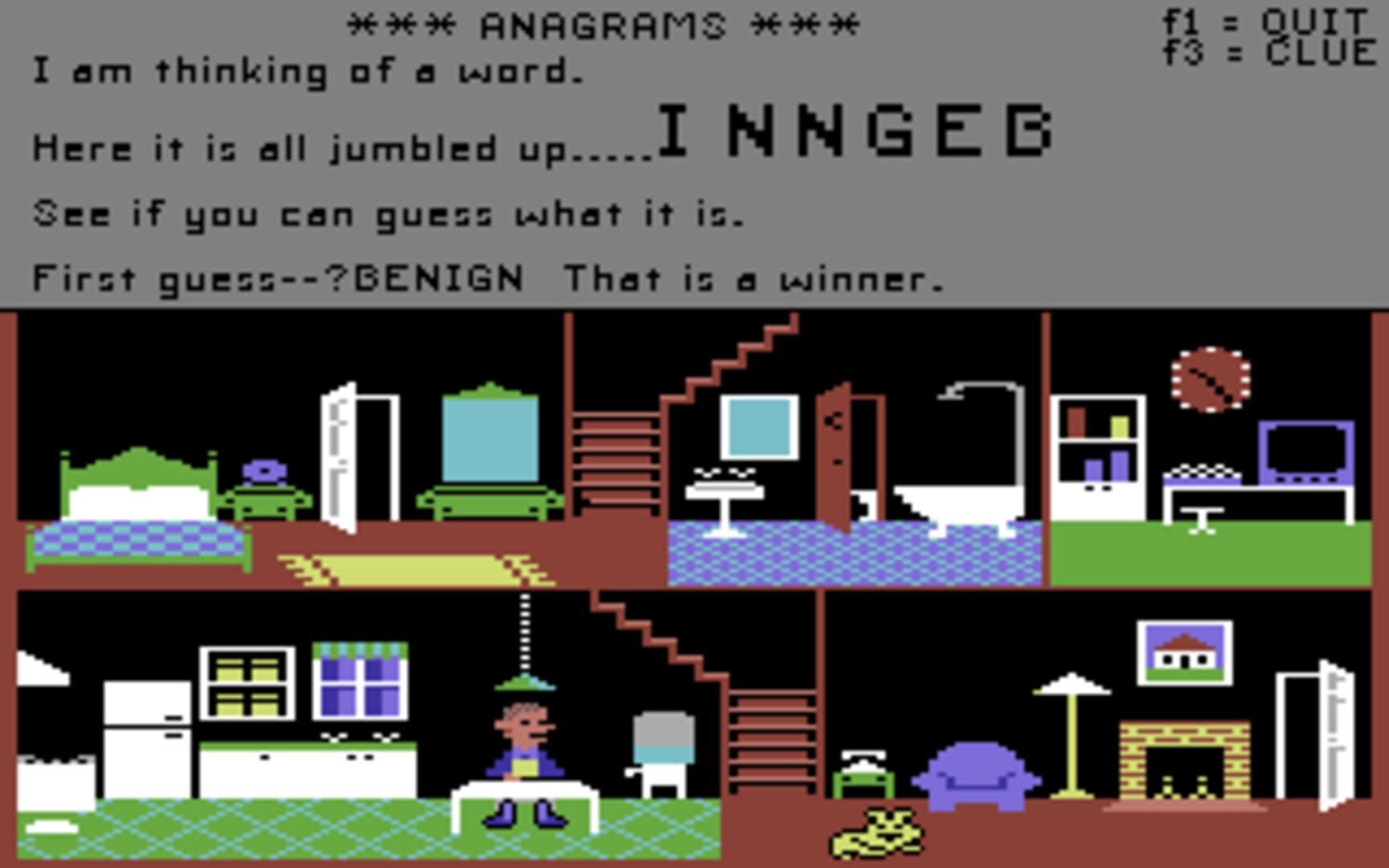
The game has no win conditions, and one setting: a cross-sectional view of a three-story house. After a short time, an animated character will move in and occupy the house. He goes about a daily routine, doing everyday tasks like cooking, watching television or reading the newspaper. Players may interact with the character in various ways such as entering simple commands, playing poker, and offering presents.
On occasion, the character initiates contact on his own, inviting the player to a game or writing a letter explaining his feelings and needs. Each copy of the game generates its own unique character, so no two copies play exactly the same. The character's name is randomly selected from a list of 256 names.
The documentation accompanying the game keeps up the pretense of the "little people" being real, and living inside one's computer (the software merely "bringing them out"), with the player as their caretaker.
Two versions of the game exist for the Commodore 64: the disk version, which plays as described above, and the cassette version, which omits several features. On tape versions, the Little Computer Person is generated from scratch every time the game is started up (not only on the first boot, as with other versions), and thus does not go through the "moving in" sequence seen on other versions. Also, on cassette versions the Computer Person has no memory, and does not communicate meaningfully with the user. Additionally, the card games, such as poker, cannot be played.
Development
The initial idea for Little Computer People was developed by Rich Gold, who wanted to create a Pet Person computer program similar to that of the Pet Rock toys of the 1970s. Gold was able to develop some funding for it and hired James Wickstead Design Associates to realize it as a game concept which was in development for about a year. This team refined the concept of a Pet Person who lived in a house. Gold initially struggled to find a publisher for the product.
At this point, the game was like screensaver, that the players would be able to boot and just see what the character was doing. Gold met with Activision president Jim Levy was an interesting enough product to show to game developer David Crane, who had popular hits with games like Pitfall! (1982) and Ghostbusters (1984) for his opinion. At this point in time, Activision was one of the largest video game publishers in the industry.
Crane said he offered to take on the project, but not as a finished game for publishing but as a starting point for an interactive product. Crane saw the project as going beyond the Pet rock concept in what Crane described as "one of the hardest programming challenges of my career." Crane wanted to add interactivity and argued with Gold with this concept, who said it was contrary to the initial Pet Rock concept. Crane later recalled in 2005 that "Part of me wanted to make him the smartest thing in computing maybe even to pass the Turing test — but with the constraints of time in the software business that was impractical."
Including the development of James Wickstead Design Associates, the game took about two years to develop in a period when most games were developed in four to five months.
Crane made the game so that each copy of it would be unique. Each copy of the game had built in parameters that gave the character a unique personality and mood parameters. He stated that this turned out to be one of the important aspects of the game as based on his personality and mood, the character could opt to ignore your commands.
While the game has the character live off a real-time six hour game schedule for a day, Crane thought it may have been better to have the character live off of a real-time schedule such as booting the game up at night would have the character sleeping.
Playing cards with the character was almost not included due to a lack of time according to Crane, who said that nearly all the time was focused on giving the character interactivity with its basic brain. Steve Cartwright was between games when the development of Little Computer People was closing, with Crane giving Cartwright the parameters to include the card game feature. Marketing staff at Activision formulated promotion through a newspaper story about the discovery of people living in computers everywhere.
Reception
Roy Wagner reviewed the game for Computer Gaming World, and stated that "The game is more cute than fun or challenging. The range of activities are limited and not very exciting, but can be interesting. The 'game' is ideally suited for children. It does a good job of teaching about caring for another."
Little Computer People earned a Zzap!64 Gold Medal Award in 1985. Games magazine listed it as one of its top 10 best entertainment software produced in 1985. Jerry Pournelle of BYTE named it his game of the month for December 1986, stating "That's not strictly a game, but it sure has consumed all the game time we have around here" and that the Amiga version's graphics were preferable to the Atari ST's.
Compute! favorably reviewed the Atari ST version in 1987, stating that it had "enormous and subtle educational appeal" to children and others. The magazine concluded that Little Computer People "is a delightful program". The game was voted best original game of the year at the 1986 Golden Joystick Awards.
Legacy
Little Computer People was described by Kim Wild of Retro Gamer as "selling well enough", but that the large amount of money in development and acquiring the property mean that any sequels were not a financial reality. During the development of the Amiga version of the game, Crane was planning add-ons being made available.
Little Computer People is often compared to an early predecessor to The Sims game series. When asked about its influence, Crane responded that "Almost everything we touched in those days could be constructed as the precursor to something on the market today. So rather than go there, I simple acknowledge that I took the first baby steps toward the simulation genre when I added human-like interactivity to Little Computer People."
Will Wright, designer of The Sims, has mentioned playing Little Computer People and receiving valuable feedback on The Sims from its designer, Rich Gold.
In 1998, German electro musician Anthony Rother released a single titled "Little Computer People", which is inspired by the computer game, as part of the group The Little Computer People Project.