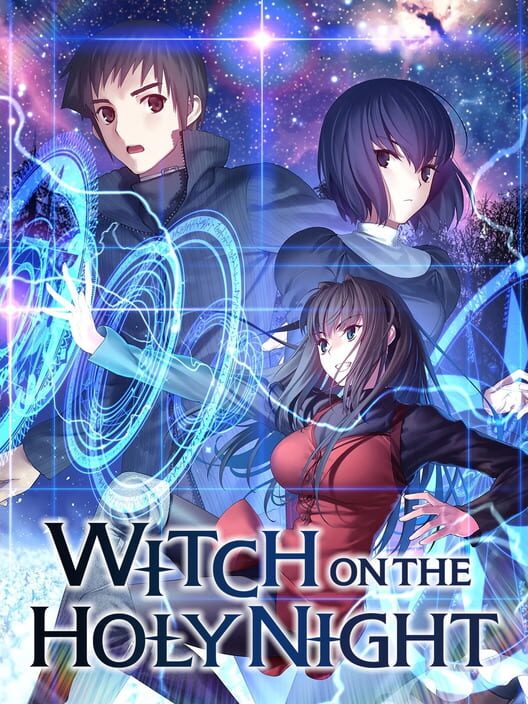
The articlegameplay, story, development, reception
Story
Near the end of the Shōwa era, in Misaki town, an old mansion is rumored to be the home of a witch. After moving there, Aoko Aozaki begins to learn sorcery from a young mage, Alice Kuonji, the rumored witch of the mansion. The Aozaki family oversees the land on which Misaki is built, and the heir (Aoko) is tasked with protecting it. Mysterious intruders have been disrupting the bounded field in Misaki, leading Alice and Aoko to investigate.
A mannequin or puppet attacks them and is incinerated. As this happens, both of them spot someone running away, a civilian who must not get away, having seen magic alive. Unexpectedly, a young boy named Sōjūrō Shizuki is drawn to the mansion and comes to reside with them as well. Eventually, it is revealed that the intruder who had been disrupting the bounded field is Touko Aozaki, Aoko's older sister.
She, having killed their grandfather, now seeks to unveil the Aozaki's path to the root.
The game takes place in the shared "Nasuverse" a colloquial term referring to a shared universe within the works created by Type-Moon, and takes place many years before the events of the original 2000 release of Tsukihime. The remakes of Tsukihime, titled Tsukihime: A Piece of Blue Glass Moon and Tsukihime: The Other Side of Red Garden, take place within the same universe as Witch on the Holy Night.
Development
Kinoko Nasu was inspired in late 1995 by the first episode of Neon Genesis Evangelion to write a novel, something he had been thinking of doing since he was in high school. Nasu originally wrote Mahōtsukai no Yoru on the spur of the moment as a roughly 400-page novel in winter 1996. He tried to enter it into several writing competitions, but was ultimately unsuccessful, leaving the work merely being passed around by his friends. Later, Nasu planned to submit it to Fujimi Shobo, but had difficulty keeping the page count under 350 pages, and left the novel unreleased. After forming Type-Moon with Takashi Takeuchi and releasing several projects under it, Takeuchi suggested remaking Mahōtsukai no Yoru so it could be released before their next planned project Girls' Work.
In April 2008, a game version of Mahōtsukai no Yoru was announced. Unlike Type-Moon's previous games, Mahōtsukai no Yoru is not an adult game, and features Hirokazu Koyama as the lead artist in place of Takeuchi. The game was set to be released sometime in 2009, but after several delays, the game received a September 2010 release date. In September, however, Type-Moon announced that the release date had been pushed back to winter 2011, and later to sometime in 2011. A free game demo was made available on December 15, 2011, and the full game was released on April 12, 2012 for Windows PCs.
An enhanced version for Nintendo Switch and PlayStation 4 was announced in April 2022, and published by Aniplex on December 8, 2022 in Japan. A demo version was released on November 3, 2022. In June 2022, it was confirmed that the game would also launch worldwide under the title Witch on the Holy Night on the same date. It features a higher resolution than the original PC release and full voice acting along with English, Simplified Chinese and Traditional Chinese language options.
A Windows port of this version was announced in September 2023, and was released via Steam on December 14, 2023. A smartphone version is to be released on November 20, 2026 in conjunction with the movie.
Two visual novel sequels are planned by Type-Moon, though no updates have been made since 2012.
Reception
Upon release, Witch on the Holy Night received "generally favorable" reviews from video game publications based on the review aggregate website Metacritic aimed towards the Nintendo Switch port.
Jason Bohn of Hardcore Gamer had called Witch on the Holy Night a "fun, but flawed" game, and criticized the pacing, saying "there are periods that just drag on", but also felt that it "does earn its reading time". The reviewer had criticized the localization, noting that "there are errant keystrokes or obvious grammatical errors." While Donald Theriault writing for Nintendo World Report said the game was "a 12 chapter novel with high resolution graphics, full voice acting, and no discernible gameplay beyond changing how text is displayed" and called it "a well-written story that sets up a lot of things for the future" while noting that "most of the text is well translated; although a few typos were present [...] they weren't occurring frequently enough to be a concern."
Anime News Network's Jean-Karlo Lemus felt that the game had lots to offer. The reviewer explained that "While Nasu's stiff, wordy narration might be a turn-off, the characters and their interactions more than redeem it, and the primary conflict is engrossing and moving." While Stephanie Liu at Siliconera said it "tells a fun and engaging story with tons of well-written and fleshed-out characters".