
The articlegameplay, story, development, reception
Gameplay
The Majin Tensei titles are strategy games in which the player takes the role of a human character who battles against demons. They navigate a field – seen in a top-down perspective in Majin Tensei and in a three-quarters perspective starting in Majin Tensei II – with characters represented by small, stick figure-like sprites, and switch to scenes with large, detailed characters when engaging in battle; in the first Majin Tensei, only the opponent is shown in battle scenes, while Majin Tensei II uses a split-screen presentation to show both sides. Ronde is an exception, and instead uses 3D graphics with a scrolling camera. On the field, the player can access pools that regenerate their energy, and starting in Majin Tensei II, they can use the terrain to gain an advantage in battles, increasing their defense rating.
The player can also use items, which are bought using money they earn from battles. To attack enemies or support allies, the player needs to move their units on the field so that they are adjacent to the target of the action.
In addition to fighting, the player can choose to talk to demons encountered on the field, and attempt to recruit them to their party; the success of this depends on the player's level, with more powerful demons only being recruitable if the player's level is sufficiently high. In Ronde, the player does not initiate these conversations themselves, however: instead, defeated demons sometimes choose to talk to the player, and sometimes decide to join their party. Like in other Megami Tensei games, the player can fuse multiple allied demons with each other, thereby creating more powerful demons. In Ronde, the player can form contracts with demons, allowing human characters to use demon magic.
Demons are fueled by magnetite, so the player needs to manage the supply of this, and thus cannot have too many allied demons on the field at once or take too long to finish a battle. By clearing battles, the player can advance to the next chapter. The games' stories are affected by player choices, and have multiple endings.
Development
The first two games were developed by Atlus, while Ronde was handled by Multimedia Intelligence Transfer, and the Blind Thinker titles by Bbmf Corporation. All the games were published by Atlus in Japan; none of them have been released in English, but the user interface of Majin Tensei II is in English rather than Japanese, and English fan translations of the first two games were released in 2019 and 2018, respectively.
Rather than the Megami Tensei series regular Tsukasa Masuko, the soundtracks for the first two games were composed by Hidehito Aoki; he composed the Majin Tensei music on his own, and cooperated with Misaki Okibe on Majin Tensei II. He made use of ambient music, while also incorporating elements of funk, electronic distortion and sound effects; for the second game, he also introduced a focus on synthesized piano in the compositions. Music albums featuring the first two games' original soundtracks, along with new arrangements, were released by Pony Canyon: Majin Tensei Excellence Sound Collection was published on March 18, 1994, and Majin Tensei II: Spiral Nemesis Excellence Sound Collection on May 19, 1995. A manga by Shinshū Ueda, Majin Tensei: The True Remembrance, was published by Enix in five volumes.
Reception
The gameplay, which several publications found similar to the Fire Emblem series, was well received, with multiple Famitsu reviewers commenting on how enjoyable they found the demon fusion. Kurt Kalata and Christopher J. Snelgrove of Hardcore Gaming 101 called Majin Tensei an interesting take on the genre, and worth playing; they said that while many players prefer Majin Tensei II, they enjoyed the first one more, but still found the second game decent; one change between the two that they liked was the larger focus on narrative, compared to the first game's focus on combat. They were highly critical of Ronde, labeling it a kusoge ("shit game"); they said that it was not "completely terrible", but that it felt like "a poor man's Shining Force III".
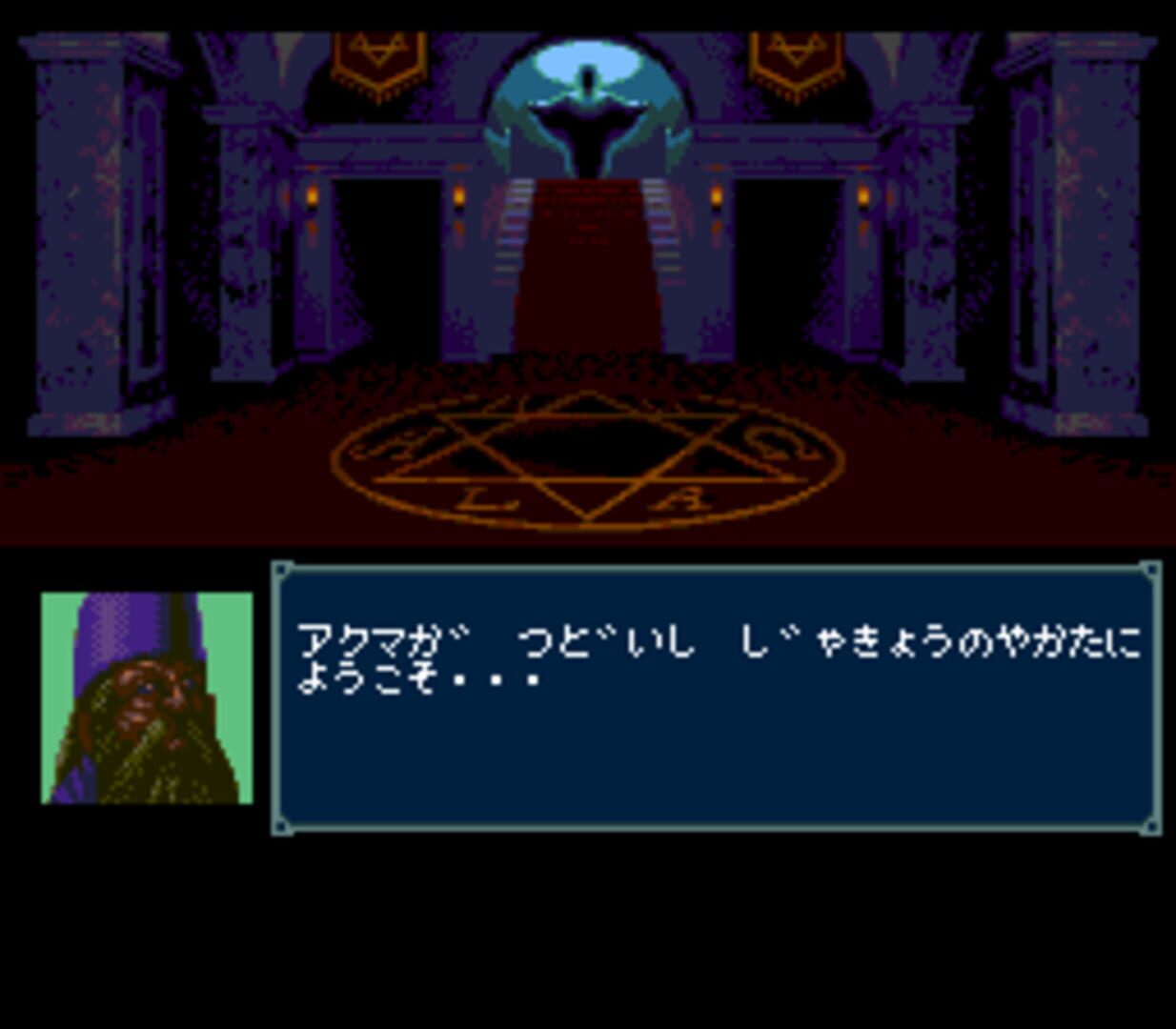
Kalata and Snelgrove criticized the first two games' field graphics for being small and only featuring little animation, while praising the battle graphics, noting their size, level of detail and high-quality backgrounds, and calling them superior to their counterparts in all other Super Famicom Megami Tensei games. They did however think that the battles in Majin Tensei II were visually a step down in quality. They criticized Ronde's visuals, saying that it was among the worst looking games from the 32-bit era, with characters looking like "blobs of discolored pixels", jerky camera movements, and slow-loading and visually unpleasing battles, and called the game "a total affront to the senses". RPGFan's Patrick Gann thought that the first Majin Tensei's music was weaker than Masuko's compositions, as well as Aoki's later compositions for the Megami Tensei spin-off series Persona, but still well done; in contrast, he called Majin Tensei II's music a pinnacle for the Super Famicom titles in the series, but still criticized its heavy use of synth.
Kalata and Snelgrove enjoyed the "moody synth soundtrack" and opening of Majin Tensei II, while calling Ronde's soundtrack mediocre. Chris Greening at VGMO called Majin Tensei "one of the most individualistic and accomplished ambient scores on the Super Nintendo", enjoying the mix of conventional ambiance and funk, saying that it both enhanced the game's mood and worked as stand-alone music. D. 1995 Story" as highlights.


