The articlegameplay, story, development, reception
Development
Producer Tetsuya Mizuguchi recounted the impetus behind the game: After Sega Rally, I wanted to make a game with a big graphic impact that used the player's body. Looking through a magazine, I saw an article about the Isle of Man and I found the island very beautiful - perfect for a nice racing game. Moreover, in Japan there are groups of bikers who love riding bikes on the open road. I wanted to make a bike game mixing these two elements.
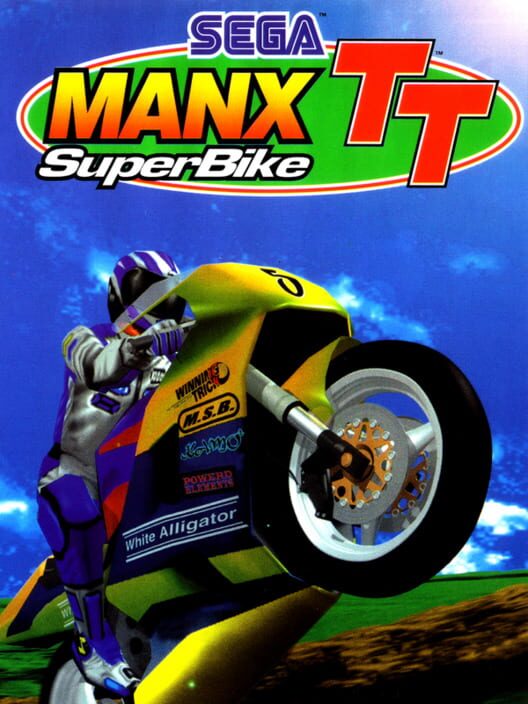
The in-game motorcycles resemble the team Honda/Castrol Honda RVF750 RC45. In making the game, AM3 consulted the motorcycle racing team Castrol/Honda Racing Corporation, who helped them on a number of points, including studies on where sound comes from on a motorcycle and how it travels to the ear of the rider. The team determined that they needed four sound outputs to recreate this experience realistically. Because the Model 2 arcade board has only two sound outputs, they used a Model 1 sound board for the additional two sound outputs.
Because it takes more polygons to render a motorcycle than to render a car with a similar level of detail, AM3's wish for the game to support up to eight players presented processing difficulties. They opted to limit the bikes to a relatively small number of polygons so that the game could support eight players without suffering slowdown.
The game was first demonstrated at the 1995 Japanese Amusement Machine Manufacturers' Association show; the game was described as only 20% complete at this time, with just one course playable.
Gaming fans and journalists assumed that the Saturn version of the game would be developed by the same internal Sega CS team which handled the Saturn conversion of Sega Rally Championship, but the team was busy with Daytona USA: Championship Circuit Edition, which Sega considered a more important release. Sega instead assigned the port to third party developer Tantalus Interactive, though several personnel from Sega of Japan assisted Tantalus towards the end of development. The assignment came to Tantalus in an indirect manner; Sega initially gave the job of both Saturn and Windows ports to Psygnosis, which contracted them out to Perfect Entertainment and Tantalus.
Reception
Following a strong audience reaction at the Amusement Trades Exhibition International (ATEI) show in January 1996, the game's UK distributor sold out of Manx TT Super Bike cabinets, despite costing £15,000 or $23,000 (equivalent to $47,000 in 2025) per deluxe cabinet. In Japan, Game Machine listed Manx TT Super Bike on their 15 February 1996 issue as being the second most-successful dedicated arcade game of the month. In March 1996, it was the second top-grossing dedicated arcade game in Japan (below Namco's Alpine Racer) and the overall top-grossing dedicated arcade game in Australia. In North America, the game was also a hit in arcades.
A reviewer for Next Generation hailed the game as "one of the fastest and most dazzling bike coin-ops in the arcades ... the next evolutionary step in bike racing sims." He said the ability to control the bike without placing one's feet on the ground makes it far more immersive and realistic than any previous cycle racing game, and additionally applauded the effective simulation of speed, high frame rate, "solid" learning curve, persistent and intelligent AI opponents, and the way the bike reacts to being hit or jostled by other racers.
Despite the controversy over Sega entrusting the Saturn conversion to an outside developer, upon its release critics agreed that it was an exemplary conversion of the arcade game. Dean Mortock, for example, admitted in Saturn Power: "... I was certainly sceptical as to the reasoning behind letting another team do the conversion. But, after playing the game inside out, I can honestly say that I believe that this is the finest conversion of Manx TT onto the Saturn possible." The game's smooth control was highly praised, with most critics commenting that all three controller options (standard joypad, analog controller, and steering wheel) work well, with the analog controller allowing the most exceptional precision of the three.
The most common criticism made of the game was that the additional content of the Saturn version was insufficient to give it the longevity expected of a home console game. GameSpot in particular concluded that while the game "is one of the best conversions the Saturn has seen and is also truly fun to play", Saturn owners should pass on it in favor of something with higher value-for-money. A Next Generation critic, however, argued that "what Manx TT is missing in depth is made up for in its ability to deliver a thrilling racing experience with an incredibly smooth frame rate, top-notch rider animation (a detail that doesn't mean much until you've seen it), and some of the best control dynamics ever offered in a racing game". Kraig Kujawa of Electronic Gaming Monthly called it "the perfect racing game to rent", while his co-reviewer Dean Hager argued that though the content is limited, "surprisingly, [it] will keep you busy for a while."
". In February 1998, Sega Saturn Magazine ranked Manx TT Super Bike 38th in its list of the 50 best Saturn games.
In the United Kingdom, the Sega Saturn release was the third best-selling game across all formats in April 1997.


