The articlegameplay, story, development, reception
Gameplay
Donkey Kong and Donkey Kong Jr. are early examples of the platform game genre. In both games, the player must guide the playable character (Mario in the first game, Donkey Kong Jr. in the second) to scale four levels while avoiding obstacles.
The player jumps to dodge incoming obstacles (such as barrels) or cross gaps, and climbs ladders or vines to reach the top of the level. In the first game, Mario can destroy obstacles by obtaining a hammer power-up, while in the second, Donkey Kong Jr. can do so by knocking pieces of fruit down from vines. Points are awarded for dodging or destroying obstacles, collecting items, and completing stages quickly.
The player begins each game with three lives, which they lose if they touch an obstacle or fall.
Donkey Kong 3 departs from this gameplay: it is a shooter game in which the player controls Stanley, an exterminator who must prevent Donkey Kong from stirring up insects in his greenhouse. The player fires bug spray at Donkey Kong and enemy insects attempting to steal Stanley's flowers. They complete levels by spraying Donkey Kong enough to force him to the top of the screen or by killing all the insects.
The 1994 Game Boy game begins with the four stages from the original Donkey Kong, but after completing the fourth, the player is presented with over 100 additional stages that introduce puzzle-platform gameplay in which Mario must scout each level within a time limit to locate a key. Mario can pick up and throw objects and enemies, similar to Super Mario Bros. 2, and perform acrobatics to reach otherwise inaccessible areas of the levels. This gameplay would serve as the basis for Mario vs.
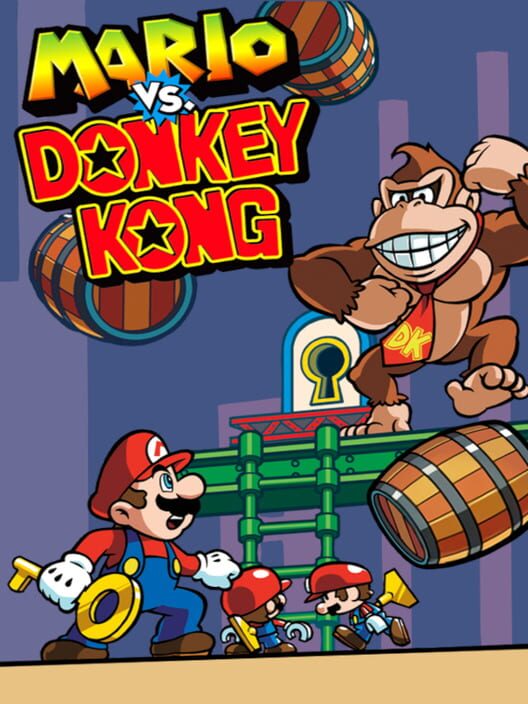
Donkey Kong, which introduces stages in which Mario must guide six Mini-Mario toys to a toy box while protecting them from hazards. Mario vs. Donkey Kong's sequels make guiding the Mini-Mario toys the focus, with each stage requiring the player to do so with touchscreen controls. This gameplay has been frequently compared to the strategy video game Lemmings (1991).
The Donkey Kong Country series features platforming gameplay in which players complete side-scrolling levels to progress, reminiscent of Nintendo's Super Mario series. The player progresses through a world map that provides access to the themed worlds and their levels. They traverse the environment, jump between platforms, and avoid enemy and inanimate obstacles. Each world ends with a boss fight with a large enemy. The Country series is known for its high difficulty level and emphasis on momentum, requiring players to react to oncoming obstacles quickly to maintain flow.
Players control one of the various playable Kongs, depending on the game: Donkey Kong, Diddy Kong, Dixie Kong, Kiddy Kong, Cranky Kong, or Funky Kong. The Rare games each feature two protagonists, with the newer protagonist carrying over to the sequel while another is introduced. The Retro Studios games star Donkey Kong with other characters as his sidekicks. Players primarily control one Kong, with the second acting as additional hit points. In the Retro Studios games, the second Kong rides on Donkey Kong's back to provide special abilities; for instance, Diddy's jetpack allows him to temporarily hover.
Barrels return from the original series and can be used as weapons, or broken to uncover power-ups. One barrel variant releases a partner Kong when thrown. Each level contains collectibles such as bananas, letters that spell out K–O–N–G, balloons, and puzzle pieces. These items can be found within the main level or by discovering hidden bonus stages, where they are earned via completing a challenge. Country's game mechanics also include blasting out of barrels that function as cannons, vehicle sequences with minecarts and barrel-themed rockets, and swinging vines.
In certain levels, the player can free an animal that provides the Kongs with special abilities, similar to the Super Mario series' Yoshi. Recurring animal friends include Rambi, a rhino that can charge into enemies and find hidden entrances; Enguarde, a swordfish that can defeat enemies underwater; and Squawks, a parrot who carries the Kongs or assists in finding collectibles. Outside the main gameplay, the Rare games' world maps contain areas where players can converse with non-player characters, such as Cranky, who provide advice, collectibles, and save points. The Retro Studios games feature shops (run by Cranky in Returns and Funky in Tropical Freeze) where the player can purchase items like power-ups and lives.
The Donkey Kong Land trilogy reflects the SNES Country gameplay, with different level design that accounts for the Game Boy's hardware limitations. Jungle Beat adds score-attack elements, challenging players to complete levels with as many points as possible.
Donkey Kong 64 blends Country elements with adventure gameplay that emphasizes collecting items to proceed, reminiscent of Super Mario 64 (1996) and Banjo-Kazooie, as well as third-person shooting. The player explores worlds and solves puzzles tailored to the unique abilities of the five playable characters (Donkey Kong, Diddy, Chunky, Tiny, and Lanky). Donkey Kong Bananza similarly focuses on exploration and collecting items in open worlds, with many journalists comparing it to Nintendo EPD's previous game, Super Mario Odyssey. Bananza is distinguished by its destructible environments: Donkey Kong can smash almost every surface, destroy terrain, and rip pieces of the environment from the ground or walls.
DK: King of Swing and DK: Jungle Climber feature settings and elements from the Country games, but require players to use the shoulder buttons to grab and climb pegboards to reach the end of a level. Diddy Kong Racing and Donkey Kong Barrel Blast are kart racing games that play similarly to the Mario Kart series, though Diddy Kong Racing features an adventure mode with boss fights, and Barrel Blast has the player shake the Wii Remote and Nunchuk alternatively to accelerate. The Donkey Konga trilogy was
Story
The original Donkey Kong features three characters: Donkey Kong, a large, antagonistic gorilla; Mario, the overall-wearing protagonist; and Pauline, Mario's girlfriend. Donkey Kong follows Mario as he ascends a construction site to rescue Pauline from Donkey Kong, his escaped pet ape. , Mario imprisons Donkey Kong in a cage. The game introduces Donkey Kong's son, the diaper-wearing Donkey Kong Jr.
Mario, Pauline, Donkey Kong, and Jr. return in the 1994 Game Boy Donkey Kong, in which Mario again must rescue Pauline from the Kongs. The Game Boy game was the first Donkey Kong game to depict Donkey Kong wearing a red necktie bearing his initials, "DK".
Beginning with Donkey Kong Country, Donkey Kong's role shifted from antagonist to protagonist. Rare's Kevin Bayliss redesigned him; along with the red tie from the Game Boy game, he was given what GamesRadar+ described as "menacing, sunken eyes" and a "beak-like muzzle", and Bayliss designed him as blocky and muscular to make animating him easier. The Donkey Kong in Rare's games is a separate character from the one in the arcade games, who appears as the elderly Cranky Kong. Cranky Kong provides scathing, fourth wall-breaking humor in which he unfavorably compares current games to older ones like the original Donkey Kong. Nintendo has been inconsistent about whether Cranky is Donkey Kong's father, making the modern Donkey Kong a grown-up Donkey Kong Jr., or grandfather.
Rare's games moved the primary setting from a city to Donkey Kong Island, an idyllic isle. Because Donkey Kong did not have much of an established universe, Rare was free to expand it with new characters. Donkey Kong Country introduced Diddy Kong, Donkey Kong's sidekick and nephew. Diddy's design was based on a spider monkey; he was created as a redesign of Donkey Kong Jr.
but retooled into a separate character at Nintendo's request. As a result, Donkey Kong Jr. has made few appearances since Country. Other supporting Kong characters that Rare introduced include Funky Kong, a surfer; Candy Kong, Donkey Kong's girlfriend; Dixie Kong, Diddy's girlfriend; Kiddy Kong, a large toddler; Chunky Kong, Kiddy's brother; Tiny Kong, Dixie's sister; and Lanky Kong, a buffoonish orangutan.
Country introduced King K. Rool, an anthropomorphic crocodile who is the series' main antagonist. K. Rool leads the Kremlings, an army of crocodiles who seek to steal Donkey Kong's hoard of bananas.
Their name is a play on the Moscow Kremlin and their theme music incorporates Soviet influences. Polygon summarized K. Rool as an archetypal game villain who "often wears disguises and invents strange gadgets for his elaborately evil schemes", such as dressing as a pirate captain in Donkey Kong Country 2. The Retro Studios Country games introduce different villains: the Tiki Tak Tribe, a race of floating masks who hypnotize animals into stealing the banana hoard, and the Snowmads, Viking invaders who summon a dragon to take over Donkey Kong Island.
, a mining company consisting of the villainous apes Void Kong, Grumpy Kong, and Poppy Kong, before K. Rool and the Kremlings replace them in a plot twist.
Although the Mario and Donkey Kong franchises largely remain separate, they take place in the same fictional universe. Donkey Kong and other Donkey Kong characters frequently appear as playable characters in Mario spin-offs such as Mario Kart, Mario Party, and Mario Tennis. Pauline appears in the 2017 Mario game Super Mario Odyssey as the mayor of the city from the original Donkey Kong. Bananza features a 13-year-old Pauline as Donkey Kong's sidekick, and implies that she is the original Pauline's granddaughter.
Development
In the late 1970s, the Japanese company Nintendo shifted its focus from producing toys and playing cards to arcade games. This followed the 1973 oil crisis, which increased the cost of manufacturing toys, and the success of Taito's arcade game Space Invaders (1978). In 1980, Nintendo released Radar Scope, a Space Invaders-style shoot 'em up game. It was a commercial failure and put the newly established subsidiary Nintendo of America in a financial crisis.
Its founder, Minoru Arakawa, asked his father-in-law, Nintendo CEO Hiroshi Yamauchi, to provide a new game that could repurpose the unsold Radar Scope cabinets. Most of Nintendo's top developers were preoccupied, so the task went to Shigeru Miyamoto, a first-time game designer.
Supervised by Gunpei Yokoi, Miyamoto settled on a love triangle with the characters Bluto, Popeye, and Olive Oyl from the Popeye franchise, but a licensing deal between Nintendo and King Features fell through. Bluto evolved into a gorilla, an animal Miyamoto said was "nothing too evil or repulsive". He was named Donkey Kong—donkey to convey stubborn and kong to imply gorilla. Popeye became Mario, the new protagonist, while Olive Oyl became Pauline, the damsel in distress. Miyamoto cited the fairy tale "Beauty and the Beast" and the 1933 film King Kong as influences.
Donkey Kong was one of the earliest platform games, with players controlling Mario as he ascends a construction site to rescue Pauline from Donkey Kong. Whereas previous platform games focused on climbing, Miyamoto placed an emphasis on jumping to avoid obstacles and cross gaps. He envisioned something akin to a playable comic strip that unfolded across multiple levels with unique scenarios. This was uncommon in contemporary arcade games, which typically featured a single scenario that repeated.
As he lacked programming expertise, Miyamoto consulted technicians on whether his ideas were possible. Four programmers from Ikegami Tsushinki spent three months turning Miyamoto's design into a finished game.
Although Miyamoto's team was told it would be a failure, Donkey Kong became Nintendo's first major international success upon its release in July 1981. The $280 million windfall gain rescued Nintendo of America from its financial crisis and established it as a prominent brand in the United States. Donkey Kong achieved further success in 1982, when Nintendo released a Game & Watch adaptation and licensed it to Coleco for ports to home consoles. 4 billion across various platforms, making it one of the highest-grossing games of all time.
In 1982, Universal City Studios filed a lawsuit alleging Donkey Kong violated its trademark of King Kong. The lawsuit failed when Nintendo's lawyer, Howard Lincoln, discovered that Universal had won a lawsuit in 1976 by declaring that King Kong was in the public domain.
Miyamoto and his team used game mechanics and levels that could not be included in Donkey Kong as the basis for a sequel. Miyamoto wanted to make Donkey Kong the protagonist, but the sprite graphic was too big to easily maneuver, so he created a new character, Donkey Kong Jr. The team still wanted Donkey Kong on top of the screen, so they conceived a plot in which Mario had caged him and Donkey Kong Jr. had to save him.
To develop Donkey Kong Jr. (1982), Nintendo reverse-engineered Ikegami's Donkey Kong code, making it the first game that Nintendo developed without outside help. 's release, Ikegami sued Nintendo for copyright infringement. In 1990, the Tokyo High Court ruled in favor of Ikegami, and the companies reached a settlement.
Donkey Kong 3, released in 1983, features shooter gameplay that departs from its predecessors. Instead of Mario, the player controls Stanley, an exterminator from the Game & Watch game Green House (1982), who must fend off Donkey Kong and a swarm of bees. Also in 1983, Nintendo released the Famicom, known worldwide as the Nintendo Entertainment System (NES), in Japan; two of the three launch games were ports of Donkey Kong and Donkey Kong Jr. The early library also included Donkey Kong Jr.
, while Hudson Soft developed the Japan exclusive Donkey Kong 3: The Great Counterattack (1984) for NEC PC-8801, NEC PC-6601, and Sharp X1. Donkey Kong 3 and Donkey Kong Jr. Math were commercial failures. A line of other educational games was canceled following the failure of Donkey Kong Jr.
Math. Bruce Lowry, Nintendo of America's vice president of sales at the time, later called it "the worst game we ever sold".
Sega obtained the license to develop a game featuring a playable Donkey Kong as a parking attendant, but it was canceled after a management buyout from Gulf and Western Industries in 1984. Donkey Kong went on an extended hiatus, while the spin-off Mario franchise found success on the NES, cementing Mario as Nintendo's mascot. Donkey Kong's appearances were limited to cameos in unrelated games. Nintendo staff began discussing a Donkey Kong revival as the original game's tenth anniversary approached in 1991.
They were unable to start a new game at the time, so they included Donkey Kong Jr. as a playable character in Super Mario Kart (1992). However, the discussions led to the production of the Game Boy game Donkey Kong (1994), the first original Donkey Kong game in ten years. It features Mario as the player character and begins as a remake of the 1981 game before introducing over 100 puzzle-platforming levels that incorporate elements from Donkey Kong Jr.
and Super Mario Bros. 2 (1988).
The 1987 Official Nintendo Player's Guide advertised a Donkey Kong revival for the NES, Return of Donkey Kong, which was never released. In the early 1990s, Philips obtained the license to use five Nintendo characters, including Donkey Kong, in games for the CD-i format. Philips contracted Riedel Software Productions to make a CD-i Donkey Kong game; it was developed between 1992 and 1993, but was canceled.
Legacy
Donkey Kong is one of Nintendo's bestselling franchises, with sales reaching 65 million units by March 2021. Five Donkey Kong games (Donkey Kong Country, Donkey Kong Land, Donkey Kong Country 3: Dixie Kong's Double Trouble!, Donkey Kong 64, and Donkey Kong Country Returns) have shipped over a million copies in Japan alone, and several have been added to Nintendo's Player's Choice and Nintendo Selects bestseller lines. Excluding rereleases and arcade games, as of 2022 the SNES version of Donkey Kong Country is the franchise's bestselling game, with 9.3 million copies sold worldwide, while DK: King of Swing is the worst-selling, with 280,000 copies sold worldwide.
The original Donkey Kong is regarded as one of the most important video games of all time. Its success established Nintendo as one of the video game industry's leaders. Computer and Video Games called Donkey Kong "the most momentous" game of 1981, as it "introduced three important names" to the industry: Nintendo, Shigeru Miyamoto, and Mario. Donkey Kong also paved the way for the NES, which rejuvenated the crashed Western game industry and shifted the home console market's dominance from the US to Japan. The NES was largely based on the Donkey Kong arcade hardware; Nintendo took a Donkey Kong arcade cabinet to the semiconductor chip manufacturer Ricoh for analysis, which led to Ricoh producing the NES's Picture Processing Unit.
Donkey Kong inspired many games, including clones such as Crazy Kong (1981) and Hard Hat Mack (1983), that featured a mix of running, jumping, and vertical traversal. These were initially referred to as "Donkey Kong-type" or "Kong-style" games, but eventually came to be known as platformers. While Donkey Kong was not the first platform game, VG247 wrote "it was the first to matter" by establishing the genre's template. Furthermore, Donkey Kong's spirited graphics, humor, and contextualization of the gameplay with a story distinguished it from contemporary arcade games. Donkey Kong is regarded as the first game to use graphics to tell a story, which GamesRadar+ said provided an unprecedented level of narrative depth.
Donkey Kong Country's pre-rendered graphics featured a level of detail unprecedented in console games at the time, and inspired many imitators. It inspired games such as BlueSky Software's Vectorman (1995), Naughty Dog's Crash Bandicoot (1996), HAL Laboratory's Kirby Super Star (1996), and Traveller's Tales and Sonic Team's Sonic 3D Blast (1996). Country's influence has carried into more modern games such as Mekazoo (2016) and Kaze and the Wild Masks (2021); the Australian Broadcasting Corporation credited it for demonstrating 2D games could remain relevant after the introduction of 3D. Yooka-Laylee and the Impossible Lair (2019)—developed by Playtonic Games, whose staff includes Rare alumni that worked on Country—was noted for its gameplay similarities to Country.
The Country games established Rare as a leading video game developer and set the standard for its work. Country originated conventions characteristic of Rare's later output, including an emphasis on collecting items, irreverent humor, visual appeal, and tech demo-like design. Conversely, Donkey Kong 64 has been blamed for precipitating 3D platforming's decline in popularity for its excessive emphasis on collecting items. Electronic Gaming Monthly wrote that whereas Super Mario 64 had "breathed life into the 3D platforming genre", Donkey Kong 64 had "sucked it all out". Jonas Kaerlev, who developed the 3D platformer A Hat in Time (2017), said Donkey Kong 64 gave the genre a reputation for tedium that contributed to a decline in interest.
Donkey Kong was described by Game Informer as an iconic video game character prior to the stardom that Mario achieved. Donkey Kong has been described as a mascot for both Nintendo and the video game industry. In 2007, the Monster Jam racing series obtained the license to use Donkey Kong's appearance for a monster truck. The truck debuted in a December 2007 show in Minneapolis and toured with Monster Jam throughout 2008. Donkey Kong appears as an antagonist in the film Pixels (2015), which pays homage to classic arcade games, while the film War for the Planet of the Apes (2017) features treacherous apes nicknamed "donkeys", a reference to Donkey Kong.
The original Donkey Kong is a popular competitive video game. The Daily Telegraph called it "the most fiercely contested video game of all time", while Polygon wrote that achieving the highest score "is probably the most coveted arcade game world record". The King of Kong (2007), a documentary film directed by Seth Gordon, brought Donkey Kong's competitive culture to prominence. It follows two players, Steve Wiebe and Billy Mitchell, in their respective attempts to obtain and maintain the world record.
The Telegraph described Donkey Kong competition as bitter and said the heated rivalries between players contribute to the game's lasting appeal. The Donkey Kong Country games are also popular in the video game speedrunning community.
IGN said that Donkey Kong Country's soundtrack contributed to an increased appreciation for video game music as an art form, and The New York Times called Country and Diddy's Kong Quest's soundtracks the video game equivalents to the Beatles' Revolver (1966) and Sgt. Pepper's Lonely Hearts Club Band (1967). Musicians such as Trent Reznor and Donald Glover have praised the Donkey Kong Country track "Aquatic Ambience". Glover sampled it in his 2012 song "Eat Your Vegetables", to which David Wise expressed approval.
OverClocked ReMix has released Donkey Kong remix albums including contributions from Wise, Beanland, and Kirkhope. Curse of the Crystal Coconut, a 2020 pirate metal album by the Scottish heavy metal band Alestorm, contains numerous references to the Donkey Kong franchise, including its title; those who pre-ordered the album had a chance to win an Alestorm-branded Nintendo 64 with a copy of Donkey Kong 64.
Donkey Ko