
The articlegameplay, story, development, reception
Gameplay
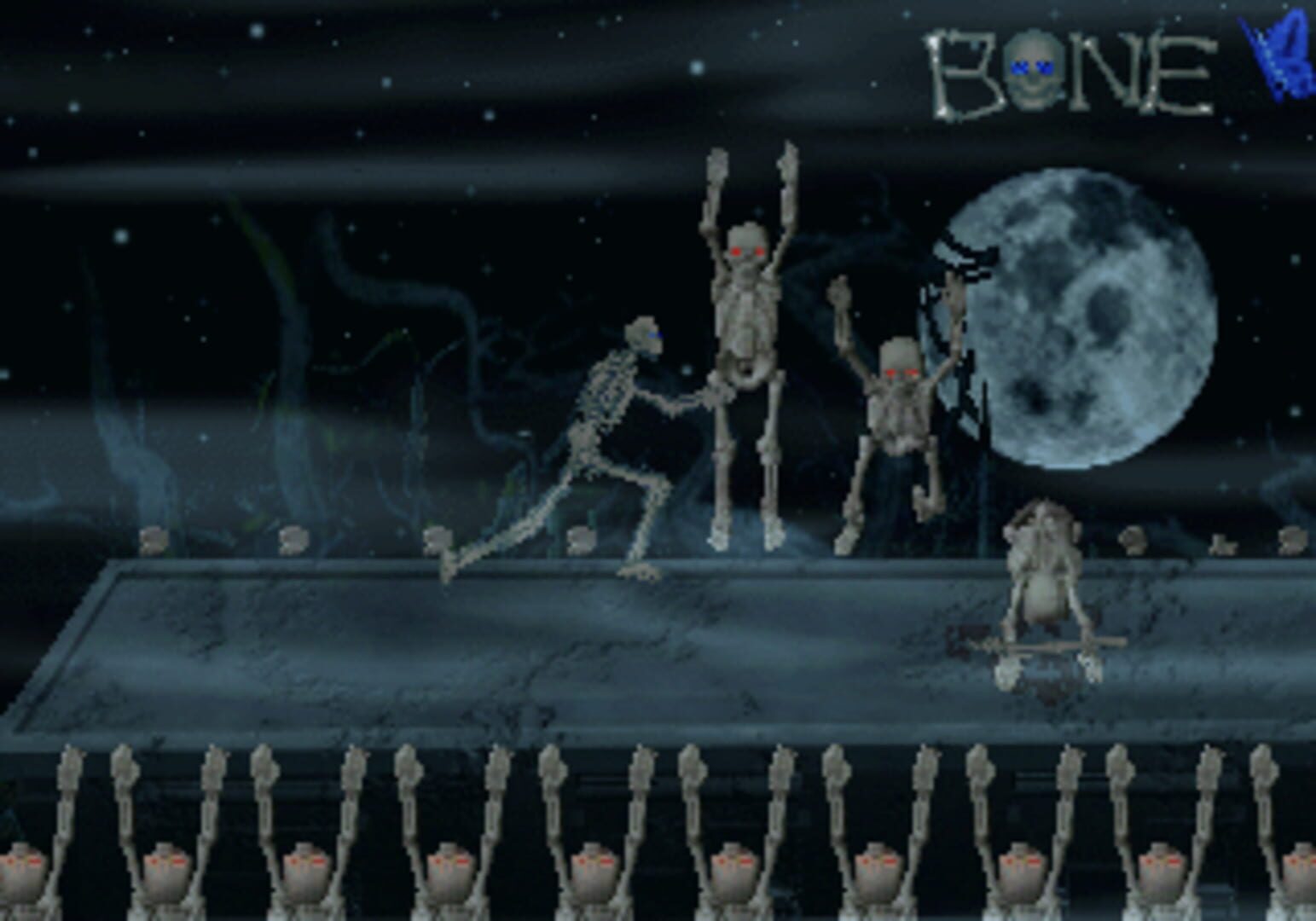
One of Mr. Bones' most distinctive qualities is in it having very few levels which share the same style of gameplay; with only a few exceptions, almost every level looks and feels different from the rest. Some levels simply change the camera perspective, while others offer up their own distinct genre. The most common thread running throughout the game is that of an action/platform game with slight gameplay and viewing angle variations per level, but at times the styles diverge far more drastically, ranging from a music/rhythm game to a Breakout-style game to a game of memorization. Once a level has been beaten, the player can return directly to that level from the main menu any time they choose.
In lieu of a normal health bar, Mr. Bones has a supply of skeletism. When his skeletism level drops, he gradually loses body parts, being reduced to just a skull and spine at his lowest levels. His lost body parts remain in play and can be reattached, though unless Mr.
Story
DaGoulian, a mad philosopher who believes that one can only "ensure the survival of good by making evil thrive", sets out to purify the world with evil. By playing a special set of drums powered by science and alchemy, he is able to tap into a primal power which he calls "skeletal magnetism" (or "skeletism") and summon the dead from their graves as his skeletal soldiers.
One inmate of the cemetery, however, is pure of heart and is thus resurrected not with red (evil) skeletism, but with blue (good) skeletism. Because of this, he retains his free will. This fact is quickly noticed by DaGoulian, and he orders his newly created army to destroy this rebel, who calls himself simply "Mr. Bones."
Development
The cinematics were designed and directed by Allen Battino. Actor Fitz Houston was the original voice of Mr. Bones though other parts were revoiced over the years. Fitz Houston was also the vocalist in the song "In This World".
A playable demo of Mr. Bones was exhibited at the May 1996 Electronic Entertainment Expo.
Reception
Mr. Bones polarized reviewers, who sharply disagreed on whether the gameplay was bizarre and extraordinarily original, or mundane "hop n bop" platforming. GameSpot's Tom Ham gave it a modest score but a relentlessly positive review, applauding the unique stage designs, varying perspectives, title character, beautiful and eerie visual design, and blues-rock soundtrack. He summarized the game as "a cool, musically interactive, multi-level scroller that's surprisingly fun to play."
The four reviewers of Electronic Gaming Monthly were also enthralled, with Dan Hsu summarizing, "Mr. Bones is completely unique – you can tell that some true geniuses worked on this project." Most of them commented that the different gameplay types in the many levels are consistently ingenious and fun, though Sushi-X said the gameplay is weak, and that it is the humorous and audio-visually stunning full-motion video cutscenes which make the game enjoyable. In contrast, GamePro completely panned the game, citing "unfinished graphics", unfairly difficult enemy AI, and "insipid hop-n-bop gameplay."


